Most "AI predicts the next COVID variant" headlines roll into the shop with chrome flames painted on the side and a suspicious rattle under the hood. But this one deserves a closer look because DeepCoV is not just guessing from yesterday's case counts. It bolts together three useful parts: viral sequence history, lab-measured mutation effects, and surveillance data that reflects the pressure our immune systems put on the virus.
That is a better engine than "we fed a spreadsheet to a neural network and hoped it achieved enlightenment."
The Problem: Variant Forecasting Has Lag
Public health teams want to know which SARS-CoV-2 lineages might become dominant before they are already filling the parking lot. The trouble is that viral evolution is not a clean drag race. A variant's success depends on how well it enters cells, dodges antibodies, survives combinations of mutations, and spreads through specific regions at specific times.
Traditional tools, including multinomial logistic regression models used by projects like Nextstrain, estimate growth advantages from observed variant frequencies. That is useful. It is also a bit like diagnosing an engine only after smoke comes out of the tailpipe. You can forecast short-term trends, but early signals from rare lineages are noisy, delayed, and uneven across countries.
DeepCoV, described by Yang and colleagues in Nature Microbiology, tries to add a better diagnostic scanner.
The Clever Fuel Injection
The "DMS" in DeepCoV stands for deep mutational scanning. In plain garage English, researchers take a protein, make a huge pile of mutation variants, and measure what those mutations do. Does a spike mutation improve ACE2 binding? Does it help the virus slip past antibodies? Does it wreck the protein like putting diesel in a lawn mower?
DeepCoV feeds those mutation phenotypes into a protein language model. Protein language models treat amino acid sequences a little like sentences, except the alphabet is made of molecular parts and the grammar was written by evolution, which has terrible handwriting but excellent long-term testing procedures.
The model also uses evolutionary sequence data and epidemiological surveillance data. That last part matters because a mutation that looks powerful in a dish may not win on the road. Geography, timing, immunity, and existing lineage background all affect torque.
The headline result: in retrospective surveillance simulations, DeepCoV forecasted recently circulating lineages becoming dominant about one month ahead, while reporting a 90% reduction in false discovery rate compared with logistic regression-based and representative deep-learning approaches. It also reconstructed regional prevalence trajectories and scanned Omicron-derived backbones for mutational hotspots, catching signs of convergent evolution - different viral lineages independently finding similar mechanical upgrades.
Why This Is More Than a Fancy Tachometer
Recent work has been converging on the same basic lesson: viral forecasting gets better when you combine population data with mutation biology. Dadonaite and colleagues showed that full-spike deep mutational scanning helps predict SARS-CoV-2 clade success. Abousamra, Figgins, and Bedford showed that fitness models can make useful 30-day variant frequency forecasts when genomic surveillance is strong. Other deep-learning approaches, like DNMS and MLAEP, have explored protein "dialects" and antigenic evolution.
DeepCoV's pitch is that these pieces should not live in separate toolboxes. Sequence trends tell you what is already moving. DMS tells you what the parts can do. Surveillance data tells you what road conditions the virus is driving through. Put those together and you get a model that may spot a dangerous lineage before it has already merged onto the highway at 80 mph.
If reproducible, this could help vaccine strain selection, antibody screening, regional warning systems, and lab triage. Instead of testing every possible mutation combo until the freezer cries for mercy, researchers could prioritize mutations and lineages that the model flags as mechanically plausible and epidemiologically relevant.
Where the Engine Can Still Overheat
This is not a crystal ball with a lab coat. Retrospective benchmarks are useful, but future viral evolution has a talent for being rude. Genomic surveillance remains patchy. Some regions sequence more than others, reporting delays vary, and immune histories differ wildly across populations.
DMS data also has limits. Many scans measure single mutations, while real variants arrive as packages. Mutations can interact, meaning one change may be harmless alone but powerful with the right accomplice. In engine terms, swapping the turbo does not tell you what happens after someone also changes the fuel map, tires, and transmission.
So DeepCoV looks promising, but the sane takeaway is not "AI solved variant prediction." It is: we may be getting better tools for early warning, especially when computational models stay bolted to real biology.
That is the kind of AI claim worth taking for a test drive.
References
-
Yang, S., Luo, X., Luo, J., Jian, F. & Cao, Y. "A deep mutational scanning-informed protein language model predicts SARS-CoV-2 evolution dynamics with spatiotemporal resolution." Nature Microbiology 11, 1850-1863 (2026). DOI: 10.1038/s41564-026-02377-5. PMID: 42204343
-
Dadonaite, B. et al. "Spike deep mutational scanning helps predict success of SARS-CoV-2 clades." Nature 631, 617-626 (2024). DOI: 10.1038/s41586-024-07636-1. PMCID: PMC11254757
-
Abousamra, E., Figgins, M. & Bedford, T. "Fitness models provide accurate short-term forecasts of SARS-CoV-2 variant frequency." PLOS Computational Biology 20, e1012443 (2024). DOI: 10.1371/journal.pcbi.1012443.
-
Elkin, M. et al. "Paying attention to the SARS-CoV-2 dialect: a deep neural network approach to predicting novel protein mutations." Communications Biology (2024). DOI: 10.1038/s42003-024-07262-7.
-
Cao, L. et al. "Predicting the antigenic evolution of SARS-CoV-2 with deep learning." Nature Communications 14, 3478 (2023). DOI: 10.1038/s41467-023-39199-6.
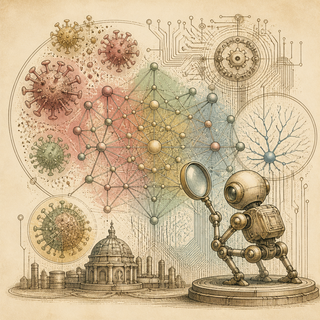
Disclaimer: This blog post is a simplified summary of published research for educational purposes. The accompanying illustration is artistic and does not depict actual model architectures, data, or experimental results. Always refer to the original paper for technical details.