The biggest catch: this model was trained retrospectively on 323 patients from two hospitals, so it is not ready to stroll into clinic wearing a white coat and asking where the coffee machine is.
That matters. Soft tissue sarcoma is rare, messy, and annoyingly diverse. It is not one disease so much as a chaotic group project with more than 70 subtypes, and somehow everyone forgot to make the grading rubric simple. Doctors already use tumor size, grade, subtype, imaging, pathology, and clinical judgment to estimate recurrence risk. The problem is that recurrence is the medical version of a sequel nobody asked for.
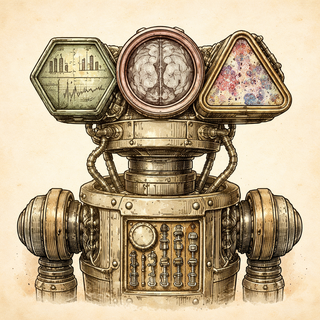
A new study in npj Precision Oncology by Wang and colleagues asks a sensible question: what if an AI model could look at more of the evidence at once? Not just the MRI. Not just the pathology slide. Not just the clinical variables. All three. Like a radiologist, pathologist, and statistician sharing one very anxious spreadsheet.
The Model Gets Three Pairs of Glasses
The researchers built a multimodal deep learning framework for predicting recurrence risk in soft tissue sarcoma. "Multimodal" sounds fancy, but the idea is simple: give the model different kinds of clues.
First, it gets clinical features, the sort of patient and tumor information doctors already care about. Second, it gets preoperative MRI scans, because tumors have the decency to occasionally reveal themselves in pictures. Third, it gets hematoxylin and eosin-stained whole slide images, which are giant digital microscope slides. These are so large that opening one can make your laptop reconsider its career choices.
For the pathology side, the team used ShuffleNetV2 to generate patch-level and whole-slide signatures. ShuffleNetV2 is an efficient convolutional neural network, originally designed with speed in mind rather than just "how many math units can we set on fire today?" For the MRI side, they used a convolutional network with channel and spatial attention mechanisms. Attention, in this context, means the model learns which features and regions deserve more weight. If neural networks were office workers, attention would be the one who actually reads the attachments before replying "looks good."
Then the researchers combined the clinical features, radiology score, and pathology score using Cox regression, a survival-analysis method that estimates risk over time. Not glamorous. Useful. Like a dishwasher.
The Numbers Are Impressive, With Asterisks Wearing Hats
In the validation set, the combined model reached a C-index of 0.857 and a time-dependent AUC of 0.959 for recurrence prediction. Translation: when comparing patients, the model was often good at ranking who had higher recurrence risk, and its time-aware discrimination looked strong.
That is the headline number. The adult supervision is this: the study was retrospective, the dataset was modest, and sarcoma is famously heterogeneous. A model can look fantastic in one setup and then trip over a new scanner, a different hospital workflow, or a subtype it barely saw during training. AI in medicine sometimes has the energy of a student who aced the practice test because the real test was printed on the same photocopier.
Still, this study does something valuable. It does not pretend one data type has the whole story. MRI shows anatomy and tumor environment. Pathology shows cellular weirdness up close. Clinical variables bring the patient context. Put together, they form a better detective squad than any single clue alone.
Why This Is More Than Algorithm Karaoke
The clinical goal is risk stratification: separating lower-risk from higher-risk patients so treatment and follow-up can be better matched. If validated in larger prospective cohorts, a tool like this could help tumor boards decide who may need more aggressive treatment, closer surveillance, or a different care plan.
That is especially relevant because soft tissue sarcoma care already involves uncomfortable tradeoffs. More treatment can mean more side effects. Less treatment can miss danger. Nobody wants to choose therapy intensity using vibes and a PDF from 2014.
There is also a nice interpretability angle. The authors used class activation maps to highlight suspected regions informing recurrence decisions. These maps do not magically explain the model's soul, because models do not have souls and, frankly, neither does my inbox. But they can help clinicians see whether the AI is staring at plausible tumor regions instead of some irrelevant artifact.
The Field Is Moving Fast
This paper fits a broader trend: oncology AI is becoming multimodal because cancer care is multimodal. A 2024 sarcoma study used MRI plus clinical variables and found that multimodal neural networks improved prediction of survival and metastasis compared with single-source models. A 2025 Scientific Reports paper, SarcNet, used histology and clinical variables with federated learning to predict metastatic relapse without pooling raw patient data across hospitals. That privacy angle matters because rare cancers need multi-center data, and hospitals generally dislike mailing patient data around like holiday cards.
Recent reviews in radiology and oncology say the same thing in more polished shoes: the future probably belongs to models that combine imaging, pathology, genomics, notes, labs, and clinical metadata. The hard part is not only building the model. It is proving that the model works across institutions, scanners, staining protocols, populations, and time. Basically, can it survive reality? Reality is where many AI papers go to discover cardio.
The Takeaway
Wang and colleagues built a smart, multi-input recurrence-risk model for soft tissue sarcoma, and its validation results look promising. The most interesting part is not that the model uses deep learning. Everyone uses deep learning now. Your toaster is probably one grant proposal away from "transformer-based bread optimization."
The interesting part is the combination: MRI plus whole-slide pathology plus clinical features, tied to survival-style prediction. That is closer to how real cancer decisions happen. Not one magic image. Not one magic biomarker. A pile of imperfect evidence, assembled carefully.
The next step is bigger, prospective, multi-center validation. Until then, this is not a clinic-ready oracle. It is a strong research prototype with a very useful message: for complicated cancers, the best AI may be the one that stops pretending one view is enough.
References
-
Wang T, Xu J, Wang H, et al. Multimodal deep learning framework for recurrence risk stratification in soft tissue sarcoma: a multicenter study. npj Precision Oncology (2026). DOI: 10.1038/s41698-026-01472-4
-
Bozzo A, Hollingsworth A, Chatterjee S, et al. A multimodal neural network with gradient blending improves predictions of survival and metastasis in sarcoma. npj Precision Oncology 8, 188 (2024). DOI: 10.1038/s41698-024-00695-7
-
Maussion C, Coindre J-M, Blay J-Y, et al. Multimodal prediction of metastatic relapse using federated deep learning in soft-tissue sarcoma with a complex genomic profile. Scientific Reports 15, 36588 (2025). DOI: 10.1038/s41598-025-20495-8
-
Lee A, et al. Multimodal artificial intelligence models for radiology. BJR Artificial Intelligence (2025). DOI: 10.1093/bjrai/ubae017
-
Ma N, Zhang X, Zheng H-T, Sun J. ShuffleNet V2: Practical Guidelines for Efficient CNN Architecture Design. arXiv (2018). arXiv: 1807.11164
Disclaimer: This blog post is a simplified summary of published research for educational purposes. The accompanying illustration is artistic and does not depict actual model architectures, data, or experimental results. Always refer to the original paper for technical details.