Somewhere inside every cell in your body, a two-meter strand of DNA is crammed into a space roughly six micrometers wide. That's like stuffing a marathon's worth of spaghetti into a thimble - except this spaghetti needs to stay organized enough that the right genes get read at the right time. How does biology pull off this storage miracle? Turns out, the answer involves something weirdly similar to how oil separates from water in salad dressing.
The Blob Theory of Genome Organization
Phase separation - the same physics that makes your vinaigrette split into layers if you don't shake it - appears to be one of the key tricks cells use to organize their genetic material. A new review by Tang and colleagues in Advanced Science pulls together the latest computational approaches for understanding how this molecular "unmixing" helps fold genomes into functional 3D structures.
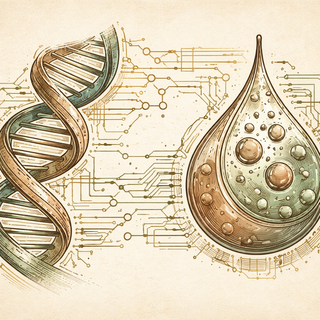
The basic idea: certain proteins and nucleic acids naturally clump together into droplet-like condensates, no membrane required. These little blobs create distinct neighborhoods inside the nucleus, keeping related genes and their regulatory machinery in the same vicinity while excluding unrelated stuff. Think of it as the VIP section at a club, except the velvet rope is made of physics.
Two Flavors of Computational Crystal Ball
The review organizes the modeling landscape into two camps that complement each other nicely.
Physics-based simulations start from first principles and work their way up. At the most detailed level, all-atom molecular dynamics tracks every jiggle of every atom - computationally brutal but revealing. Coarse-grained models trade some atomic detail for the ability to simulate longer timescales and bigger chunks of chromatin. Polymer physics approaches treat DNA as a chain with specific mechanical properties, which turns out to capture a surprising amount of the real behavior.
Data-driven approaches flip the script. Instead of building up from physics, machine learning models learn patterns directly from experimental data - Hi-C contact maps, imaging datasets, chromatin accessibility assays. They're getting scary good at predicting 3D structures and regulatory relationships, even if they sometimes feel like black boxes (Belokopytova & Fishman, 2023).
The real magic happens when researchers combine both paradigms. Physics provides mechanistic insight; data provides grounding in biological reality. Together, they're starting to explain how multiple organizing principles - phase separation, loop extrusion by molecular motors, epigenetic marks, and chromatin's intrinsic polymer properties - work together rather than in isolation.
The Loop Extrusion Plot Twist
For a while, the field had a bit of a turf war between "loop extrusion" fans and "phase separation" enthusiasts. Loop extrusion involves motor proteins (like cohesin) actively threading chromatin into loops, while phase separation is more of a passive self-organization phenomenon. The computational work synthesized in this review suggests the answer is "why not both?"
Simulations now show that loop extrusion and phase separation can reinforce each other. Motors create loops that bring compatible regions together, which then phase-separate more readily. Meanwhile, condensates can influence where and how motors operate. It's less of a versus situation and more of a buddy comedy where both characters need each other to solve the case.
From Nucleosomes to the Whole Nucleus
One particularly satisfying aspect of this review is how it traces genome organization across scales. At the smallest scale, nucleosomes (DNA wrapped around histone proteins) can themselves show phase-separation behavior depending on their modifications. Zoom out, and you get topologically associating domains (TADs) - megabase-scale neighborhoods where genes preferentially interact with nearby sequences. Zoom out further, and entire chromosomes segregate into active and inactive compartments, again through phase separation physics.
The computational models are getting good enough to connect these scales. That's a big deal, because diseases from cancer to developmental disorders involve disruptions to 3D genome architecture. Understanding the underlying physics could eventually point toward therapeutic angles - though we're definitely still in the "basic science" phase of that journey.
The 4D Nucleome: Now With Added Time
Static 3D structures are impressive, but cells are dynamic. The review points toward the frontier: non-equilibrium models that capture how genome organization changes during the cell cycle, in response to signals, or during development. This "4D nucleome" (three spatial dimensions plus time) is where the field is headed, and it's going to require even more sophisticated computational approaches.
For anyone trying to make sense of complex information architectures, tools like mapb2.io can help visualize how different organizational levels connect - not unlike how researchers diagram the nested structures of chromatin domains.
Why Should You Care About Nuclear Blobs?
Beyond the sheer elegance of the physics, there's a practical payoff. Misregulated phase separation has been linked to neurodegenerative diseases, certain cancers, and aging. If we understand how condensates form and dissolve, we might eventually develop drugs that tune these processes. The computational models reviewed here are the proving ground for those ideas - cheaper and faster than endless bench experiments, though ultimately needing experimental validation.
The genome isn't just a parts list. It's a dynamic, self-organizing system where physics and biology dance together in ways we're only beginning to appreciate. And the choreographers, increasingly, are algorithms.
References
Tang, J., Feng, C., Su, H., & Chu, X. (2025). Investigating Phase Separation in Genome Folding via Multiscale Computational Modeling. Advanced Science. https://doi.org/10.1002/advs.74997
Belokopytova, P., & Fishman, V. (2023). Predicting genome architecture: Challenges and solutions. Frontiers in Genetics, 14, 1048002. https://doi.org/10.3389/fgene.2023.1048002
Misteli, T. (2020). The Self-Organizing Genome: Principles of Genome Architecture and Function. Cell, 183(1), 28 - 45. https://doi.org/10.1016/j.cell.2020.09.014
Hildebrand, E. M., & Bhattacharyya, S. (2024). Phase separation and genome organization: Current understanding and future perspectives. Current Opinion in Genetics & Development, 85, 102155. https://doi.org/10.1016/j.gde.2024.102155
Fudenberg, G., Imakaev, M., Lu, C., Goloborodko, A., Abdennur, N., & Mirny, L. A. (2016). Formation of Chromosomal Domains by Loop Extrusion. Cell Reports, 15(9), 2038 - 2049. https://doi.org/10.1016/j.celrep.2016.04.085
Disclaimer: This blog post is a simplified summary of published research for educational purposes. The accompanying illustration is artistic and does not depict actual model architectures, data, or experimental results. Always refer to the original paper for technical details.