Now that this paper exists, your air-quality model can stop treating the atmosphere like a perfectly stirred smoothie and start asking the suspicious question it should have asked all along: where, exactly, is the gunk?
That is the quiet little reveal in “Vertical Aerosol Structure Matters: Improving the AOD-PM2.5 Link for Air Quality and Exposure” by Irina Rogozovsky, Albert Ansmann, and Alexandra Chudnovsky. The paper looks at a classic air-pollution problem: satellites can see aerosols in the whole atmospheric column, but humans breathe air near the ground, because we are inconveniently not 2 kilometers tall.
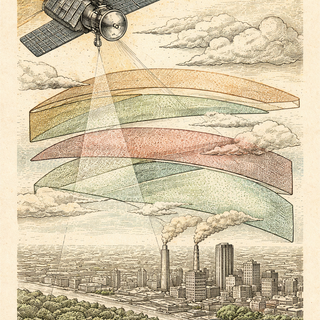
The usual satellite measurement here is aerosol optical depth, or AOD. Think of AOD as the atmosphere’s “how hazy is this column of air?” score. NASA describes it as a measure of how much particles block or scatter light through the atmosphere. PM2.5, meanwhile, is the fine particulate matter small enough to get deep into lungs, the stuff the EPA politely describes as particles 2.5 micrometers or smaller, because “microscopic lung confetti” did not clear regulatory review.
The problem: AOD sees the full column. PM2.5 monitors measure the street-level part. Those are not always the same story. Follow the particles.
The Column Was Lying, Allegedly
The researchers studied five years of observations around Tel Aviv, combining satellite AOD from MODIS MAIAC, ground PM2.5 monitors, AERONET data, meteorology, and lidar measurements from a PollyXT system. Lidar is basically the atmosphere getting interrogated by laser, which sounds dramatic because it is.
Their move was simple but sneaky: instead of asking, “Does AOD predict PM2.5?” they asked, “Does AOD predict PM2.5 under this specific vertical aerosol arrangement?” They classified the atmosphere into 10 layering types, A through J, including situations with dust, anthropogenic pollution, mixed layers, and elevated transport layers.
And suddenly the conspiracy board got strings.
When the aerosol layers were physically connected to the surface, AOD and PM2.5 could line up pretty well. In some regimes, the relationship reached about R² ≈ 0.7, which in environmental sensing is not “case closed,” but it is definitely “the suspect has entered the building.” In other regimes, especially mixed-layer cases, the relationship collapsed toward R² ≈ 0. Translation: the satellite saw haze, but the ground monitor shrugged.
That matters because a lot of satellite-based PM2.5 models use AOD as a key ingredient. Recent machine-learning work has gotten very good at blending AOD with weather, land use, chemical transport models, and sensor data. For example, Li et al. used spatiotemporally weighted tree-based models to improve satellite-derived PM2.5 estimates, while other reviews show a whole buffet of random forests, boosting models, neural networks, and hybrid systems marching into air-quality prediction like they own the place.
But Rogozovsky and colleagues are pointing at the ceiling and saying: yes, yes, lovely algorithms, but did anyone check whether the pollution was upstairs?
The Machine Learning Part, With Less Incense
The team tested Random Forest, Gradient Boosting, and LightGBM models. These are ensemble methods, which is a fancy way of saying “many small decision trees arguing until the answer improves.” If neural networks are mysterious interns with headphones, tree ensembles are a committee with clipboards.
The models performed better when the researchers included lidar-derived vertical features, such as relative humidity at different altitudes and aerosol optical properties. That makes physical sense. Humidity can make particles swell with water, increasing light scattering and boosting AOD without a matching increase in dry PM2.5 mass. Dust behaves differently from urban sulfates or marine salts. Elevated dust today may become ground-level trouble tomorrow. Interesting how “previous-day” satellite signals sometimes worked better for transport layers, almost as if the atmosphere was leaving breadcrumbs. Coincidence? The particles decline to comment.
This is the paper’s strongest contribution: it does not just throw more data into a model and hope the GPU gods accept the offering. It uses atmospheric structure to explain when the satellite signal means “bad air down here” and when it means “there is stuff above you, relax slightly, but keep watching.”
Why This Actually Changes the Air-Quality Game
If these findings reproduce elsewhere, they could sharpen exposure estimates in cities with few ground monitors. That matters for health studies, public alerts, environmental justice mapping, and policy decisions. A satellite can cover places where monitors are sparse; lidar and regime-aware modeling can help keep that satellite from confidently making stuff up like your uncle at Thanksgiving.
It also gives model builders a useful warning label: do not treat AOD as a universal PM2.5 proxy. The AOD-PM2.5 relationship depends on aerosol type, humidity, boundary-layer dynamics, transport, and whether the pollution layer is connected to the ground. The atmosphere has floors. Apparently, we needed lasers to remind us.
There are limits. This study focuses on one metropolitan region, and lidar networks are not exactly sitting on every street corner next to the coffee cart. The 10-layer classification needs testing in other climates, terrain, seasons, and pollution mixes. Machine-learning models can learn these patterns, but only if the training data includes the physics instead of hiding it under a rug labeled “feature engineering.”
Still, the paper’s message is delightfully practical: better PM2.5 estimates may come not from bigger black-box models alone, but from asking a more suspicious question about the air column. Where are the particles? What are they made of? Are they wet? Are they falling? Who benefits? Fine, maybe not that last one.
References
-
Rogozovsky, I.; Ansmann, A.; Chudnovsky, A. “Vertical Aerosol Structure Matters: Improving the AOD-PM2.5 Link for Air Quality and Exposure.” Environmental Science & Technology, 2026. DOI: 10.1021/acs.est.6c00095. PMID: 42101958.
-
Li, T.; Wang, Y.; Wu, J. “Deriving PM2.5 from satellite observations with spatiotemporally weighted tree-based algorithms: enhancing modeling accuracy and interpretability.” npj Climate and Atmospheric Science, 2024. DOI: 10.1038/s41612-024-00692-4.
-
Zaman, M. et al. “The Role of Machine Learning in Enhancing Particulate Matter Estimation: A Systematic Literature Review.” Technologies, 2024. DOI: 10.3390/technologies12100198.
-
“How Important Is Satellite-Retrieved Aerosol Optical Depth in Deriving Surface PM2.5 Using Machine Learning?” Remote Sensing, 2023. DOI: 10.3390/rs15153780.
-
NOAA repository record: “Ozone, nitrogen dioxide, and PM2.5 estimation from observation-model machine learning fusion over S. Korea.” Atmospheric Environment, 2024. DOI: 10.1016/j.atmosenv.2024.120603.
-
Porcheddu, A. et al. “Machine learning data fusion for high spatio-temporal resolution PM2.5.” Atmospheric Measurement Techniques, 2025. DOI: 10.5194/amt-18-4771-2025.
Disclaimer: This blog post is a simplified summary of published research for educational purposes. The accompanying illustration is artistic and does not depict actual model architectures, data, or experimental results. Always refer to the original paper for technical details.