Practitioners hate this matchup: the blood-pressure cuff says one thing, then the heart, brain, kidneys, liver, and blood vessels quietly reveal they have been taking chip damage for years.
That is the problem this new Circulation paper attacks. High blood pressure is not just a number on a cuff. It is a long campaign where multiple organs can get nerfed at different speeds, in different ways, and sometimes before anyone sees the boss health bar moving. Alkhodari and colleagues built a machine-learning framework called contrastive trajectory inference, or cTI, to turn that messy multiorgan replay into something closer to a ranked ladder: a global damage score called HyperScore and six progression “builds” called HyperTrajectories (DOI: 10.1161/CIRCULATIONAHA.125.077394).
The Cuff Is Not the Whole HUD
Blood pressure is useful. Nobody is rage-quitting the sphygmomanometer. But hypertension damage is sneaky because organs do not all fail on the same schedule. The brain may show white matter changes. The heart may remodel. The kidneys may start taking penalties. The liver and metabolic system may join the lobby uninvited.
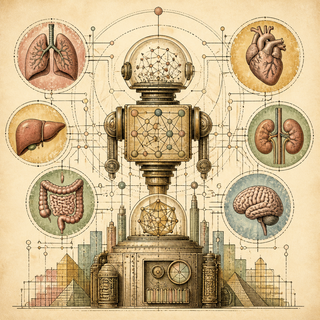
The researchers analyzed 566 imaging and non-imaging variables from 27,099 UK Biobank participants, covering the heart, brain, kidneys, vasculature, lungs, liver, and metabolic features. Then they externally tested the model on 5,507 people from ARIC, a U.S. cohort study. That external validation matters because medical AI that only works on its home dataset is basically a one-map specialist demanding respect in ranked.
Contrastive Learning Enters the Arena
Contrastive learning is the ML version of “spot the difference.” The model learns by pulling similar examples closer together and pushing different examples apart. In this paper, that means learning what “more hypertension-associated damage” looks like across a whole body’s worth of signals.
Then comes the trajectory part. Pseudotime methods usually show up in biology to order messy snapshots along a plausible progression path. Here, cTI tries to map people from healthier states toward advanced hypertension-related organ damage. It is not a literal time machine, which is tragic because cardiology could really use one. It is more like reconstructing the match from scattered replay clips.
The result, HyperScore, performed strongly for identifying severe end-organ disease: AUC 0.964 in UK Biobank. More interestingly, survival odds differed across HyperScore stages, while blood-pressure stratification alone was not significant in the same way. That is a spicy stat line. The cuff still has utility, but HyperScore is saying, “Check the minimap.”
Six Builds, One Annoying Boss
The model found six hypertension-associated phenotypes: mainly cardiac, lipoprotein, atherothrombosis, brain, cardiorenal, and liver feature patterns. Think of them like disease builds. Same enemy class, different loadouts.
That is the paper’s strongest gameplay idea. Instead of treating hypertension as one generic debuff, clinicians might eventually track which organ system is losing the lane. One patient may need closer brain or vascular surveillance. Another may show a heart-kidney pattern. If validated in broader and more diverse populations, this could help decide who needs earlier imaging, tighter monitoring, or phenotype-specific treatment plans.
If you are trying to sketch the concept, this is exactly the kind of branching disease map that belongs in a visual tool like mapb2.io: one starting pressure problem, several possible damage routes, and way too many arrows for a napkin.
S-Tier Idea, Still Needs Patch Notes
This is not ready to replace clinical judgment, and the authors do not claim it is. The study is observational. Pseudotime is an inferred progression, not guaranteed causality. Imaging-rich datasets like UK Biobank are powerful, but they are not every clinic, every country, or every patient population. Also, any model that depends on lots of imaging has to survive the real-world dungeon: cost, access, missing data, scanner differences, workflow, fairness, and whether doctors can actually trust the output during a 14-minute appointment.
Still, the broader meta is moving this way. A 2026 systematic review of AI imaging for hypertension found that most prior studies focused on single organs, especially the heart, with limited external validation and limited phenotyping (DOI: 10.1093/ehjdh/ztag063). This paper lands right on that weakness and goes multiorgan with an external test set. That is a real buff.
Final Ranking
For current clinical use: promising, not deploy-and-done.
For research direction: strong A-tier, flirting with S-tier if future cohorts confirm it.
For the core idea: hypertension needs a damage meter, not just a pressure reading. HyperScore is an attempt to build one, and it makes the old “one number tells the story” approach look like playing with the UI turned off.
References
-
Alkhodari M, Lapidaire W, Kart T, et al. Contrastive Machine Learning to Quantify Hypertensive Multiorgan Damage and Identify New Disease Phenotypes: A Multinational Multimodal Study. Circulation. 2026. PMID: 42323953. DOI: 10.1161/CIRCULATIONAHA.125.077394
-
Alkhodari M, Sattwika PD, Cutler HR, et al. Applications of artificial intelligence and computational approaches to imaging for hypertension identification, phenotyping, and outcome prediction: a systematic review. European Heart Journal - Digital Health. 2026. DOI: 10.1093/ehjdh/ztag063
-
Layton AT. AI, Machine Learning, and ChatGPT in Hypertension. Hypertension. 2024;81(4):709-716. PMID: 38380541. DOI: 10.1161/HYPERTENSIONAHA.124.19468
-
Alkhodari M, Lapidaire W, Xiong Z, et al. HyperScore: A unified measure to model hypertension progression using multi-modality measurements and semi-supervised learning. IEEE BIBM 2023. DOI: 10.1109/BIBM58861.2023.10385558
-
Obaido G, Mienye ID, Aruleba K, Chukwu CW, Esenogho E, Modisane C. A Systematic Review of Contrastive Learning in Medical AI. Bioengineering. 2026;13(2):176. PMID: 41749716. DOI: 10.3390/bioengineering13020176
Disclaimer: This blog post is a simplified summary of published research for educational purposes. The accompanying illustration is artistic and does not depict actual model architectures, data, or experimental results. Always refer to the original paper for technical details.