How can squeezing a molecule into a zeolite pore make it move faster when squeezing things into tiny spaces is also how you ruin every airplane boarding process?
That is the wonderfully inconvenient question behind “Confinement-Driven Anomalous Behaviors for Diffusion in Zeolites” by Qi, Yuan, Liu, and Zheng (DOI: 10.1021/acs.accounts.6c00154, PMID: 42340205). The paper is basically a Series A deck disguised as a chemistry review: the market is molecular transport, the moat is angstrom-scale pore geometry, and the flywheel is every refinery, separation unit, and catalyst bed quietly begging molecules to move at the right speed.
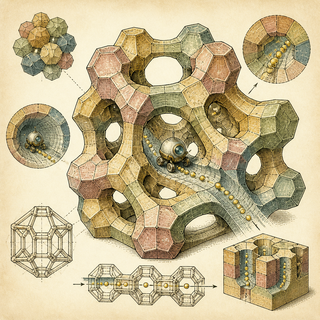
Zeolites: Tiny Buildings With Strict Door Policies
Zeolites are crystalline materials full of nanopores, channels, and cages. Think of them as molecular coworking spaces where every hallway is measured in ångströms and the security guard is a ring of oxygen atoms. They already matter in catalysis, adsorption, gas separation, and chemical manufacturing because they can sort molecules by size, shape, and interaction strength.
Classical diffusion theory, via Fick’s laws, says particles generally drift from crowded places to less crowded places in a predictable way. Nice. Clean. Investable.
Then zeolites show up and say, “Actually, sometimes hotter means slower. Smaller means slower. More crowded means faster, until it does not.” This is the kind of curveball that makes process engineers reach for coffee and molecular dynamics simulations in the same motion.
The Product-Market Fit Is Confusion
The Account organizes anomalous zeolite diffusion into three big buckets.
First, the molecule itself can cause trouble. Symmetry matters. A molecule that looks only slightly awkward can rotate asymmetrically inside a pore, bumping into the framework like a founder trying to carry a whiteboard through a WeWork hallway. A 2025 Nature Communications study showed that smaller, weaker-adsorbing dihalobenzenes can diffuse more slowly than larger ones under confinement because asymmetric rotations jam up translation (DOI: 10.1038/s41467-025-57242-6). That is not a bug. That is the physics wearing a fake mustache.
Second, the zeolite architecture can rewrite the route map. Intersecting channels may steer molecules differently as loading changes. Cage-type zeolites can create “self-gating” behavior, where pore windows act less like open doors and more like nightclub bouncers who change the guest list based on how crowded the room feels.
Third, guest-framework matching can produce the levitation effect. When molecule size and pore size line up just right, the molecule may avoid strong wall interactions and glide closer to the pore center. The authors even describe long-chain molecules moving through one-dimensional zeolites in a hyperloop-like fashion. Somewhere, a transportation startup just felt seen.
Why This Actually Matters
This is not just molecular slapstick. Diffusion often sets the pace for catalysis and separation. If a reactant cannot reach active sites, or a product cannot escape before overreacting, your shiny catalyst becomes a tiny expensive waiting room.
Better diffusion rules could help design zeolites that separate hydrocarbons more efficiently, improve catalyst lifetime, tune product selectivity, and reduce energy costs. In VC terms, the TAM is “all the molecules currently wasting everyone’s time by moving incorrectly.” In less caffeinated language, the payoff is better control over chemical processes that already underpin fuels, plastics, environmental cleanup, and gas purification.
A related 2026 review in Chemical Society Reviews frames confinement as a central design variable for zeolite catalysts, connecting topology, loading, acid sites, temperature, and molecular conformation to diffusion behavior (DOI: 10.1039/D5CS00613A). Translation: the pore is not a passive pipe. It is a product manager with opinions.
The AI Angle: Less Guessing, More Screening
The paper also points toward machine learning as a way to accelerate structure-diffusion discovery. That makes sense because zeolite design has a combinatorial problem: hundreds of known frameworks, many hypothetical ones, different acid sites, cations, pore sizes, molecule shapes, loadings, and temperatures. Trying every combination experimentally is not science. It is a hostage situation with glassware.
Recent work has started building interpretable ML models for alkane diffusion in zeolite catalysts, aiming to connect pore topology and confinement descriptors to diffusion coefficients (DOI: 10.1038/s41467-026-71698-0). Broader reviews of AI-guided zeolite design also describe models for property prediction, inverse design, machine-learning potentials, and synthesis planning (DOI: 10.1063/5.0253847). If you are mapping these relationships visually, a tool like mapb2.io would honestly be useful here, because “guest-host-pore-loading-temperature-acid-site interaction graph” is not something you want living only in a spreadsheet named final_FINAL_v7.
The Catch, Because There Is Always a Catch
The hard part is reproducibility across scales. Molecular dynamics can see atomic motion, but experiments like PFG-NMR or uptake measurements observe different length and time windows. Framework flexibility, defects, extra-framework cations, and acid-site distributions can all shift the story. A zeolite crystal in a model and a catalyst particle in a reactor are cousins, not twins.
Still, the big insight is durable: diffusion in zeolites is not just “small molecule enters small hole.” It is a negotiation among shape, motion, chemistry, crowding, and architecture. The weirdness is the opportunity. If researchers can predict when the dominant mechanism flips, they can design pores that behave less like random hallways and more like programmable logistics infrastructure.
Zero to one, but for molecules in tiny rocks.
References
-
Qi, J.; Yuan, J.; Liu, Z.; Zheng, A. “Confinement-Driven Anomalous Behaviors for Diffusion in Zeolites: Mechanisms and Beyond.” Accounts of Chemical Research (2026). DOI: 10.1021/acs.accounts.6c00154. PMID: 42340205.
-
Zhao, L.; Yuan, J.; Xing, Y.; Qi, J.; Peng, P.; Liu, Z.; Zheng, A. “Confinement effects on molecular diffusion in zeolites: mechanisms and perspectives.” Chemical Society Reviews 55, 210-253 (2026). DOI: 10.1039/D5CS00613A.
-
Liu, Z.; Kan, X.; Gao, M. et al. “Asymmetric rotations slow down diffusion under confinement.” Nature Communications 16, 2018 (2025). DOI: 10.1038/s41467-025-57242-6.
-
Wang, X.; Qi, J.; Wan, M. et al. “Harnessing confinement effect and interpretable machine learning to predict alkane diffusion in zeolite catalysts.” Nature Communications 17, 5414 (2026). DOI: 10.1038/s41467-026-71698-0.
-
Wu, M.; Zhang, S.; Ren, J. “AI-empowered digital design of zeolites: Progress, challenges, and perspectives.” APL Materials 13, 020601 (2025). DOI: 10.1063/5.0253847.
Disclaimer: This blog post is a simplified summary of published research for educational purposes. The accompanying illustration is artistic and does not depict actual model architectures, data, or experimental results. Always refer to the original paper for technical details.