Thirty years ago, transplant teams tried judging donor livers with tiny biopsies and battlefield instinct. It didn't work. This paper explains why and fixes it.
Gather close, traveler, for this is a tale of a precious organ, a waiting list, and a suspiciously powerful beam of light. The kingdom is liver transplantation, where surgeons must decide whether a donor liver is fit for rescue or secretly carrying trouble in its tissue. The old ritual is biopsy: take a small sample, stain it, ask pathology to read the omen. Useful? Absolutely. Perfect? Not even close. A biopsy can miss damage hiding elsewhere in the liver, because apparently organs did not get the memo about being uniform for human convenience.
Feng Yan and colleagues, writing in Science Translational Medicine, bring forth a new instrument: polarization-sensitive optical coherence tomography, or PS-OCT, which sounds like a spell a wizard casts after three espressos but is really a high-resolution imaging technique that uses light to see tissue structure beneath the surface [1].
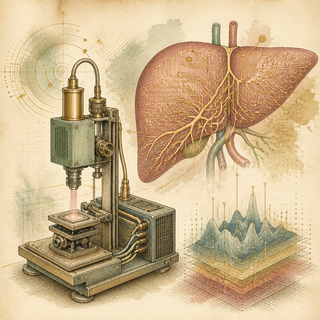
The Tiny Biopsy Problem, Also Known As "Guessing the Dragon From One Scale"
A donor liver can look decent in one region and less merry in another. Fat buildup, called steatosis, may cluster unevenly. Fibrosis can lurk like old scar tissue in the walls of a forgotten castle. Inflammation and necrosis are worse omens still. The trouble is that a biopsy samples a tiny bit of the organ, then everyone must act as if that pinch speaks for the whole beast.
That is not foolish. It is just the best imperfect tool clinicians have had. But when transplant teams face marginal or extended-criteria donor livers, the stakes rise. Reject too many organs and patients wait. Accept the wrong one and the recipient may suffer graft failure. It is a grim version of "choose your fighter," except the fighter is a liver and nobody is having fun.
Enter PS-OCT, the Lantern of the Tissue Caverns
Optical coherence tomography is often described as optical ultrasound: instead of sound, it uses reflected light to create microscopic cross-sectional images. PS-OCT adds polarization sensitivity, meaning it can pick up how tissue alters the polarization of light. That extra signal helps reveal microstructural features linked to fibrosis and other tissue changes.
In this study, the researchers scanned multiple regions across human donor livers and compared the imaging results with traditional histopathology. Then came the machine learning squires: texture analysis and ML models that looked at PS-OCT patterns and estimated steatosis, fibrosis, inflammation, and necrosis.
And lo, the algorithm did not simply gaze at pixels and say, "vibes." It extracted quantitative features from the images and matched them against pathology scores. The reported correlations between PS-OCT quantifications and pathology were greater than 80 percent [1]. For a field where one small tissue slice can sway a huge decision, whole-surface imaging is a serious upgrade.
The Trial by Perfusion
The authors also compared PS-OCT findings with liver performance during normothermic machine perfusion, or NMP. That is the technique where a donor liver is kept warm and supplied with oxygenated fluid so clinicians can watch it function outside the body. Think of NMP as a medieval proving ground, except the tournament tent has pumps, tubing, lactate measurements, and nobody is allowed to yell "huzzah" near the sterile field.
NMP itself has been gaining ground. A 2023 randomized U.S. trial found that NMP was safe and appeared especially useful for higher-risk donor livers, even though its primary endpoint did not improve across all livers [2]. A 2025 review noted that NMP viability criteria still vary across centers, with lactate clearance, bile production, bile chemistry, biomarkers, and other measures all competing for space at the council table [3].
That matters because PS-OCT might complement these tests. NMP asks, "How does the liver behave?" PS-OCT asks, "What does the tissue look like across the map?" Together, they could make transplant assessment less like reading tea leaves from one teacup and more like surveying the whole battlefield before sending in the cavalry.
The Machine Learning Beast, Mostly Tamed
The ML piece here is practical, not flashy. No giant chatbot is composing sonnets about hepatocytes. The models analyze imaging texture, which is exactly the sort of job computers enjoy: repetitive, pattern-heavy, and free of small talk.
This fits a wider trend. Recent work such as LiverColor has used photographs plus color and texture features to classify donor liver grafts, reaching an AUC of 0.82 and 85 percent accuracy against biopsy-based labels [4]. Another 2023 system used donor and graft variables to help predict whether a liver would be transplanted or discarded, reporting an AUC of 0.79 [5]. The grand theme is clear: transplant teams are trying to turn hard-to-standardize human judgment into measurable, repeatable signals.
But let us not crown the machine king just yet. Medical ML models can stumble when hospitals, scanners, patient populations, or labeling habits change. A model trained in one hall may not sing correctly in another. The dragon of external validation remains undefeated, though researchers keep poking it with increasingly sharp statistics.
Why This Tale Matters
If PS-OCT proves reliable in larger, multi-center studies, it could help reduce unnecessary liver discard while also flagging organs that look acceptable but carry hidden risk. That is the sweet spot: more usable livers, fewer bad surprises, and better evidence for the surgeon standing at the edge of a life-changing decision.
The paper does not abolish pathology. It complements it. Biopsy still has power, but PS-OCT offers breadth. Pathology gives microscopic confirmation; PS-OCT gives a broader map. And in transplantation, maps matter. Nobody wants to cross Mordor using only a postcard.
The next quests are obvious: larger cohorts, standardized scanning protocols, real-time workflow testing, and proof that PS-OCT-guided decisions improve patient outcomes. Until then, this study gives the field a promising new lantern: noninvasive, quantitative, and blessedly less dependent on one tiny tissue sample pretending to be the whole kingdom.
References
-
Yan F, Zhang Q, Mutembei BM, et al. Human donor liver viability evaluation with polarization-sensitive optical coherence tomography. Science Translational Medicine. 2026;18(855):eadv7124. DOI: 10.1126/scitranslmed.adv7124. PMID: 42341084
-
Chapman WC, Barbas AS, D'Alessandro AM, et al. Normothermic Machine Perfusion of Donor Livers for Transplantation in the United States: A Randomized Controlled Trial. Annals of Surgery. 2023;278(5):E912-E921. DOI: 10.1097/SLA.0000000000005934
-
Czigany Z, et al. Viability Assessment During Normothermic Machine Liver Perfusion: A Literature Review. Liver International. 2025. DOI: 10.1111/liv.16244. PMCID: PMC11740183
-
Piella G, Farré N, Esono D, et al. LiverColor: An Artificial Intelligence Platform for Liver Graft Assessment. Diagnostics. 2024;14(15):1654. DOI: 10.3390/diagnostics14151654
-
Martín-Mateos RM, et al. Development of a liver graft assessment expert machine-learning system: when the artificial intelligence helps liver transplant surgeons. Frontiers in Surgery. 2023;10:1048451. DOI: 10.3389/fsurg.2023.1048451
Disclaimer: This blog post is a simplified summary of published research for educational purposes. The accompanying illustration is artistic and does not depict actual model architectures, data, or experimental results. Always refer to the original paper for technical details.