The failure starts with a very 2026 kind of headache: you map a bunch of single cells, ask the software where they’re headed, and it gives you elegant little arrows that say “this way, probably,” while the actual gene circuitry sits off to the side like a drummer who never got the set list. The cells are changing. The genes are arguing. And your model, bless its hardworking silicon heart, only understands half the band.
That gap is exactly what RegVelo tries to close. The paper asks a simple but nasty question: if cell fate is driven by gene regulation, why do so many RNA velocity methods model motion without really modeling the regulators doing the shoving? RNA velocity has been useful because it estimates where a cell is heading by comparing immature RNA transcripts with mature ones - basically catching gene expression mid-sentence rather than after the period. Handy trick. But it often treats genes like solo acts when biology is more of a tangled jazz ensemble.
On the flip side, gene regulatory network methods try to infer who controls whom, but many of them act like time is optional. That is not ideal when you’re studying development, where timing is the whole show.
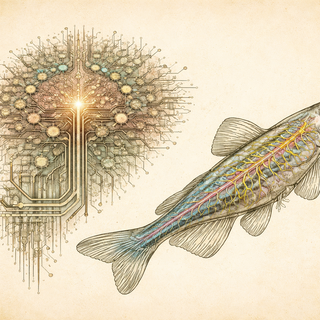
RegVelo combines these views. It jointly models splicing kinetics and gene regulatory interactions in one deep learning framework, so the model is not just saying “this cell seems to be moving toward pigment fate,” but also “here are the regulatory players likely nudging it there” Wang et al., 2026.
Biology, but with a better bass line
The paper’s showcase is zebrafish neural crest development, which is one of those systems biologists love because cells there make a lot of dramatic life choices. Neural crest cells can become pigment cells, cartilage, neurons, and more. It is developmental biology with genuine plot twists.
Using full-length Smart-seq3 data plus matched gene expression and chromatin accessibility measurements, the authors used RegVelo to trace those choices and simulate perturbations in silico. Then they did the part that separates “interesting model” from “please calm down, machine-learning person”: they validated predictions experimentally with CRISPR-Cas9 knockout and single-cell Perturb-seq. That led them to identify tfec as an early driver and elf1 as a regulator of pigment cell fate.
That matters because a lot of computational biology papers stop at “the heatmap seems encouraging.” RegVelo goes further. It says, here is a mechanistic guess, now let’s see if the cells agree. That is a much better groove.
Why this feels different
The larger story here is that single-cell biology has been moving from snapshots to cinema. Recent methods have pushed RNA velocity in more flexible directions, including deep generative models like veloVI, cell-specific kinetics in DeepVelo, transcription-factor-aware dynamics in TFvelo, and more expressive Bayesian formulations in cell2fate Gayoso et al., 2024; Cui et al., 2024; Li et al., 2024; Aivazidis et al., 2025. In parallel, reviews of single-cell multi-omics have been hammering the same point: if you want mechanistic insight, you need to connect transcript levels, chromatin state, and regulatory wiring rather than pretending one modality is the whole truth Badia-i-Mompel et al., 2023.
RegVelo lands right in that sweet spot. It is not content with drawing prettier arrows. It wants to infer the sheet music.
For non-biologists, think of it like this: older RNA velocity tools could often tell that a crowd in a train station was drifting toward platform 4. RegVelo also tries to identify who made the announcement, who opened the gate, and which panicked commuter started the stampede.
The catch, because there is always a catch
No, this does not mean we can now perfectly predict cell fate like some microscopic sports book. These models still depend on data quality, sampling, assumptions about dynamics, and the eternal biological fact that cells love being noisy little weirdos. Regulatory network inference is also notoriously sensitive to missing variables and experimental context. A model can be interpretable and still be wrong in a very legible font.
And yet, this is exactly the sort of step people have wanted. Not just prediction. Not just correlation. Something closer to an actionable map.
If RegVelo holds up across more tissues and disease settings, it could help researchers narrow down which genes to perturb in development, regeneration, and maybe cancer, where cell-state transitions are often the whole problem wearing a lab coat. That does not make the mystery disappear. It just turns the solo into a chart you can actually play from.
References
-
Wang W, Hu Z, Weiler P, et al. RegVelo: Gene-regulatory-informed dynamics of single cells. Cell (2026). DOI: 10.1016/j.cell.2026.04.022. PubMed: 42119563
-
Gayoso A, Weiler P, Lotfollahi M, et al. Deep generative modeling of transcriptional dynamics for RNA velocity analysis in single cells. Nature Methods 21, 50-59 (2024). DOI: 10.1038/s41592-023-01994-w. PubMed: 37735568
-
Cui H, Maan H, Vladoiu MC, et al. DeepVelo: deep learning extends RNA velocity to multi-lineage systems with cell-specific kinetics. Genome Biology 25, 27 (2024). DOI: 10.1186/s13059-023-03148-9
-
Li Z, Nagai JS, Kuppe C, et al. TFvelo: gene regulation inspired RNA velocity estimation. Nature Communications 15, 1387 (2024). DOI: 10.1038/s41467-024-45661-w
-
Aivazidis A, Tejada-Martinez D, Schuster R, et al. Cell2fate infers RNA velocity modules to improve cell fate prediction. Nature Methods (2025). DOI: 10.1038/s41592-025-02608-3
-
Badia-i-Mompel P, Wessels L, Müller-Dott S, et al. Gene regulatory network inference in the era of single-cell multi-omics. Nature Reviews Genetics 24, 739-754 (2023). DOI: 10.1038/s41576-023-00618-5
Disclaimer: This blog post is a simplified summary of published research for educational purposes. The accompanying illustration is artistic and does not depict actual model architectures, data, or experimental results. Always refer to the original paper for technical details.