Imagine your heart as a rockstar - shiny, complex, and always beating to its own rhythm. Now, picture a team of AI models trying to figure out its greatest hits through cardiac MRIs. That's exactly what's happening in the world of medical imaging, thanks to some brainy researchers who came together to create a deep learning system for cardiac MRI that’s as generalizable as your favorite multi-tool.
MRIs: Your Heart's Personal Paparazzi
Cardiac MRI is like a high-tech photoshoot for your heart, capturing every twist and turn in exquisite detail. It's a key player in understanding everything from the heart's structure to its tissue characteristics. But, like every good photoshoot needs a savvy photographer, these MRIs needed an intelligent system to interpret the complex symphony of data. Enter Rohan Shad and his band of researchers, who've now trained a deep-learning model that could make any AI enthusiast's heart skip a beat.
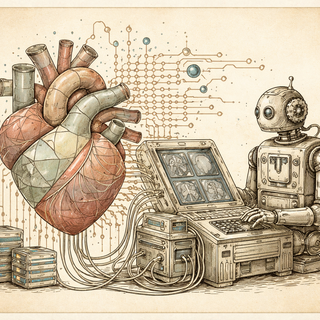
A New Way to Learn: Contrastive Learning
The team threw a curveball by choosing self-supervised contrastive learning for their model. Instead of spoon-feeding the model information, it's like they handed it a treasure map and said, "Go find the gold!". The model learned visual concepts from cine-sequence cardiac MRI scans using the raw text from radiology reports. Say goodbye to AI models that need their hands held - this one figured out how to connect the dots on its own. It’s like giving a neural network the ability to decipher medical hieroglyphics without a Rosetta Stone.
Performance Worth a Standing Ovation
The researchers tested their model on data from four large academic institutions in the U.S., and the results could make even a seasoned clinician nod in approval. But they didn't stop there. For an encore, they showcased their model's prowess on the UK BioBank and some other publicly available datasets. Whether it was calculating the left-ventricular ejection fraction or diagnosing a host of conditions like hypertrophic cardiomyopathy, the model performed with clinical-grade accuracy. And all this with less training data than your average AI model would demand. Talk about a thrifty performer!
Real-World Impact: More Than Just Science Fiction
Why should you care? Well, imagine a world where diagnosing heart conditions is as quick as your morning latte run. This research could make cardiac diagnostics faster, more accurate, and accessible to more people around the globe. It's like giving doctors a powerful new instrument in their medical orchestra, capable of playing a whole symphony of diagnostic possibilities.
Challenges: Not a Walk in the Park
Of course, with great power comes great responsibility - and a few challenges. Training AI models with self-supervised methods means they're a bit like rebellious teenagers - they sometimes do unpredictable things. There's also the eternal question of data privacy and the ethical use of medical data. But hey, every superhero has their kryptonite, right?
In the wild rollercoaster ride that is AI research, projects like this serve as a reminder of the incredible possibilities when technology meets medicine. So next time you get a glimpse of your heart on an MRI, remember, there's a digital brain out there ready to turn those images into a life-saving symphony.
References
- Shad, R., et al. "A generalizable deep learning system for cardiac MRI." Nature Biomedical Engineering. DOI: 10.1038/s41551-026-01637-3
Disclaimer: This blog post is a simplified summary of published research for educational purposes. The accompanying illustration is artistic and does not depict actual model architectures, data, or experimental results. Always refer to the original paper for technical details.
```