If this line of research reaches its logical extreme, future labs will solve materials discovery like a detective solves a locked-room murder: dust the atomic structure for fingerprints, interrogate every pore, and let topology point dramatically at the culprit. Reality is less trench coat, more math notebook - but Zheng and colleagues' review makes a pretty convincing case that materials data has been leaving clues in plain sight.
The paper, Topological Data Analysis in Materials Science, is not a single experiment with one smoking beaker. It is a case file. The authors walk through how topological data analysis, or TDA, can help materials scientists describe structure in a way that survives noise, scale changes, and the general chaos of experimental data. Which is good, because materials data can be messier than a crime board made by someone with unlimited red string.
Clue One: Shape Knows Things
Most machine learning for materials starts by turning a material into numbers: composition, bond lengths, descriptors, graphs, spectra, microscopy features. Then the model tries to connect those numbers to properties like conductivity, strength, catalytic activity, or stability.
TDA asks a slightly stranger question: what is the shape of the data?
Not shape like "this crystal looks like a cube." Shape like connected components, loops, cavities, voids, and patterns that remain meaningful as you zoom in and out. Persistent homology, the star witness here, tracks features across many spatial scales. If a loop appears only for a tiny instant, it may be noise. If it keeps showing up across scales, topology leans across the table and whispers, "That one knows something."
This matters because materials are multiscale little weirdos. Atomic arrangements, pores, grain boundaries, molecular networks, and phase structures can all influence performance. Traditional descriptors may miss those relationships or flatten them into numbers with the emotional range of a parking receipt.
The Suspects: Holes, Voids, and Curves
Zheng et al. focus on several TDA tools. Persistent homology detects durable topological features. Persistent GLMY homology, developed in molecular and materials contexts, extends this idea to richer chemical representations. Euler characteristic curves offer a cheaper topological summary by counting how connected pieces, tunnels, and cavities change across thresholds.
That last one is the budget detective of the squad. It may not capture every detail, but it is fast, interpretable, and surprisingly useful. Recent work by Hacquard and Lebovici showed Euler characteristic profiles can perform strongly in machine learning settings at low computational cost. In other words, sometimes the intern with a spreadsheet solves the case while the expensive consultant is still naming the conference room.
Where Machine Learning Enters the Interrogation Room
The review's most useful move is showing how TDA can plug into machine learning. Topological features can become inputs to models, sit alongside graph neural network descriptors, or help interpret what a model has learned. That is especially appealing in materials informatics, where black-box predictions often make scientists squint and say, "Okay, but why?"
A model that predicts a better battery material is nice. A model that says, "These pore-network features and atomic-scale cavities seem tied to ion transport" is much more useful. That gives researchers something to test, not just something to admire from across the lab.
There is also a visualization angle. TDA methods like Mapper can turn high-dimensional data into networks that reveal clusters and transitions. If you are sketching out how material structures, features, and properties connect, a visual tool like mapb2.io fits the vibe nicely: less "spreadsheet fog," more "detective wall, but socially acceptable."
The Victim: Interpretability
The crime scene here is a familiar one: modern AI can predict materials properties, but the reasoning often vanishes behind layers of math. TDA offers a way to recover some structure. It gives scientists descriptors with physical flavor: connectedness, cavities, persistence, topology across scales.
That does not magically solve materials discovery. Nobody should read this and sprint into the street yelling that holes have replaced quantum mechanics. Please do not make topology testify beyond its expertise.
The challenges are real. Persistent homology can get computationally expensive. Choosing filtrations and representations requires judgment. Some topological summaries throw away chemical detail. Data quality still matters, because if your dataset is haunted, topology will politely map the haunting. And integrating TDA with deep learning remains a young field, with active debates about when it beats simpler baselines.
Why This Case Stays Open
The intriguing part is not that TDA replaces existing materials science methods. It probably will not. The better story is that it adds another lens. Chemistry gives composition. Physics gives mechanisms. Machine learning gives prediction. TDA says, "Has anyone checked the shape of the evidence?"
That question has already started to travel. Recent studies have used persistent homology features for molecular machine learning, surveys now track topological methods in manufacturing, and topological deep learning is trying to bring these ideas into neural architectures. The field still has loose threads, but loose threads are what detectives pull.
Zheng and colleagues' review is valuable because it gathers the scattered clues into one dossier for materials scientists. If the results keep holding up across datasets and labs, TDA could help researchers design catalysts, batteries, porous materials, polymers, and biomaterials with descriptors that are robust, interpretable, and weirdly elegant.
The suspect is still at large. But now we know where to look: in the holes.
References
-
Zheng, S. et al. "Topological Data Analysis in Materials Science: Principles, Machine Learning Integration, and Application Landscapes." Chemical Reviews (2026). DOI: 10.1021/acs.chemrev.5c01098. PMID: 42261790.
-
Hacquard, O., and Lebovici, V. "Euler Characteristic Tools for Topological Data Analysis." Journal of Machine Learning Research 25 (2024): 1-39. JMLR link.
-
Gale, E. "Shape is (almost) all!: Persistent homology features are an information rich input for efficient molecular machine learning." arXiv: 2304.07554 (2023). DOI: 10.48550/arXiv.2304.07554.
-
Coskunuzer, B., and Akçora, C. G. "Topological Methods in Machine Learning: A Tutorial for Practitioners." arXiv: 2409.02901 (2024). DOI: 10.48550/arXiv.2409.02901.
-
Uray, M., Giunti, B., Kerber, M., and Huber, S. "Topological Data Analysis in Smart Manufacturing: State of the Art and Future Directions." arXiv: 2310.09319 (2023).
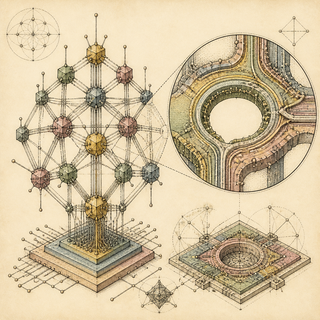
Disclaimer: This blog post is a simplified summary of published research for educational purposes. The accompanying illustration is artistic and does not depict actual model architectures, data, or experimental results. Always refer to the original paper for technical details.