The internet spent years yelling "let him cook," and CVSP-AIE is basically a robot chemist being told to cook through 100,000 molecules before lunch, with a clipboard, a protein pocket, and absolutely no patience for weak reps.
The paper, published in Nature Protocols, introduces the Comprehensive Virtual Screening Platform with AI Engine, or CVSP-AIE, which is a mouthful in the same way "just one more set" is a mouthful when your trainer is lying to you. The idea is simple enough: if you have a protein target and a known binder that marks the binding pocket, the platform helps rank a huge pile of candidate molecules by how likely they are to fit and bind there Gu et al., 2026.
That is structure-based virtual screening: instead of testing every compound in a wet lab, you first run computational tryouts. Think of it as molecule auditions. Some candidates walk in confidently, trip over the binding pocket, and leave with their shoelaces tied together. Others look like they might actually have chemistry. Literally.
The Training Split: Speed, Form, Finish
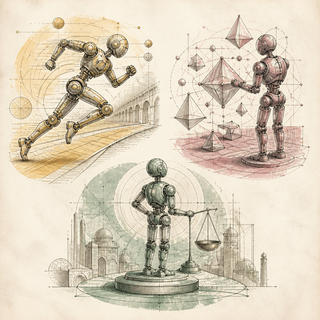
CVSP-AIE uses three AI models like a disciplined gym program.
First up is KarmaDock, the sprinter. It directly updates ligand atomic coordinates, which means it can move fast through large libraries while generating binding poses and rough binding estimates. In its own paper, KarmaDock used encoders, equivariant graph neural networks, self-attention, and scoring machinery to speed docking and was validated on benchmark datasets plus a real screening campaign for leukocyte tyrosine kinase inhibitors Zhang et al., 2023. That is the HIIT class of the pipeline.
Then comes CarsiDock, the form coach. It predicts protein-ligand distance matrices, then reconstructs plausible binding poses through geometry optimization. CarsiDock was pretrained on around 9 million predicted protein-ligand complexes, which is the computational equivalent of eating chicken breast and distance constraints for breakfast Cai et al., 2024.
Finally, RTMScore handles the judging table. It learns residue-atom distance distributions with a graph transformer-style scoring function to estimate affinity Shen et al., 2022. If KarmaDock does the cardio and CarsiDock checks the squat depth, RTMScore decides who gets on the leaderboard.
The platform wraps these into a hierarchical workflow: preprocess the protein and molecules, predict poses and scores, then postprocess interactions and visualizations. The authors report that screening 100,000 compounds takes about 30 to 45 minutes. For early-stage drug discovery, that is not just faster reps. That is finishing the workout before the old docking pipeline has found its parking spot.
Why This Is Useful Outside the AI Weight Room
Drug discovery often starts with "hit identification," which means finding molecules that bind well enough to deserve real experiments. The problem is that chemical space is absurdly huge. It is not a haystack. It is a haystack that joined a haystack multiverse.
Traditional docking can be accurate but slow, and different tools behave differently depending on the target, binding site, ligand type, and scoring setup. CVSP-AIE tackles a practical bottleneck: researchers do not just need another model flexing on a benchmark. They need a usable platform that tells them, "Upload this, define the pocket, run the screen, inspect the hits."
That matters because reproducibility in computational drug discovery is a contact sport. A beautiful AI model trapped in a difficult install process is like a treadmill with no power cord. CVSP-AIE ships as both a web server and a local command-line package, so teams can start small and scale up when the library gets swole.
But Check the Form Before Adding Plates
Now, trainer voice: do not ego-lift your conclusions.
Recent benchmarks have warned that AI docking methods can score well while producing poses with questionable physical realism. A 2025 Nature Machine Intelligence benchmark found that KarmaDock and CarsiDock performed strongly on docking accuracy, while physics-based tools often produced more physically reasonable structures. It also found RTMScore useful as a rescoring function and supported the idea of hierarchical screening Gu et al., 2025.
Another benchmark, PoseBench, reported that modern deep learning docking and co-folding methods still struggle to balance structural accuracy with chemical specificity, especially for novel binding poses and messy real-world cases Morehead et al., 2026. Translation: the model may look ripped under benchmark lighting, but you still need to see it lift in the wild.
That is why CVSP-AIE should be viewed as a ranking and triage machine, not a magic pill vending machine. Predicted hits still need medicinal chemistry review, synthesis feasibility checks, assay validation, toxicity screening, and the whole exhausting obstacle course that separates "nice docking pose" from "possible drug."
The Real Gain
The best part of CVSP-AIE is not that it replaces scientists. It gives them a stronger first pass. It helps researchers burn down giant compound libraries, compare candidates faster, and spend wet-lab effort on molecules with better odds. That is progressive overload for discovery: same scientific muscles, smarter load management.
If the platform holds up across more targets and prospective experiments, it could make AI-driven virtual screening more accessible to groups that do not have a warehouse full of compute or a docking specialist living under the conference table. And in a field where one bad score can send months of work into the biochemical void, a faster, clearer shortlist is a very solid gain.
References
-
Gu, S. et al. "Facilitating structure-based drug discovery with an artificial intelligence-driven virtual screening platform." Nature Protocols (2026). DOI: 10.1038/s41596-026-01389-z PMID: 42342989
-
Zhang, X. et al. "Efficient and accurate large library ligand docking with KarmaDock." Nature Computational Science 3, 789-804 (2023). DOI: 10.1038/s43588-023-00511-5
-
Cai, H. et al. "CarsiDock: a deep learning paradigm for accurate protein-ligand docking and screening based on large-scale pre-training." Chemical Science 15, 1449-1471 (2024). DOI: 10.1039/D3SC05552C
-
Gu, S. et al. "Benchmarking AI-powered docking methods from the perspective of virtual screening." Nature Machine Intelligence 7, 509-520 (2025). DOI: 10.1038/s42256-025-00993-0
-
Morehead, A. et al. "Assessing the potential of deep learning for protein-ligand docking." Nature Machine Intelligence 8, 32-41 (2026). DOI: 10.1038/s42256-025-01160-1
Disclaimer: This blog post is a simplified summary of published research for educational purposes. The accompanying illustration is artistic and does not depict actual model architectures, data, or experimental results. Always refer to the original paper for technical details.