Against PVDF fibers that usually need careful drawing and post-poling, piezoresistive insoles that act like bathroom scales with a grant budget, and triboelectric socks that harvest charge by rubbing layers together, Zhang and colleagues propose a tidier floor plan: make a piezoelectret fiber and polarize it while it is being melt-spun.
The Facade Looks Like Thread
The paper, published in Advanced Materials, is about a deceptively humble object: a polypropylene/barium titanate fiber. Polypropylene is the familiar, cheap, durable polymer. Barium titanate, or BTO, is the ceramic guest with the fancy resume: ferroelectric, piezoelectric, and generally the sort of material that walks into a room and immediately asks where the transducers are.
Piezoelectricity is simple in the way that plumbing is simple until you open the wall. Squeeze certain materials and they produce electrical charge. In a gait-monitoring textile, that means a step, bend, or knee-rehab movement can become a signal. No tiny battery pleading for mercy under your sock. No rigid sensor tile trying to cosplay as clothing.
The hard part is architecture. A lab sensor can be a beautiful pavilion nobody can afford to maintain. A useful textile has to be spun, bent, knotted, woven, and potentially made by the kilometer without turning the factory into a séance.
The Load-Bearing Trick
The clever move here is in situ poling during melt-spinning. Normally, piezoelectric fibers often need post-processing: extra charging, heating, stretching, or electroding after the fiber exists. That is the service corridor nobody wants to draw on the glossy rendering.
Zhang et al. fold the charging step into the manufacturing line. During fiber drawing, a high electric field helps polarize dipoles while interfacial cavitation creates tiny electret pore structures. Translation: the fiber gets its internal electrical floor plan while it is still being born. The walls go up, the wiring goes in, and nobody has to come back later with a clipboard and a heroic budget.
The optimized fibers reached a d33 piezoelectric coefficient of 1.8 pC/N, a surface potential of -3.4 V, and needed only 0.3 seconds of poling time. If you are used to ceramic piezoelectrics, 1.8 pC/N may not make you spill your drink. But this is not a brittle palace made for a vibration table. It is a weavable polymer composite fiber, which changes the design brief. The point is not maximum grandeur. The point is load distribution across fabric, comfort, scale, and manufacturability.
Negative Space, Now Electrified
Piezoelectrets are a lovely bit of materials weirdness. Instead of relying only on crystal symmetry, they use trapped charges and internal cavities. The empty space matters. It is negative space doing actual engineering, like a flying buttress made of air and stubborn electrostatics.
That is why the cavitation step matters. The pores are not defects in the usual sad-building-inspection sense. They help create the electret structure that lets mechanical deformation generate useful electrical signals. In architectural terms, the facade and the structural frame are having the same conversation for once.
Recent reviews have pointed to the same big challenge: flexible piezoelectric and ferroelectret devices look promising for wearables, but scaling them cleanly while keeping performance, durability, and comfort is the awkward staircase everyone keeps tripping over. This paper’s appeal is that it attacks the staircase directly.
The Insole Becomes a Tiny Gait Gallery
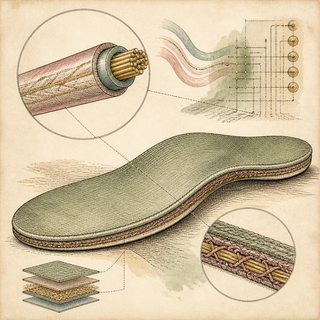
For proof of concept, the team wove the fibers into a smart insole for real-time gait monitoring. Then machine learning classified different gait patterns with over 84% accuracy. The machine learning here is not the building. It is the slightly judgmental building inspector, walking around with a tablet and saying, “That stride has asymmetry on the mezzanine.”
Gait analysis already matters in rehabilitation because walking patterns reveal how people compensate, recover, or overload joints. Traditional gait labs can be powerful, but they are not exactly casual. You do not pop into a motion-capture room between coffee and laundry. A textile insole points toward monitoring that could happen during normal movement, which is where bodies insist on doing most of their living.
This fits a broader push toward self-powered biomonitoring textiles, acoustic smart fabrics, and wearable gait sensors. Some systems use triboelectric contact, some use acoustic waves, some use piezoresistive pressure changes. The field is basically an expo hall of fabrics trying to become instruments. This paper’s booth has a nice cantilever: continuous melt-spinning with built-in polarization.
Where the Roof Still Leaks
The authors show a compelling prototype, but the building is not ready for tenants yet. The accuracy number is promising, not a medical-grade verdict. We still need broader testing across bodies, shoes, sweat, washing, long-term fatigue, sensor drift, and the thousand tiny indignities of daily wear. Textiles live hard lives. They get stretched, folded, ignored, and occasionally thrown into a washing machine with denim, which is basically a demolition derby with detergent.
There is also the question of signal interpretation. A smart insole can tell you patterns, but rehab decisions need clinical context. A classifier that recognizes gait types is useful; a clinician still needs to know what those patterns mean for pain, recovery, and risk.
Why This Design Has Legs
The paper is intriguing because it treats smart textiles less like gadgets glued onto cloth and more like architecture built from the fiber up. The form, function, and manufacturing route line up unusually well. If the results hold across larger studies and harsher real-world testing, this kind of fiber could help make rehab monitoring softer, cheaper, and less dependent on clinic-bound equipment.
That is the best kind of materials design: not a louder facade, but better load-bearing logic.
References
-
Zhang, H., Li, T., Liu, M., Zhang, S., Chen, Q., Qu, J., & Wang, Z. “High-Performance Weavable Piezoelectret Fibers via Scalable In Situ Poling Melt-Spinning for Real-Time Knee Joint Rehabilitation Monitoring.” Advanced Materials, 2026. DOI: 10.1002/adma.73883. PMID: 42394230.
-
Chen, Y., Zhang, X., & Lu, C. “Flexible piezoelectric materials and strain sensors for wearable electronics and artificial intelligence applications.” Chemical Science, 2024. DOI: 10.1039/D4SC05166A.
-
Wang, N., Zhang, H., Qiu, X., et al. “Recent Advances in Ferroelectret Fabrication, Performance Optimization, and Applications.” Advanced Materials, 2024. DOI: 10.1002/adma.202400657.
-
Yin, J., Wang, S., Di Carlo, A., et al. “Smart textiles for self-powered biomonitoring.” Med-X, 2023. DOI: 10.1007/s44258-023-00001-3.
-
Mao, Y., Liang, J., Zhang, R., Zhao, T., & Zhou, A. “Research Progress of Self-Powered Gait Monitoring Sensor Based on Triboelectric Nanogenerator.” Applied Sciences, 2025. DOI: 10.3390/app15105637.
-
Wang, Y., Sun, C., & Ahmed, D. “A smart acoustic textile for health monitoring.” Nature Electronics, 2025. DOI: 10.1038/s41928-025-01386-2.
Disclaimer: This blog post is a simplified summary of published research for educational purposes. The accompanying illustration is artistic and does not depict actual model architectures, data, or experimental results. Always refer to the original paper for technical details.