Most folks assume you have to chop, tag, dye, digest, or otherwise put a protein through a biochemical vaudeville act before a machine can recognize it; this paper marches in with a tiny pore, a voltage, and the nerve to say: “Friends, perhaps not.”
The study, “Single-Molecule Fingerprinting of Unlabeled Full-Length Proteins Using an Aerolysin Nanopore,” reports a label-free way to identify intact proteins by pulling unfolded molecules through an aerolysin nanopore and reading the electrical hiccups they leave behind. No fluorescent tags. No enzymatic confetti. No molecular name badges. Just proteins slipping through a nanoscale doorway while the instrument listens for their signature crackle. The authors then use machine learning classifiers to distinguish seven related proteins with about 80% accuracy.1
Eighty percent is not “throw away your mass spectrometer and crown the pore king” territory. But it is very much “somebody call the bandleader, because the tune has changed” territory.
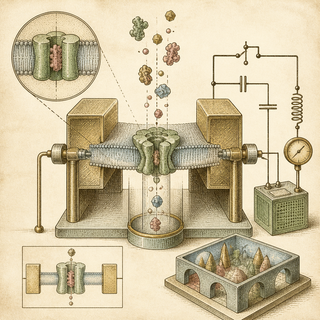
Tonight’s Mystery: Who Blocked the Current?
A nanopore is exactly what it sounds like: a very small hole, usually sitting in a membrane, with an electrical current flowing through it. When a molecule passes through, it partly blocks the current. That creates a signal, often called a blockade, which looks less like a neat barcode and more like a seismograph trying to describe spaghetti.
For DNA, nanopores already became famous because DNA has a tidy alphabet and a convenient backbone charge. Proteins, meanwhile, are chaos in formalwear. They fold into shapes, carry uneven charges, come decorated with chemical modifications, and generally behave like guests who refuse to follow the seating chart.
That is why protein nanopore sensing has been such a stubborn problem. If a protein zips through too fast, the instrument sees only a blur. If it folds up, it may not fit. If it sticks, the experiment becomes molecular traffic court.
Rukes and colleagues tackle this by using low pH and guanidinium chloride, a chemical that helps unfold proteins. Together, these conditions create strong electroosmotic flow, meaning the fluid movement itself helps drive the proteins through the aerolysin pore. Imagine a microscopic lazy river, except the inner tubes are denatured proteins and the lifeguard is an electrode with no patience.
The Fingerprint Is in the Wiggle
The key move is not claiming the pore reads every amino acid like a ticker tape. It does not. Instead, the system records directional electrical fingerprints as full-length proteins translocate through the pore. Those fingerprints appear to reflect, at least partly, how volume and charge distribute along the protein sequence. The authors also suggest translocation dynamics may add more information.1
That matters because proteomics has a long-standing nuisance: proteoforms. A single gene can produce many protein variants through splicing, cleavage, chemical modifications, and other cellular bookkeeping that makes biology powerful and graduate students tired. Standard mass spectrometry is extraordinary, but full-length, low-abundance, highly similar proteoforms remain hard to resolve cleanly in every context.
Recent work has been circling this mountain from several sides. Yu and colleagues showed enzyme-free, single-file transport of full-length proteins through a nanopore.2 Filius and colleagues used single-molecule FRET to fingerprint full-length proteins and locate modifications with high precision.3 Dutt and colleagues combined solid-state nanopore measurements with machine learning to classify similar-sized proteins.4 Reviews in Nature Chemistry and Nature Biotechnology argue that nanopores may become a serious route toward single-molecule protein analysis, provided researchers solve speed, control, throughput, and interpretation.56
In other words, this JACS paper is not a lone trumpet in an empty hall. It is part of an orchestra warming up, with half the violins still arguing about buffer conditions.
Enter the Classifier, Wearing a Tiny Fedora
The machine learning here plays detective. It gets examples of nanopore signals from known proteins, learns the statistical patterns, and then tries to identify new events. This is less “AI understands proteins” and more “the classifier has heard enough suspicious electrical jazz to recognize the saxophonist.”
That distinction matters. Machine learning does not magically solve the physics. It helps extract patterns from noisy, high-dimensional signals. If the experimental setup drifts, if the protein mixture becomes more complex, or if two proteoforms differ by a subtle modification, the classifier may need more data, better features, and sterner supervision than a nightclub bouncer on New Year’s Eve.
Still, the 80% result is compelling because the proteins were related and sequence-similar. The method found useful signal where many people might expect mush.
Why This Could Matter
If this approach becomes more accurate and scalable, it could help detect low-abundance proteoforms directly, especially in cases where labels, digestion, or amplification distort the story. Disease biomarkers, cell-state measurements, and drug-response studies all care about tiny protein differences. Biology often hides the plot twist in a modification site, because apparently cells enjoy writing mysteries in invisible ink.
The dream is not merely “protein sequencing, but smaller.” It is fast, direct, single-molecule protein identification that can reveal heterogeneity hidden by bulk measurements. That would complement mass spectrometry rather than replace it overnight. Mass spec is not going quietly; it has been running the proteomics switchboard for decades and knows where all the cables are buried.
The hard parts remain: better temporal resolution, larger protein panels, complex mixtures, reproducible pore behavior, and reliable links between sequence features and signal. But the paper shows a believable path: unfold the proteins, thread them through, capture directional fingerprints, and let carefully trained algorithms separate one molecular voice from another.
Ladies and gentlemen, keep your receivers tuned. The protein may be unlabeled, but it is not silent.
References
Disclaimer: This blog post is a simplified summary of published research for educational purposes. The accompanying illustration is artistic and does not depict actual model architectures, data, or experimental results. Always refer to the original paper for technical details.
-
Rukes, V.; Norkute, E.; Barnikol, G.; Duan, J.; Gao, J.; Cao, C. “Single-Molecule Fingerprinting of Unlabeled Full-Length Proteins Using an Aerolysin Nanopore.” Journal of the American Chemical Society (2026). DOI: 10.1021/jacs.6c01018. PMID: 42366868. ↩↩
-
Yu, L. et al. “Unidirectional Single-File Transport of Full-Length Proteins through a Nanopore.” Nature Biotechnology 41, 1130-1139 (2023). DOI: 10.1038/s41587-022-01598-3. ↩
-
Filius, M. et al. “Full-Length Single-Molecule Protein Fingerprinting.” Nature Nanotechnology 19, 652-659 (2024). DOI: 10.1038/s41565-023-01598-7. ↩
-
Dutt, S. et al. “High Accuracy Protein Identification: Fusion of Solid-State Nanopore Sensing and Machine Learning.” Small Methods 7, 2300676 (2023). DOI: 10.1002/smtd.202300676. arXiv: 2302.12098. ↩
-
Dorey, A.; Howorka, S. “Nanopore DNA Sequencing Technologies and Their Applications towards Single-Molecule Proteomics.” Nature Chemistry 16, 314-334 (2024). DOI: 10.1038/s41557-023-01322-x. ↩
-
Lu, C.; Bonini, A.; Viel, J. H.; Maglia, G. “Toward Single-Molecule Protein Sequencing Using Nanopores.” Nature Biotechnology 43, 312-322 (2025). DOI: 10.1038/s41587-025-02587-y. ↩