Before this contraption arrived, suspicious lung clots waited in the radiology queue like uninvited guests at a manor dinner. After it arrived, the machine began tapping the butler on the shoulder and whispering, "Pardon me, but this one looks alarming."
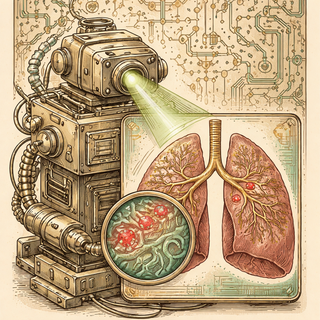
It is with considerable delight that I report a very modern species of helper: an FDA-cleared AI system that scans CT pulmonary angiography, or CTPA, for pulmonary embolism, those treacherous clots that lodge in the arteries of the lungs. CTPA is the workhorse scan for this problem because it shows contrast-filled pulmonary arteries directly, making a clot appear as a dark filling defect where blood ought to be sailing along in civilized fashion.
The paper at hand did not merely show off an algorithm in a laboratory terrarium. Goldberg-Stein and colleagues studied what happened after the tool was actually deployed across a large U.S. health network, covering 32,501 CTPA exams from 29,492 adult patients between August 9, 2021 and February 20, 2023.[1] That scale matters. Plenty of AI papers perform splendidly under chandelier lighting and then lose their composure the moment they meet real hospital workflow, scanner variation, and the occasional chaos goblin of clinical practice.
What the Investigators Actually Observed
The setup was admirably practical. The AI read each scan in real time while radiologists read the same exams in routine care. If the human and the machine disagreed, thoracic radiologists adjudicated the case through a quality oversight process. That means the most intense scrutiny fell on the disagreements, which is exactly where the interesting trouble lives.
Overall concordance between the AI and radiologists was 97.79%.[1] On first glance, that sounds almost indecently tidy. Yet the more revealing detail is what happened in the mismatches. Expert adjudication favored the radiologist in 88.73% of discordant cases, and the interpreting radiologist made a unique PE diagnosis in 14.97% of positive cases, compared with just 0.81% uniquely identified by the AI.[1] Translation: the machine was useful, but it was not the captain of the ship. More like a diligent cabin boy with sharp eyesight and occasional dramatic overconfidence.
The system also behaved differently depending on the clot. Concordance was much better for acute than chronic pulmonary embolism, and far better for central clots than for subsegmental ones.[1] That is not terribly shocking. Large, central emboli are the neon signs of this business. Tiny peripheral clots are more like trying to spot a suspicious breadcrumb in a storm drain.
Why This Is Interesting Beyond the Spreadsheet
This study matters because pulmonary embolism is one of those diagnoses where speed and accuracy both have teeth. Miss it, and the patient can deteriorate fast. Overcall it, and you invite unnecessary anticoagulation, which is not a harmless pastime. Radiologists are reading a great many scans, often under substantial time pressure. If AI can reliably wave the red flag on urgent cases, that changes workflow in a very concrete way.
Other recent studies suggest the same general promise, with caveats attached like warning labels on Victorian patent medicine. A 2023 RSNA study found that AI-assisted triage for cancer-associated incidental PE increased detection and sharply shortened report turnaround time and time to treatment.[2] A 2024 clinical imaging study reported high sensitivity and specificity, and showed the software could recover a substantial share of missed cases in retrospective review.[3] Meanwhile, method papers continue to push the technical frontier, such as anatomically aware deep learning that uses structural context to improve detection on CTPA.[4]
But the field is still sorting out where the lantern shines brightest. A 2024 systematic review found that AI work for chronic pulmonary embolism and chronic thromboembolic pulmonary hypertension remains comparatively sparse and inconsistently reported.[5] A 2025 review likewise argued that validation, bias, interpretability, workflow integration, and legal responsibility remain stubborn obstacles.[6] Quite right. Hospitals do not run on benchmark curves alone. They run on trust, liability, staffing, and whether the thing behaves sensibly on a rainy Tuesday.
The Real Plot Twist: AI as Colleague, Not Oracle
The loveliest part of this paper is that it refuses the usual robot melodrama. The result is not "AI replaces radiologists," which was always the sort of claim one makes before meeting an actual hospital. The result is that AI and radiologists can complement one another, but the human still wins most disputed judgments.[1]
That feels honest. In medicine, honest beats flashy every time.
So what have we catalogued here? Not an artificial mind, not a silicon savior, but a pattern-hunting assistant that can help surface dangerous scans in a mountain of images. A very useful assistant, perhaps. Still an assistant. If the attention mechanism in a neural network is the one clerk who actually reads the whole file before speaking, clinical oversight is the senior physician who knows when the clerk has mistaken a smudge for a scandal.
That, in truth, is progress of the sensible kind.
References
[1] Goldberg-Stein S, Gandomi A, Barish MA, et al. Clinical Implementation of AI for Pulmonary Embolism Detection in over 30,000 CT Pulmonary Angiography Examinations. Radiology: Artificial Intelligence. 2026. DOI: 10.1148/ryai.250017. PMID: 42126306
[2] van Hoorn F, de Jong PA, Lessmann N, et al. Use of a Deep Learning Algorithm for Detection and Triage of Cancer-associated Incidental Pulmonary Embolism. Radiology: Artificial Intelligence. 2023. DOI: 10.1148/ryai.220286
[3] Ayobi A, Chang PD, Chow DS, et al. Performance and clinical utility of an artificial intelligence-enabled tool for pulmonary embolism detection. Clinical Imaging. 2024. DOI: 10.1016/j.clinimag.2024.110245
[4] Condrea F, Rapaka S, Itu L, et al. Anatomically aware dual-hop learning for pulmonary embolism detection in CT pulmonary angiograms. Computer Biology and Medicine. 2024;174:108464. DOI: 10.1016/j.compbiomed.2024.108464. PMID: 38613894
[5] Abdulaal A, Maiter A, Salehi M, et al. A systematic review of artificial intelligence tools for chronic pulmonary embolism on CT pulmonary angiography. Frontiers in Radiology. 2024. DOI: 10.3389/fradi.2024.1335349. PMID: 38654762
[6] Li L, Peng M, Zou Y, Li Y, Qiao P. The promise and limitations of artificial intelligence in CTPA-based pulmonary embolism detection. Frontiers in Medicine. 2025;12:1514931. DOI: 10.3389/fmed.2025.1514931
Disclaimer: This blog post is a simplified summary of published research for educational purposes. The accompanying illustration is artistic and does not depict actual model architectures, data, or experimental results. Always refer to the original paper for technical details.