Nine years ago, researchers tried chemistry-based physically unclonable tags for anti-counterfeiting. It didn't work. This paper explains why and fixes it.
That opening sounds a little dramatic, but only a little. The idea behind a physical unclonable function, or PUF, has been around for years: let randomness in a material create a one-of-a-kind fingerprint that counterfeiters cannot copy, like a snowflake that went to engineering school and got very into authentication protocols. The problem is that many anti-counterfeit labels still lean on patterns that are hard to make, yet not hard enough to fake, or on human inspection, which is a polite way of saying "somebody squints at it and hopes for the best."
According to Yang and colleagues, their answer is a piezochromic polymer hydrogel - a soft material whose fluorescence changes under pressure - that can be turned into a stable optical fingerprint for authentication [1].
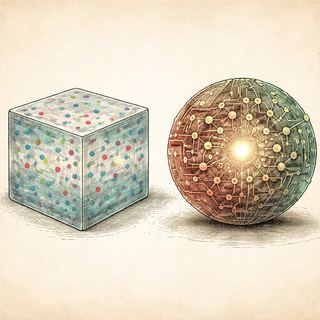
The Trick Is Not the Color Change - It's the Chaos
Here is the core move. The hydrogel starts with red-emissive particles. Press on it, and some of those particles switch to blue emission. Not temporarily. The blue state sticks around after the pressure is released [1]. That matters, because a good anti-counterfeit tag cannot behave like a moody laptop charger that only works when you hold it at exactly the wrong angle.
The authors trace that red-to-blue shift to suppressed through-space interactions and reduced electron delocalization [1]. In plain English: pressure changes how the light-emitting parts of the material "talk" to each other. Less chatter, different glow. Chemistry, as usual, is just atoms rearranging the office seating chart and suddenly the whole team dynamic changes.
The important part is what happens next. Those red and blue particles end up scattered in stochastic, spatially unique patterns. According to the paper, statistical analysis shows near-ideal randomness along with high uniqueness and reliability [1]. That randomness is the security feature. If ordinary labels are passwords, these things are fingerprints.
Why Existing Anti-Counterfeit Tech Keeps Getting Into Fights It Can't Win
This is where the paper gets more interesting than the headline. Counterfeit protection usually fails for boring reasons: deterministic fabrication, limited entropy, easy visual mimicry, or authentication systems that are too fragile outside the lab. A hologram looks fancy until somebody copies the fancy.
That is why the broader PUF literature has been moving toward messier, richer physical signatures. Recent work has explored dynamic fractal structures with AI authentication [2], silicon optical PUFs for integrated circuits [3], reversible all-optical multilevel PUFs [4], and biodegradable silk-based PUF tags for agriculture supply chains [5]. The field is clearly chasing the same dream: make the object itself carry the secret, instead of storing the secret in a way that can be stolen.
This hydrogel paper joins that race with a clever angle. It uses pressure as the writing tool. Not lasers. Not elaborate clean-room fabrication. Just compression that permanently changes emission states inside a soft material [1]. That is a nice twist because it potentially lowers manufacturing friction while preserving the thing PUFs live or die on - irreproducible randomness.
The Machine Learning Part Is Doing Real Work
The title mentions machine learning, and for once that is not just garnish sprinkled on top like parsley nobody asked for.
The authors use a similarity-based machine learning framework to authenticate the optical patterns automatically [1]. That addresses one of the most obvious weaknesses in visual anti-counterfeiting: people are inconsistent. Lighting changes. Cameras drift. Humans get tired. Humans also get overconfident, which is how you end up buying "definitely authentic" sneakers from a guy whose business address is a parking lot.
So the real contribution is not just "we made a weird fluorescent material." It is "we made a weird fluorescent material and paired it with a readout system that scales better than eyeballs." That lines up with other recent studies using AI or computer vision to verify PUF-style labels and optical fingerprints [2,6].
But the numbers tell a more cautious story across the field. A 2024 analysis in IEEE Transactions on Information Forensics and Security argues that some optical PUF designs can be learned efficiently under practical assumptions, meaning the "unclonable" part depends heavily on how the physics and the authentication protocol are set up [6]. In other words, if the material is the lock, the machine-learning pipeline is part of the doorframe. You need both.
What This Could Actually Change
If reproducible at scale, this kind of tag could matter anywhere fake goods are expensive, dangerous, or both: pharmaceuticals, electronics, luxury goods, supply chains. That matters because counterfeit trade is not a niche headache. OECD reporting published in 2024 and updated in 2025 describes counterfeit and pirated goods as a persistent global trade problem tied to consumer safety, brand losses, and supply-chain integrity [7,8].
So yes, a pressure-written hydrogel that stores a durable optical fingerprint sounds niche. Until you remember that modern commerce runs on trust signals, and many of those trust signals are embarrassingly easy to forge.
The open questions are practical ones. How stable are these tags under heat, humidity, abrasion, and long-term storage? How cheap is imaging at scale? How robust is the model against tampering, drift, or adversarial spoofing? The paper makes a strong materials case [1]. The next chapter is systems engineering, where many elegant lab ideas discover the outside world is rude and full of dust.
Still, this is a sharp piece of work. It takes a soft, pressure-responsive material and turns it into something much harder to fake. And in anti-counterfeiting, that is the whole game.
References
-
Yang J, Wu J, Xiao G, et al. Piezochromic hydrogels for physically unclonable optical anti-counterfeiting with machine-learning assisted automatic identification. Nature Communications. 2026. doi:10.1038/s41467-026-73060-w. PubMed: https://pubmed.ncbi.nlm.nih.gov/42103784/
-
Kim S, Seo S, Lee H, et al. Random fractal-enabled physical unclonable functions with dynamic AI authentication. Nature Communications. 2023;14:2185. doi:10.1038/s41467-023-37588-5
-
Wang K, Shi J, Lai W, et al. All-silicon multidimensionally-encoded optical physical unclonable functions for integrated circuit anti-counterfeiting. Nature Communications. 2024;15:3203. doi:10.1038/s41467-024-47479-y
-
Kim J, Kim Y, Rho J, et al. All-optical multilevel physical unclonable functions. Nature Materials. 2024;23:369-376. doi:10.1038/s41563-023-01734-7
-
Sun H, Maji S, Chandrakasan AP, Marelli B. Integrating biopolymer design with physical unclonable functions for anticounterfeiting and product traceability in agriculture. Science Advances. 2023;9(12):eadf1978. doi:10.1126/sciadv.adf1978
-
Albright AJY, Gelfand B, Dixon MJ. Learnability of Optical Physical Unclonable Functions Through the Lens of Learning With Errors. IEEE Transactions on Information Forensics and Security. 2024;20. doi:10.1109/TIFS.2024.3518065
-
Gao Y, Al-Sarawi SF, Abbott D. Physical unclonable functions. Nature Electronics. 2020;3:81-91. doi:10.1038/s41928-020-0372-5
-
OECD/EUIPO. Illicit Trade in Fakes under the COVID-19. OECD Publishing; 2024. doi:10.1787/0c475a23-en. See also OECD topic update on counterfeit and pirated goods (16 December 2024): https://www.oecd.org/en/topics/sub-issues/counterfeit-and-pirated-goods.html
Disclaimer: This blog post is a simplified summary of published research for educational purposes. The accompanying illustration is artistic and does not depict actual model architectures, data, or experimental results. Always refer to the original paper for technical details.