Seagrass, noun: a flowering marine plant that looks like lawn clippings got tenure underwater; in Peng et al.'s new Nature paper, it is also a planet-scale computer-vision problem with carbon, coastlines, and marine-protected-area paperwork attached.
That sounds like a lot for a plant most people mentally file under "green stuff near fish." Rude, but understandable. Seagrass is not seaweed. It has roots, flowers, seeds, and the exhausting responsibility of supporting coastal ecosystems while somehow receiving less public-relations funding than coral reefs, whales, and whatever animal currently has a Pixar deal.
The Map Was Missing, Which Is Awkward
The problem Peng and colleagues tackle is beautifully simple and scientifically annoying: you cannot protect what you cannot locate. Earlier global seagrass estimates varied because methods, field data, image sources, and local conditions varied. Classic research problem: everyone has a map, nobody has the same map, and Reviewer 2 wants to know why your coastline has vibes instead of confidence intervals.
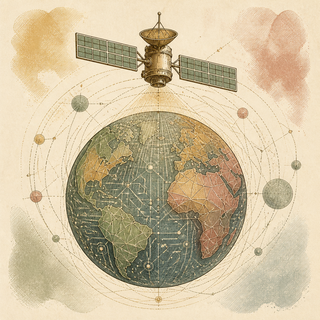
So the team built what they describe as the first global 10-meter-resolution maps and change analysis of clear, shallow-water seagrass. They processed 4.75 million Sentinel-2 MSI satellite images from two time windows, 2019-2020 and 2023-2024, then used a deep-learning classifier trained on curated reference data to identify seagrass from space [1].
"From space" is doing a lot of work there. Satellites see reflected light, water messes with light, clouds photobomb everything, and underwater habitats like coral, algae, rock, sand, and seagrass can look inconveniently similar. This is not a neural network casually recognizing a cat. This is a neural network squinting through seawater at a salad.
How to Teach a Satellite Botany
The model learned from field-verified examples: divers and researchers confirmed where seagrass and non-seagrass habitats actually existed, creating "ground truth." In machine learning terms, ground truth is the answer key. In academic terms, it is the thing you spent three field seasons collecting so someone can later ask whether n should have been larger.
This fits a broader wave of remote-sensing work using AI to map marine habitats. Peng et al.'s earlier SGDenseNet paper focused on the spectral-overlap problem and reported about 90% overall accuracy for broad-scale seagrass mapping [2]. Chowdhury et al. showed a related Sentinel-2 deep-learning pipeline for Mediterranean Posidonia oceanica, reaching strong accuracy in shallower zones [3]. The new Nature paper takes that general idea and scales it to the planet, which is what happens when your spreadsheet grows up and becomes a grant proposal.
Tools like combb2.io use AI to clean up messy images; this project uses the same broad computer-vision family tree for a harder job: deciding whether faint underwater pixels are plants, sand, algae, coral, or aquatic nonsense.
The Numbers Are Not Exactly Spa Music
The team mapped 148,506 square kilometers of seagrass globally, including 5,961 square kilometers of intertidal seagrass and 142,545 square kilometers of subtidal seagrass [1]. About 69% sits in just five places: The Bahamas, Cuba, the United States, Australia, and Indonesia.
Then comes the conservation gut punch. Only 21% of mapped seagrass lies inside marine protected areas. Between the two study periods, the authors found 5,969 square kilometers lost, about 4%, plus another 6,221 square kilometers degraded from dense to sparse cover in tropical regions [1]. That is not just ecological sadness with a nice color ramp. Seagrass meadows buffer coastlines, shelter juvenile fish, improve water quality, and store blue carbon in biomass and sediment.
Recent reviews put this in context: seagrass ecosystems support biodiversity, fisheries, coastal protection, and carbon storage, but uncertainty about their distribution has slowed conservation [4]. A 2025 global carbon study estimated seagrass biomass carbon stocks and net primary production across countries and bioregions, showing why better maps matter for climate accounting [5]. Translation: carbon math gets much less hand-wavy when you know where the plants are.
Why This Map Could Matter
If the method holds up and expands, the practical uses are obvious: better marine protected area design, faster detection of losses, smarter restoration planning, blue-carbon monitoring, and maybe even enforcement when coastal damage happens and everyone suddenly develops a very selective memory.
The map is also being connected to the Allen Coral Atlas, and the paper reports public data and code through Zenodo [1]. That matters. Science is better when people can inspect the sausage factory, even if the sausage factory contains atmospheric correction, dense neural networks, and the faint smell of conference deadlines.
The Fine Print, Because Science Is a Contract With Humility
This map covers clear, shallow coastal waters. Turbid water, deep seagrass, seasonal variation, and regional quirks can still fool satellites. The authors note current satellite limits around roughly 30 meters depth, while some seagrass grows deeper. Also, four years is useful for change detection, but not enough to pin every loss on one cause without more evidence.
Still, this is a serious step from "we think the seagrass is somewhere over there" to "here is a consistent global baseline." For conservation, that difference is not cosmetic. It is the difference between wandering around with binoculars and finally opening the map app.
References
- Peng, J., Li, J., Krause, J. R. et al. "Global high-resolution mapping of seagrass to support conservation." Nature (2026). DOI: 10.1038/s41586-026-10704-3. PMID: 42343128.
- Peng, J., Li, J., Ingalls, T. C. et al. "A novel deep learning algorithm for broad scale seagrass extent mapping in shallow coastal environments." ISPRS Journal of Photogrammetry and Remote Sensing 220, 277-294 (2025). DOI: 10.1016/j.isprsjprs.2024.12.008.
- Chowdhury, M. et al. "AI-driven remote sensing enhances Mediterranean seagrass monitoring and conservation to combat climate change and anthropogenic impacts." Scientific Reports 14, 8360 (2024). DOI: 10.1038/s41598-024-59091-7. PMCID: PMC11006664.
- Duarte, C. M. et al. "Conserving seagrass ecosystems to meet global biodiversity and climate goals." Nature Reviews Biodiversity 1, 150-165 (2025). DOI: 10.1038/s44358-025-00028-x.
- Gomis, E. et al. "Global estimates of seagrass blue carbon stocks in biomass and net primary production." Nature Communications 16, 9530 (2025). DOI: 10.1038/s41467-025-64667-6.
Disclaimer: This blog post is a simplified summary of published research for educational purposes. The accompanying illustration is artistic and does not depict actual model architectures, data, or experimental results. Always refer to the original paper for technical details.