Back in 2014, the Nature sugar beet genome paper gave breeders something like a first decent road atlas for one major sugar crop: not perfect, not magic, but much better than squinting at field notes and hoping the plants behaved themselves. Wang and colleagues' new review, Revisiting the Molecular Roadmap for Sugar Crops, asks what happens when that atlas gets upgraded with genome sequencing, multi-omics, genomic selection, CRISPR, high-throughput phenotyping, and AI. The answer is: potentially smarter sugar crops. Also: several thousand caveats wearing lab coats.
The Old Way: Cross, Wait, Repeat, Sigh
Sugar crops are not just candy infrastructure. Sugarcane, sugar beet, sweet sorghum, and stevia feed sugar markets, ethanol production, natural sweetener demand, and parts of the bioeconomy. Sugarcane alone is a monster crop: huge biomass, big industrial footprint, and a genome that looks like someone photocopied a chromosome set during an earthquake.
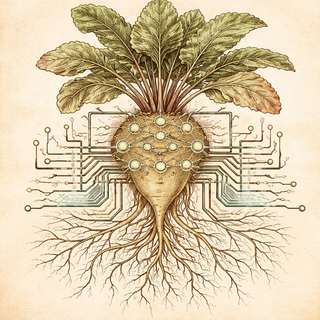
Traditional breeding works, but it can be painfully slow. You cross plants, grow offspring, measure traits, run field trials, and then discover that the plant with great sugar content has the disease resistance of a damp napkin. Climate change adds drought, heat, pests, and weird weather into the mix, because apparently agriculture needed more side quests.
The review argues that sugar-crop breeding is moving from "pick the best-looking plants" toward "design the plant you want, then test whether reality agrees." That last part matters. Reality has tenure.
Reading the Genome Without Pretending It Is Easy
The first layer is genome reading: sequencing, pangenomes, transcriptomics, proteomics, metabolomics, epigenomics, and all the other omics that make biology sound like a streaming-service bundle.
For sugar beet, this is comparatively civilized. Its genome was published in 2014, giving researchers a strong base for finding genes, studying domestication, and improving traits Dohm et al., 2014. For sugarcane, the story is messier. Modern sugarcane is highly polyploid and heterozygous, meaning it carries many chromosome copies with lots of variation. If a normal crop genome is a cookbook, sugarcane is a cookbook printed in six editions, shuffled, annotated, translated, and dropped behind the refrigerator.
That complexity is why marker-assisted selection has helped most when traits are tied to clear markers, like some disease-resistance targets. But many useful traits - yield, drought tolerance, sugar accumulation, biomass - are controlled by many small-effect genes plus environment. That is where genomic selection comes in.
Genomic Selection: Breeding's Slightly Suspicious Crystal Ball
Genomic selection predicts plant performance from genome-wide markers. Instead of hunting one magic gene, breeders train models on plants with known DNA and measured traits, then use those models to score new candidates early.
This is useful because field trials are slow and expensive. A seedling that looks innocent today may become a disappointing adult plant later, which is basically crop breeding's version of hiring from a very polished resume.
Studies in sugar beet showed genomic prediction can work well for several complex traits, though models need recalibration as breeding populations change Hofheinz et al., 2012; Würschum et al., 2013. In sugarcane, researchers keep emphasizing both promise and pain: genomic selection can speed selection, but sugarcane's genome, genotype-by-environment effects, and data-management demands make the whole thing less "push button, receive super cane" and more "assemble aircraft while measuring leaf rust" Yadav et al., 2022.
Writing Traits: CRISPR Enters With a Clipboard
The review's second big idea is trait writing. Once researchers identify useful genes or regulatory elements, they can try genetic transformation, RNA interference, CRISPR, base editing, or synthetic biology approaches.
That sounds clean. It is not always clean. Editing one gene can change several traits. Editing a polyploid crop may mean editing many gene copies, and missing a few can blunt the effect. Transformation systems vary by crop and genotype. Regulatory systems differ by country. Public acceptance can change faster than a TikTok nutrition trend.
Still, the toolbox is getting better. Recent reviews argue that machine learning can help design guide RNAs, predict editing outcomes, reduce off-target effects, and prioritize candidate genes from messy biological datasets Chen et al., 2024. That is genuinely useful, provided nobody forgets that a model prediction is not a field trial. The GPU may be confident. The soil does not care.
The AI Breeder, But Make It Accountable
Wang and colleagues point toward an "intelligent breeding" framework: combine genome data, trait measurements, environmental data, AI models, and precision editing to design climate-adaptive cultivars. In principle, this could help breeders build sugarcane that handles drought better, sugar beet with stronger disease resistance, sweet sorghum optimized for bioenergy, or stevia with improved sweetener profiles.
High-throughput phenotyping is a key piece. Drones, sensors, imaging, and automated measurements can track plant height, canopy structure, stress signals, and growth patterns at scales humans cannot manage without becoming very sunburned and emotionally unavailable. A 2023 review on sugarcane argued that genomics plus phenomics is needed to boost breeding, especially for traits that are hard to select early Luo et al., 2023.
This is also where visual thinking tools like mapb2.io feel oddly relevant: the breeding pipeline is basically a giant concept map of genes, traits, environments, sensors, models, and decisions. Except the nodes are alive, expensive, and occasionally eaten by insects.
The Catch, Because There Is Always a Catch
The review is optimistic, but the fine print is doing cardio. More data does not automatically mean better decisions. AI models can overfit. Omics datasets can be uneven. Gene edits can behave differently across environments. Field validation remains slow. Smallholder access, cost, regulation, and seed-system realities will shape who benefits.
So the real message is not "AI will redesign sugar crops overnight." It is sharper than that: sugar-crop breeding is gaining the tools to become more predictive, targeted, and climate-aware, but only if researchers keep connecting molecular predictions to actual plants in actual fields.
Sugar security, bioenergy, and sustainable biomanufacturing are big stakes. But in plant breeding, the final boss is never the press release. It is the next growing season.
References
- Wang, P., Wu, Q., Wang, W., Lakshmanan, P., Li, Y., Muhammad, K., Wang, Y., & Que, Y. (2026). Revisiting the Molecular Roadmap for Sugar Crops: Genome Reading, Trait Writing and Variety Redesigning. Plant Biotechnology Journal. DOI: 10.1111/pbi.70683. PMID: 42126266
- Dohm, J. C. et al. (2014). The genome of the recently domesticated crop plant sugar beet. Nature. DOI: 10.1038/nature12817
- Würschum, T. et al. (2013). Genomic selection in sugar beet breeding populations. BMC Genetics. DOI: 10.1186/1471-2156-14-85
- Luo, T., Liu, X., & Lakshmanan, P. (2023). A Combined Genomics and Phenomics Approach is Needed to Boost Breeding in Sugarcane. Plant Phenomics. DOI: 10.34133/plantphenomics.0074. PMCID: PMC10348406
- Chen, L., Liu, G., & Zhang, T. (2024). Integrating machine learning and genome editing for crop improvement. aBIOTECH. DOI: 10.1007/s42994-023-00133-5
Disclaimer: This blog post is a simplified summary of published research for educational purposes. The accompanying illustration is artistic and does not depict actual model architectures, data, or experimental results. Always refer to the original paper for technical details.