A fungus walks into a materials science lab. No, this isn't the setup for a bad joke - it's the premise of a genuinely wild new study that figured out how to make mushroom-based materials that are simultaneously strong AND tough, which is basically the materials science equivalent of being both a morning person and a night owl.
The Problem Nobody Could Solve (Until Now)
Here's a dirty little secret in materials science: strong materials are usually brittle, and tough materials are usually weak. It's an annoying trade-off that's plagued engineers since forever. Think of it like trying to find someone who's both spontaneous AND reliable - technically possible, but good luck finding them through trial and error.
Traditional methods for developing new composite materials involve what researchers politely call "design of experiments" and what everyone else calls "making educated guesses and hoping something works." When you're juggling multiple variables - ratios of ingredients, processing temperatures, curing times - the number of possible combinations explodes faster than a TikTok trend.
Enter the Algorithm That Plays Favorites
Researchers from multiple institutions decided to throw machine learning at this problem, and not just any ML - they used a sophisticated Gaussian process surrogate model combined with something called Pareto set learning.
The Pareto bit is particularly clever. Named after the Italian economist who noticed 80% of Italy's land was owned by 20% of the population, Pareto optimization acknowledges that sometimes you can't have it all. Instead of finding ONE perfect solution, it maps out all the "best possible" solutions where improving one property means sacrificing another.
Think of it as the algorithm admitting: "Look, I can't make you a material that's maximum everything. But I CAN show you every option where you're not leaving performance on the table."
The Mycelium Connection
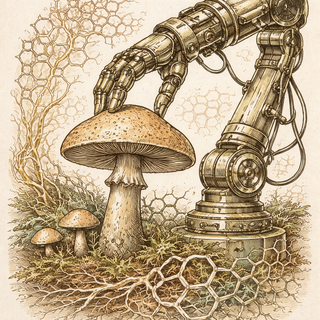
The materials in question? Mycelium-graphene composites. Mycelium - the root-like network structure of fungi - has been getting serious attention as a sustainable material. It grows on agricultural waste, biodegrades when you're done with it, and doesn't require fossil fuels to manufacture. Essentially, it's materials science's version of composting your way to innovation.
Add graphene - that wonder-material that's 200 times stronger than steel - and you've got a promising combo. The challenge was figuring out exactly how much of each ingredient, processed exactly how, would yield the best results.
60 Experiments vs. 250: The AI Advantage
Here's where things get impressive. The ML-guided approach converged on optimal materials after roughly 60 experiments. Traditional methods? They would have required 250+ experiments to achieve comparable results. That's a 74-85% reduction in experimental count, project duration, and cost.
The active learning component kept things efficient by continuously asking: "Given what I've learned so far, which experiment would teach me the most?" Instead of blindly testing everything, the algorithm strategically explored the design space, balancing between exploiting what it knew worked and exploring regions where it was uncertain.
The Numbers That Matter
The resulting mycelium-graphene composites achieved:
- Strength exceeding 58 MPa
- Toughness above 6 MJ/m³
- Magnetic levitation capability over 0.14 mm
That last one is particularly interesting - these bio-based materials can actually levitate in a magnetic field, opening doors for electromagnetic shielding and specialized electronics applications.
What This Means for Future Materials
This study is part of a larger trend where machine learning is reshaping materials discovery. Similar approaches have been applied to polymer composites, biodegradable nanocomposites, and high-entropy alloys.
The implications for sustainable materials are significant. Mycelium-based materials already show promise for construction, packaging, and acoustic insulation. Pairing them with ML-optimized processing could accelerate their path from lab curiosity to practical application.
The Bigger Picture
We're watching a fundamental shift in how materials get designed. Instead of chemists and engineers relying on intuition and incremental tweaks, algorithms are mapping vast design spaces and identifying promising candidates faster than any human team could. It's not replacing human expertise - someone still needs to interpret results and design meaningful experiments - but it's amplifying what researchers can accomplish.
The mycelium-graphene work demonstrates that even biological systems with inherent variability can be optimized systematically. If ML can handle mushroom composites, more predictable material systems should be straightforward by comparison.
References
-
Wang, H., et al. (2025). Machine Learning - Assisted Bio‐Interfacial Engineering Resolves Structural - Functional Conflicts in Nanocomposites. Advanced Materials. DOI: 10.1002/adma.202518806
-
Nurazzi, N. M., et al. (2022). Machine Learning for Property Prediction and Optimization of Polymeric Nanocomposites: A State-of-the-Art. International Journal of Molecular Sciences, 23(18), 10712. PMCID: PMC9505448
-
Robles Hernández, F. C., et al. (2024). A review of recent advances in fungal mycelium based composites. Discover Materials. Link
-
Lookman, T., et al. (2019). Multi-objective optimization in machine learning assisted materials design and discovery. Journal of Materials Informatics. Link
-
Xue, D., et al. (2018). Multi-objective Optimization for Materials Discovery via Adaptive Design. Scientific Reports, 8, 3738. Link
Disclaimer: This blog post is a simplified summary of published research for educational purposes. The accompanying illustration is artistic and does not depict actual model architectures, data, or experimental results. Always refer to the original paper for technical details.