This paper does not unveil a chatty plant robot, does not make a fern write Python, and does not claim your basil has achieved consciousness after one weird afternoon near a GPU. What it does is quieter and, honestly, much stranger: it asks scientists to stop treating the inside of a plant cell like one big soup bowl.
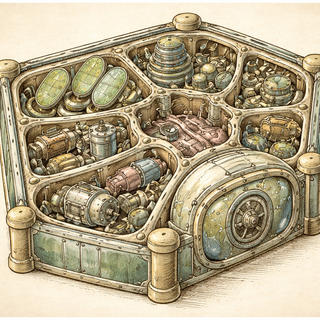
A plant cell is more like a tiny apartment building where every room has its own rules. Chloroplasts are running the solar panels. Mitochondria are handling the power bill. Vacuoles are doing storage, security, and occasional chemical hoarding. The cytosol is the hallway where everyone keeps bumping into each other with packages.
Hans-Henning Kunz and Thomas Nägele, writing in Trends in Plant Science, argue that we have been inventorying the packages and the hardware separately for too long. The packages are metabolites: sugars, amino acids, hormones, and other small molecules. The hardware includes ions and mineral elements: iron, zinc, calcium, manganese, potassium, and friends. Together, they shape what a plant can build, burn, store, repair, and survive.
The twist? We often know what is in the whole building, but not what is in each room.
The Problem With Blending the Whole House
Metabolomics is the study of small molecules involved in metabolism, the chemical fingerprints of life doing its daily errands. Ionomics studies the mineral and elemental side of biology. Both are powerful. Both generate lovely, terrifying spreadsheets. And both can mislead you if you grind up the whole leaf and ask, "So, what was happening in there?"
That is like making a smoothie out of an entire office and trying to figure out which department lost the stapler.
Plants care deeply about location. Iron in a chloroplast is not the same story as iron in a vacuole. A metabolite sitting in the cytosol may be ready for action; the same metabolite locked in a storage compartment may be waiting for a future crisis, like a biochemical canned bean collection.
Kunz and Nägele point out that many enzymes depend on metal cofactors. If the metabolome is the set of ingredients and recipes, the ionome includes the little metal keys that let enzymes actually work. No key, no reaction. Too many keys in the wrong drawer, also bad. Biology is picky like that.
Enter NAF, the Least Watery Detective
The paper centers on nonaqueous fractionation, or NAF. The name sounds like a chemical procedure invented by someone allergic to fun, but the idea is clever: freeze plant tissue, dry it, separate cell fragments without water, and use marker molecules to infer which fractions came from which organelles.
Why avoid water? Because water wakes things up. Enzymes keep reacting, metabolites leak, compartments blur, and suddenly your careful experiment turns into a cellular rummage sale. NAF helps preserve a snapshot of who had what before the lab work disturbed the scene.
NAF has already been used for subcellular metabolomics and proteomics. Recently, researchers adapted it to look at subcellular metal distributions too. In related work on Arabidopsis chloroplasts, scientists found that an opt3 mutant with unusually high iron had far more iron not only in plastids but also in vacuoles. The plant, apparently, had opened extra storage units.
That is the kind of detail bulk measurements can miss.
Where AI Gets Invited, But Not Given the Lab Coat
This is where machine learning enters the story. Not as a magic oracle wearing a tiny wizard hat. More like a patient cartographer trying to reconcile three messy maps drawn by different people after too much coffee.
If researchers can measure metabolites, proteins, and ions across organelles, they can use network analysis and ML models to find patterns: which ions travel with which metabolites, which organelles change together under stress, and which transport proteins might be quietly running the whole operation.
The challenge is that these data are heterogeneous. Metabolomics and ionomics use different instruments, scales, noise patterns, and missing-value disasters. ML engineers will recognize the smell immediately: multimodal integration, batch effects, sparse labels, and features that refuse to behave because biology did not read the documentation.
Tools like mapb2.io are useful for sketching complex relationship maps, and this field badly needs that kind of visual thinking. Once you have organelles, ions, metabolites, transporters, fluxes, and sensors in the same story, a plain table starts looking like a crime board with too much red string.
Why This Could Matter Beyond the Lab Bench
If this approach works at scale, it could improve how we understand plant stress. Drought, salinity, nutrient deficiency, and toxic metals all reshape the inner logistics of a cell. Crops do not just need "more iron" or "less sodium" in some vague motivational-poster sense. They need the right elements in the right compartments at the right time.
That could help researchers breed or engineer plants that use nutrients more efficiently, tolerate rough soils, or recover from stress without turning into dramatic little salad actors. It could also improve metabolic engineering, where scientists try to coax plants into making valuable compounds. If a pathway spans organelles, you need to know where the ingredients and cofactors actually are.
Still, the paper is a petition, not a victory parade. NAF has limitations. Organelle fractions can overlap. Some compartments are harder to resolve than others. Dynamic fluxes still need sensors and time-resolved experiments. And machine learning can only help if the measurements are good enough. Feed it scrambled biology and it will return confident scrambled biology, possibly with a very polished figure.
The real value of this paper is its insistence on spatial honesty. Plant cells are organized. Our measurements should be too.
References
-
Kunz, H.-H., & Nägele, T. "Integrating ionomes and metabolomes across organelles." Trends in Plant Science (2026). DOI: 10.1016/j.tplants.2026.04.028. PMID: 42115071
-
Holzner, L. J. et al. "The chloroplast ionome shines light on the dynamics of organellar iron homeostasis." The Plant Cell (2026). DOI: 10.1093/plcell/koag017
-
Babele, P. K. et al. "Data Science and Plant Metabolomics." Metabolites 13, 454 (2023). DOI: 10.3390/metabo13030454
-
Hao, Y., Zhang, Z. et al. "Plant metabolomics: applications and challenges in the era of multi-omics big data." aBIOTECH 6, 116-132 (2025). DOI: 10.1007/s42994-024-00194-0
-
Yao, J. et al. "Advances in plant spatial multi-omics data analysis." Trends in Plant Science 31, 337-352 (2026). DOI: 10.1016/j.tplants.2025.10.005
Disclaimer: This blog post is a simplified summary of published research for educational purposes. The accompanying illustration is artistic and does not depict actual model architectures, data, or experimental results. Always refer to the original paper for technical details.