Most people assume cancer immunotherapy is about inventing fiercer immune cells, but this paper argues something sweeter and sneakier: sometimes the injured little helper just needs a better leash, a calmer handler, and fewer opportunities to bite the furniture.
The review by Jiao and colleagues in Molecular Cancer looks at T-cell bispecific antibodies, or TCBs: engineered antibodies with two grabby ends. One end latches onto a tumor marker. The other taps a T cell, often through CD3, and says, "Excuse me, this suspicious lump over here requires your professional attention." That is the whole trick, roughly speaking. A molecule becomes a tiny bridge between a cancer cell and a cytotoxic T cell, turning immune wandering into a guided rescue mission.1
The Two-Ended Treat Pouch
A normal antibody is usually a one-target specialist. Very respectable. Very clipboard-and-khaki-vest. A bispecific antibody has two binding jobs at once, which is why Wikipedia's plain definition works nicely here: it can bind two different antigens, or two epitopes on one antigen.2 In cancer therapy, that means one arm can recognize the tumor while the other recruits the immune system.
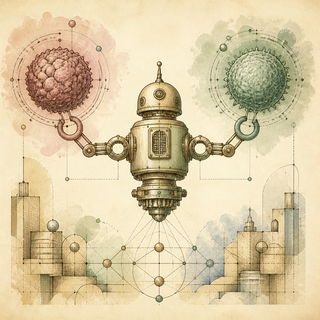
TCBs are the particularly spicy subgroup. They redirect T cells toward malignant cells and help trigger killing through T-cell receptor signaling. Some designs also tinker with immune checkpoints, those molecular "do not disturb" signs tumors love to hang on the door. The review's big map covers formats, targets, clinical results, toxicities, resistance, combination therapies, antibody-drug conjugates, and even AI-assisted antibody design. It is less a paper than a field guide for a rapidly multiplying species.
And yes, like most rescue animals, the early successes are both heartwarming and a little chaotic.
Where the Pup Learned to Hunt
TCBs have shined brightest in blood cancers. That makes biological sense. Blood cancers are more accessible to immune cells, like trying to find a tennis ball in a gym instead of in a swamp at midnight. Drugs such as blinatumomab helped establish the idea that an antibody could physically redirect T cells against cancer, and newer CD20/CD3 and BCMA/CD3 agents have expanded the kennel.
The harder territory is solid tumors. Here, T cells must reach the tumor, survive a hostile neighborhood, recognize cells that may not all share the same antigen, and avoid attacking healthy tissue. The tumor microenvironment is basically a gated community run by exhausted immune cells, suppressive signals, bad plumbing, and a homeowners association made entirely of cytokines.
Recent reviews agree with Jiao and colleagues: antigen selection, immune exclusion, toxicity, and resistance remain the hard parts.34 A 2024 Nature Reviews Clinical Oncology review notes that more than 200 bispecific antibodies are in preclinical or clinical evaluation, but also flags target choice and cytokine release syndrome as major obstacles.3 Translation: the field has many promising animals in rehabilitation, but nobody should leave the enclosure gate open.
The Scary Bark: CRS and ICANS
The main safety problem is that T cells do not always do "moderate enthusiasm." Cytokine release syndrome, or CRS, can happen when immune activation becomes systemic. Fever, inflammation, low blood pressure, organ stress - the body starts acting like someone pulled the fire alarm and then handed everyone a megaphone.
Immune effector cell-associated neurotoxicity syndrome, or ICANS, is another serious risk. It can involve confusion, speech problems, seizures, and other neurological symptoms. These are not cute side effects. They are why clinical dosing strategies matter so much.
The encouraging bit is that clinicians and engineers are learning how to calm the overexcited patient. Strategies include step-up dosing, steroid pretreatment, subcutaneous delivery, adjusting CD3 binding strength, and masked or conditional antibodies that activate more selectively near tumors.3 Think less "release the wolves" and more "gentle lead training with snacks and a very alert vet."
Why This Review Matters
The value of this paper is not that it crowns one winning design. It does something more useful: it sorts the messy landscape. TCBs can be built in different molecular formats, aimed at different tumor antigens, paired with checkpoint inhibitors, combined with other immunomodulators, or armed with drug payloads. Each choice changes efficacy, toxicity, manufacturability, and patient selection.
That matters because the next gains may come from better matching, not just stronger molecules. A TCB that works beautifully in lymphoma may flop in pancreatic cancer if the antigen is patchy, the T cells are exhausted, or the tumor barricade is built like a medieval fortress with Wi-Fi.
This is where AI enters the adoption pen, wearing a tiny vest labeled "may help, still needs supervision." Tools for antibody design and target-pair prediction are emerging, including pairwise learning approaches for bispecific target combinations and generative models for de novo antibody design.56 These methods might help researchers screen combinations faster, but biology still gets the final vote. The wet lab remains the place where confident computational predictions either stretch their legs or immediately hide under the exam table.
The Future: Kinder, Smarter, More Selective
If TCBs become safer and more precise, their impact could be large. Off-the-shelf immune redirection could reach patients who cannot wait for personalized cell therapy. Solid tumor strategies could improve if researchers solve antigen heterogeneity, immune suppression, and delivery. Combination regimens might help tired T cells perk up without turning the whole immune system into a fireworks warehouse.
But the honest forecast is measured. TCBs are powerful, not magical. They need better biomarkers, smarter trial design, careful toxicity management, and long-term evidence. We should be proud of the progress, like watching a once-wobbly model trot across the clinic floor with a bandaged paw and a ridiculous amount of dignity. But we should keep the leash on.
The best version of this field is not louder immune activation. It is better-timed, better-aimed immune care. Less chaos. More precision. More patients getting the right T cell to the right tumor at the right moment.
And maybe, after a lot more rehabilitation, fewer emergency cytokine incidents on the carpet.
References
Disclaimer: This blog post is a simplified summary of published research for educational purposes. The accompanying illustration is artistic and does not depict actual model architectures, data, or experimental results. Always refer to the original paper for technical details.
-
Jiao G, Peng H, Yang Y, Liu Y, Liu X, Hu Y, Dai Y, Li Z, Zhao Q. "Landscape of T-cell bispecific antibodies in cancer therapy: therapeutic strategies, challenges and future prospection." Molecular Cancer. 2026. DOI: 10.1186/s12943-026-02685-8. PMID: 42226254. ↩
-
"Bispecific monoclonal antibody." Wikipedia. Background definition of bispecific antibodies. https://en.wikipedia.org/wiki/Bispecific_monoclonal_antibody ↩
-
Perez P, et al. "Bispecific and multispecific antibodies in oncology: opportunities and challenges." Nature Reviews Clinical Oncology. 2024. DOI: 10.1038/s41571-024-00905-y. ↩↩↩
-
Burton KA, Metropulos AE, Kamath S, Munshi HG, Principe DR. "Bispecific T-cell engager therapy for gastrointestinal cancers." Cancer Letters. 2026;646:218417. DOI: 10.1016/j.canlet.2026.218417. PMID: 41806779. ↩
-
Sun J, et al. "BiSpec Pairwise AI: guiding the selection of bispecific antibody target combinations with pairwise learning and GPT augmentation." Journal of Cancer Research and Clinical Oncology. 2024;150:237. DOI: 10.1007/s00432-024-05740-3. ↩
-
Luo S, et al. "De novo antibody design with SE(3) diffusion." arXiv: 2405.07622, 2024. ↩