Somewhere between sequencing your genome and understanding what it actually means lies a gap so wide you could park a woolly mammoth in it. That's where machine learning is now showing up, coffee in hand, ready to work the night shift.
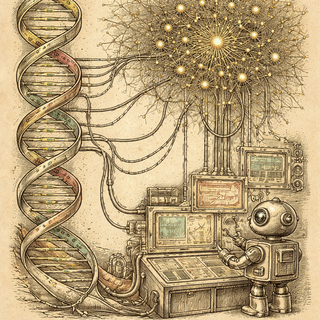
A recent review in Trends in Genetics by Svetec, Lee, and Zhao makes the case that evolutionary genetics - the field that studies how genes change across generations and species - is about to get the AI treatment that protein folding already received. And honestly? It was about time.
The Problem: Too Much Data, Not Enough Brains
Here's the situation. We can now sequence entire genomes for the cost of a nice dinner. The Human Genome Project took 13 years and $3 billion. Today, you can get your genome sequenced for under a thousand bucks while you grab a latte. The problem is that generating data is easy. Understanding it is hard.
Traditional methods in population genetics rely on mathematical models that assume populations behave in tidy, predictable ways. Spoiler: they don't. Populations migrate, mix, split apart, experience plagues, survive bottlenecks, and occasionally make questionable reproductive choices. Modeling this with classical statistics is like trying to predict traffic patterns using only a compass.
Machine learning doesn't care about your elegant equations. It just looks at the data - raw SNPs, haplotypes, allele frequency spectra - and finds patterns humans never thought to look for. As Korfmann et al. put it, population genetics is "transitioning into a data-driven discipline," and deep learning is leading the charge.
What Can Neural Networks Actually Do Here?
Quite a lot, it turns out.
Detecting natural selection: When a beneficial mutation spreads through a population, it leaves signatures in the genome - "selective sweeps" that classical tests try to detect. Neural networks trained on simulated data can now spot these patterns with accuracy that matches or beats traditional methods, even when the signal is weak or buried in noise.
Inferring demographic history: Want to know if your ancestors went through a population bottleneck 50,000 years ago? Deep learning models can analyze the ripples that event left in modern genomes, reconstructing ancient population sizes without needing a time machine. Tools like donni are making this process faster and more accessible.
Connecting genotype to phenotype: This is the holy grail. Why does one DNA variant cause disease while another does nothing? Random forests - the algorithm, not the actual forests - are proving particularly useful here, analyzing thousands of genetic loci simultaneously to find associations that simpler methods miss.
The AlphaFold Effect
You can't discuss ML in biology without mentioning the protein-folding elephant in the room. AlphaFold won Demis Hassabis and John Jumper the 2024 Nobel Prize in Chemistry by solving a problem that had stumped biologists for 50 years. It now provides structure predictions for over 214 million proteins.
The relevance to evolution? AlphaFold works by learning evolutionary relationships. Its Evoformer module processes multiple sequence alignments - essentially family trees of related proteins across species - to figure out which amino acids co-evolve. The patterns of evolutionary conservation encode structural information. Evolution isn't just history; it's the training data.
This points to something the Svetec review emphasizes: ML isn't just a statistical hammer. When done right, it can reveal genuinely new biology by finding evolutionary patterns humans never knew existed.
The Catch (Because There's Always a Catch)
ML in evolutionary genetics isn't plug-and-play. Biological data is messy, confounded, and full of hidden correlations. As recent systematic reviews warn, overfitting remains a constant threat, and models can learn spurious patterns that have nothing to do with real biology.
The bigger issue is interpretability. A neural network might correctly predict that a particular genomic region was under selection, but it can't explain why. Traditional population genetics, for all its limitations, at least tells you what's going on mechanistically. The field needs both: ML for prediction, theory for understanding.
Where This Is Going
The paper's authors argue we're heading toward models that integrate everything - genotype, phenotype, and evolutionary history - in one framework. Multi-omics data (genomics, proteomics, epigenomics all talking to each other) combined with deep learning could finally let us trace the arrow from DNA to trait to fitness, and watch how natural selection shapes it all.
That's not a small ambition. But given what AlphaFold did for protein structure, betting against ML might not be wise.
References:
- Svetec N, Lee U, Zhao L. Machine learning for evolutionary genetics and molecular evolution. Trends in Genetics. 2026. DOI: 10.1016/j.tig.2026.01.013
- Korfmann K, Gaggiotti OE, Fumagalli M. Deep Learning in Population Genetics. Genome Biology and Evolution. 2023;15(2):evad008. Link
- Harnessing deep learning for population genetic inference. Nature Reviews Genetics. 2023. Link
- Machine learning in biological research: key algorithms, applications, and future directions. PMC. 2025. PMCID: PMC12574268
- Computationally Efficient Demographic History Inference from Allele Frequencies with Supervised Machine Learning. Molecular Biology and Evolution. 2024;41(5):msae077. Link
- AlphaFold Protein Structure Database. Nucleic Acids Research. 2024;52(D1):D368-D375. Link
Disclaimer: This blog post is a simplified summary of published research for educational purposes. The accompanying illustration is artistic and does not depict actual model architectures, data, or experimental results. Always refer to the original paper for technical details.