The first reaction, if you read these results while awake enough to feel things, is a little vertigo: a donor lung, held alive outside the body, now gets a computational double that can whisper what might happen next, which is either medicine becoming beautifully precise or a sci-fi prop department getting dangerously close to tenure.
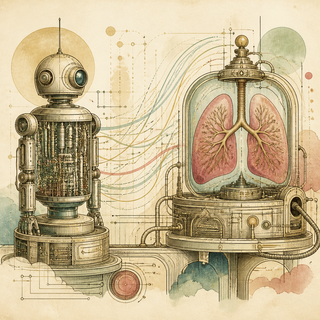
Karen O'Leary's short Nature Medicine news piece, "From donor lungs to digital twins" (PMID: 42215696, DOI: 10.1038/d41591-026-00029-z), points to a larger Nature Biotechnology study that built digital twins of human lungs during ex vivo lung perfusion, or EVLP. EVLP is exactly as strange and elegant as it sounds: donor lungs are kept functioning outside the body on a machine that warms, ventilates, and perfuses them, like a spa day designed by thoracic surgeons and people who own many labeled tubes.
A Lung, But Also a Question
A digital twin is not just a dashboard. It is a computational model tied to a physical thing, built to simulate how that thing behaves. In engineering, this is old magic: jet engines, buildings, and factories have had virtual counterparts for years. In medicine, the dream has been harder, because bodies are not engines. Bodies are wet, moody, nonlinear systems that respond to stress with the emotional consistency of a group chat at midnight.
That is why lungs on EVLP are such an interesting bridge. They are human organs, but they are also isolated enough to measure intensively. The main study by Zhou and colleagues used data from 951 ex vivo human lungs and modeled more than 75 parameters across physiology, biochemistry, X-ray imaging, transcriptomics, metabolomics, and proteomics (DOI: 10.1038/s41587-026-03121-4). In plainer terms: the model watched how lungs breathed, exchanged gases, changed chemically, looked in images, and shifted molecularly, then learned to forecast what came next.
The team used a hybrid approach, combining physics-based features, such as lung mechanics derived from ventilator waveforms, with machine learning models including gated recurrent units, XGBoost, and convolutional neural network-derived image features. If the attention mechanism in a transformer is the employee who reads the whole email chain, this system is the hospital intern who reads the ventilator, the lab report, the X-ray, and the molecular gossip before saying, "I have thoughts."
The Counterfactual Lung
The most philosophically spicy part is not that the model predicted lung behavior. It is that it acted as a counterfactual control.
In experiments, a control group asks: what would have happened without treatment? But donor lungs are scarce, variable, and not exactly available in Costco quantities. So when clinicians treat one lung, they often cannot perfectly compare it with an identical untreated lung, because nature rudely refuses to issue matched spare organs.
The digital twin tries to answer a subtler question: what would this same lung probably have done if we had not intervened?
In the Nature Biotechnology study, the authors tested this idea with alteplase, a clot-dissolving drug used when pulmonary embolism is suspected during EVLP. The twin simulated the untreated trajectory, while the real lung received therapy. Comparing the two suggested whether alteplase lowered pulmonary arterial pressure without adding unsafe edema. That is not just prediction. It is a rehearsal of an alternate reality, minus the ominous string music.
Why This Matters, If It Holds Up
Lung transplantation has a brutal arithmetic problem: many patients need organs, but many donor lungs get declined because clinicians cannot be sure they will function well after transplant. Earlier work from the same ecosystem showed that machine learning during EVLP could predict transplant outcomes and potentially promote organ use, including the InsighTx model in Nature Communications (DOI: 10.1038/s41467-023-40468-7). Another study used isolated lung radiographs to improve prognostic accuracy with computer vision (DOI: 10.1038/s41746-024-01260-z).
The digital twin work goes further by asking whether one organ can become its own comparison group. If reproducible, expanded, and clinically validated, this could make preclinical therapy testing more efficient, reduce dependence on tiny control cohorts, and help clinicians evaluate marginal lungs with less guesswork. Not no guesswork. Less. Medicine rarely gives you "certainty"; it usually gives you a flashlight and a fog machine.
The Caveats Are Not Small
This is still a model built from particular data under particular conditions. The lungs were ex vivo, not inside living patients with immune systems, infections, medications, blood flow, and all the other biological plot twists. The authors also note that these twins reflect disease-free donor lungs, so damaged or diseased lungs will need careful tailoring.
There is also the broader digital twin problem: definitions vary, clinical validation is hard, and the phrase itself risks becoming one of those terms people put on pitch decks when "model" sounds too modest. Recent reviews have mapped this confusion and promise, including scoping reviews in npj Digital Medicine and JMIR (DOI: 10.1038/s41746-024-01073-0, DOI: 10.2196/58504).
Still, the deeper question lingers. If a model can represent an organ closely enough to ask what might have happened otherwise, then medicine gains not a crystal ball, but a disciplined imagination. And perhaps that is what good AI in healthcare should be: not a replacement for judgment, not a shiny oracle in a lab coat, but a way to make better counterfactuals before real people carry the consequences.
References
-
O'Leary K. From donor lungs to digital twins. Nature Medicine. 2026. PMID: 42215696. DOI: 10.1038/d41591-026-00029-z
-
Zhou E, et al. Digital twins of ex vivo human lungs enable accurate and personalized evaluation of therapeutic efficacy. Nature Biotechnology. 2026. DOI: 10.1038/s41587-026-03121-4
-
Sage AT, et al. A machine-learning approach to human ex vivo lung perfusion predicts transplantation outcomes and promotes organ utilization. Nature Communications. 2023. DOI: 10.1038/s41467-023-40468-7
-
Chao BT, et al. Improving prognostic accuracy in lung transplantation using unique features of isolated human lung radiographs. npj Digital Medicine. 2024. DOI: 10.1038/s41746-024-01260-z
-
Drummond D, Gonsard A. Definitions and characteristics of patient digital twins being developed for clinical use: scoping review. Journal of Medical Internet Research. 2024. DOI: 10.2196/58504
Disclaimer: This blog post is a simplified summary of published research for educational purposes. The accompanying illustration is artistic and does not depict actual model architectures, data, or experimental results. Always refer to the original paper for technical details.