The annoying truth up front: this method still does not let scientists glance at a single cell and predict its future with magical, scary accuracy. The signal is noisy. The accuracy is moderate. Some cell types were easier than others. And yet - this paper still pulls off something pretty wild. It shows that if you track how cells change shape, shift position, and behave over time, you can recover real clues about what those cells are going to become later on.
That matters because biology usually treats cell fate like a transcriptomics problem. Read the genes, cluster the cells, draw a fancy UMAP, act calm. But cells are physical things in crowded tissues, not just little bags of RNA with a branding department. They move. They stretch. They pop up in different layers. They basically do body language, and this study asks: what if that body language is telling us something important? (Tolonen et al., 2026)
The Setup: Frog Skin, But Make It Predictive
The team studied the Xenopus mucociliary epithelium, a frog tissue often used as a model for airway-like epithelial development. This tissue contains a mix of cell types, including multiciliated cells that help move mucus around. In earlier work, researchers mapped how these cell types emerge using single-cell RNA sequencing and found that development looks more continuous and messy than a clean branching flowchart would suggest. Biology loves a gradient when we were hoping for a flowchart with arrows and self-esteem. (A single-cell, time-resolved profiling...; Formation and function of multiciliated cells)
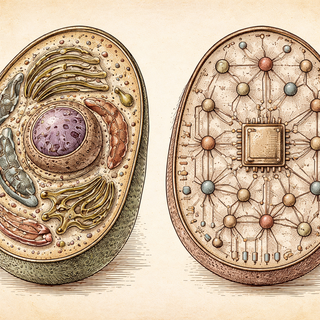
In the new paper, instead of starting from gene expression, the authors built a live-imaging pipeline to track thousands of individual cells over time in this tissue. From those movies, they extracted features like cell shape, nuclear shape, where the cell sat along the tissue’s Z axis, and the offset between the membrane and nucleus. Then they trained supervised machine learning models - mainly gradient-boosted trees and multinomial logistic regression - to predict each cell’s eventual fate from those time-resolved features.
That last bit is the key. A single frame was not enough. One feature at one moment mostly looked like mush. But when the models got the history, not just the snapshot, prediction improved. Which makes intuitive sense. One awkward freeze-frame of you on a dance floor tells me nothing. Ten seconds of footage? Different story.
The Surprise Wasn’t Movement
You might think cell movement would be the star here. Cells are differentiating, tissue is remodeling, things are happening. Nope. The heavy hitters were more boring in a useful way: normalized Z position, membrane-nucleus offset, and even absolute experimental time carried much of the predictive signal. Movement mattered far less than expected. (Tolonen et al., 2026)
That is interesting for two reasons. First, it suggests that fate-related information may be encoded less in dramatic cell motility and more in quieter structural context - where a cell sits, how its internal geometry shifts, how the tissue itself matures around it. Second, it is a reminder that machine learning in biology often wins by noticing the thing humans would call “kind of subtle” and then pretend they totally expected.
The paper also fits a broader trend. Recent reviews in live-cell imaging argue that computation is becoming inseparable from microscopy itself, not just a nice afterthought for the supplement nobody reads (Testa et al., 2024). And developmental biologists are increasingly framing cell fate and tissue shape as linked dynamical systems rather than separate stories awkwardly stapled together (Dynamical systems of fate and form in development).
Why You Should Care Even If You Don’t Study Frog Epithelia
If these kinds of morphodynamic signals generalize, they could make live imaging more than a descriptive tool. Instead of just filming development like a very expensive nature documentary, researchers could use morphology to forecast which cells are heading toward which identities before molecular markers fully lock in.
That has obvious implications for developmental biology, organoids, tissue engineering, and maybe disease models where cell-state transitions go sideways. Think airway repair, abnormal differentiation, or screening drugs that nudge tissues toward healthier outcomes. Not tomorrow. Not with this paper alone. But the direction is clear.
There is also a practical upside. Gene expression assays are powerful, but they are often destructive snapshots. Live imaging keeps the movie running. If morphology can serve as even a partial proxy for fate, that gives researchers a non-destructive way to watch decisions unfold in real time. Sort of like reading the room, except the room is embryonic tissue and the guests are all becoming specialized epithelial cells.
The Catch, Because There Is Always a Catch
This is not “shape alone solves cell fate.” The models were moderately accurate, not omniscient. Performance was better for abundant lineages than rare ones. Absolute time being predictive is useful, but it also hints that developmental stage itself carries a lot of the signal, which can blur the line between genuine cell-specific prediction and “well, yes, later things look later.”
Still, that honesty is part of why the study works. It does not oversell. It says, basically: morphology is noisy, but not empty. And in biology, that is often how progress starts. First the data look like chaos. Then someone trains a model on the chaos. Then everyone has to admit the cells were giving off vibes the whole time.
References
-
Tolonen M, Xu Z, Beker O, Kapoor V, Dumitrascu B, Sedzinski J. Single-cell morphodynamics predict cell fate decisions during mucociliary epithelial differentiation. Molecular Systems Biology. 2026. DOI: 10.1038/s44320-026-00212-x. PubMed: 42115437
-
A single-cell, time-resolved profiling of Xenopus mucociliary epithelium reveals nonhierarchical model of development. Science Advances. 2023. PMCID: PMC10081853
-
Testa I, et al. Live-cell imaging powered by computation. Nature Reviews Molecular Cell Biology. 2024. DOI/article: s41580-024-00702-6
-
Formation and function of multiciliated cells. Journal of Cell Biology. 2024. DOI: 10.1083/jcb.202307150
-
Dynamical systems of fate and form in development. Seminars in Cell & Developmental Biology. 2025. DOI: 10.1016/j.semcdb.2025.103620
-
Calcium transients regulate the apical emergence of basally located progenitors during Xenopus skin development. Nature Communications. 2025. DOI: 10.1038/s41467-025-61610-7
Disclaimer: This blog post is a simplified summary of published research for educational purposes. The accompanying illustration is artistic and does not depict actual model architectures, data, or experimental results. Always refer to the original paper for technical details.