If we cannot build safer brain-computer interfaces, people who still have sentences queued up in their minds may remain trapped behind silence unless they accept brain surgery as the cover charge. Ladies and gentlemen of the jury, that is the case before us: can AI recover typed language from brain activity without an implant, or are we still staring at science fiction wearing a lab coat?
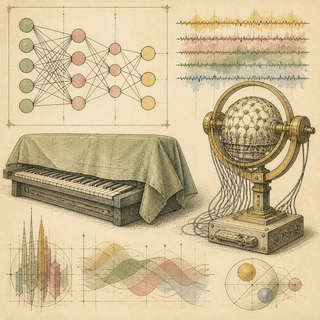
In Noninvasive decoding of typed sentences from human brain activity, Lévy and colleagues present Brain2Qwerty, a deep learning system trained on EEG and MEG recordings while 35 healthy Spanish-speaking volunteers typed briefly memorized sentences on a covered QWERTY keyboard. The covered keyboard matters. Nobody got to cheat by looking at the keys, which is good experimental hygiene and also a cruel reminder that typing is mostly muscle memory and optimism.
Exhibit A: The Brain Makes a Typing Trail
A brain-computer interface is basically a direct route from neural activity to an external device. The dream is simple: skip broken muscles, damaged speech systems, or locked-in paralysis, and let the brain talk to a machine directly.
The problem, Your Honor, is signal quality. Invasive systems have already shown powerful results. Willett et al. decoded attempted speech at 62 words per minute using intracortical microelectrode arrays, while Metzger et al. decoded text, speech audio, and avatar movement from high-density cortical recordings. Impressive? Absolutely. But both require hardware close to or inside the brain, and brains are famously not enthusiastic about home renovations.
Brain2Qwerty asks a narrower but important question: if a person is actually typing, can sensors outside the skull detect enough motor and language-related activity to reconstruct the sentence?
Exhibit B: MEG Brings the Better Witness
The evidence shows a stark split. With MEG, Brain2Qwerty reached an average character error rate of 29%. With EEG, it landed at 65%. For the best MEG participants, the error rate dropped to 18%, and some sentences outside the training set were decoded perfectly.
Character error rate is just edit distance for letters: substitutions, insertions, and deletions divided by the true sentence length. A 29% error rate would make your laptop keyboard legally unfit for brunch reservations. But from noninvasive brain signals? That is no small thing.
Why did MEG do better? EEG records electrical activity at the scalp, after the skull has muffled the signal like a neighbor hearing courtroom testimony through drywall. MEG records tiny magnetic fields from neural currents and tends to preserve cleaner timing and spatial information. The catch is that MEG machines are bulky, expensive, and often need magnetically shielded rooms. So yes, the witness is reliable, but it arrives in a truck.
Exhibit C: The Model Had an Accomplice
Brain2Qwerty uses three parts: a convolutional module that reads 500 millisecond slices around each keystroke, a transformer that adds sentence-level context, and a pretrained character-level language model that cleans up predictions.
I submit to you that the language model is doing what autocomplete always wanted to do: intervene before your sentence looks like it was typed during turbulence. The ablation studies support this. The convolutional network helped, the transformer helped more, and the language model improved the final character decoding again.
That last part deserves a raised eyebrow. The model is not simply reading pure intention from the ether. It benefits from motor signals, keyboard layout, sentence context, and natural language statistics. When participants made typing errors, decoding got worse. The paper’s own error analysis suggests Brain2Qwerty leans heavily on motor execution, not a magical transcript of inner thought.
The Defense Objects
And the defense has a point. This system is not real-time. It relies on known keystroke timings. It was tested in healthy, skilled typists, not in locked-in patients. It used Spanish sentences with constrained structure. It also needed MEG for its best results, and MEG is not exactly a wearable coffee-shop gadget.
Privacy panic should also take a breath. This is not a secret mind-reading death ray in a beanie. As with earlier fMRI language decoding work by Tang et al., cooperation, task design, and training data matter. Still, the legal department of the future should probably keep a folder labeled "brain data, please do not be weird about this."
The Verdict
The verdict is not "case closed." It is "probable cause for excitement."
Brain2Qwerty narrows the gap between invasive and noninvasive communication BCIs by showing that typed sentence production leaves decodable traces in noninvasive brain recordings. It also fits a broader pattern: Défossez et al. decoded perceived speech segments from MEG and EEG, d’Ascoli et al. scaled noninvasive word decoding across hundreds of participants, and recent invasive systems set a high clinical bar for speed and accuracy.
If future systems can work continuously, generalize to attempted movement, shrink MEG-like sensing into practical hardware, and reduce errors without leaning too hard on language-model guesswork, then noninvasive communication support starts looking less like a lab stunt and more like a courtroom exhibit worth admitting.
References
- Lévy, J., Zhang, M., Pinet, S. et al. Noninvasive decoding of typed sentences from human brain activity. Nature Neuroscience, 2026. DOI: 10.1038/s41593-026-02303-2. PMID: 42374156. arXiv: 2502.17480
- Défossez, A., Caucheteux, C., Rapin, J. et al. Decoding speech perception from non-invasive brain recordings. Nature Machine Intelligence, 2023. DOI: 10.1038/s42256-023-00714-5
- Tang, J., LeBel, A., Jain, S. et al. Semantic reconstruction of continuous language from non-invasive brain recordings. Nature Neuroscience, 2023. DOI: 10.1038/s41593-023-01304-9. PMCID: PMC11304553
- d’Ascoli, S., Bel, C., Rapin, J. et al. Towards decoding individual words from non-invasive brain recordings. Nature Communications, 2025. DOI: 10.1038/s41467-025-65499-0
- Willett, F. R., Kunz, E. M., Fan, C. et al. A high-performance speech neuroprosthesis. Nature, 2023. DOI: 10.1038/s41586-023-06377-x. PMCID: PMC10468393
- Metzger, S. L., Littlejohn, K. T., Silva, A. B. et al. A high-performance neuroprosthesis for speech decoding and avatar control. Nature, 2023. DOI: 10.1038/s41586-023-06443-4
Disclaimer: This blog post is a simplified summary of published research for educational purposes. The accompanying illustration is artistic and does not depict actual model architectures, data, or experimental results. Always refer to the original paper for technical details.