Plot twist: the same general AI vibe that helps your phone guess “sounds good!” when you are absolutely not emotionally committed to “sounds good!” is now being used to model kidney proteins in 3D.
OK, slightly less cursed version: this Nature Reviews Nephrology paper by Wu and colleagues is about AI-based protein structure prediction in nephrology, especially tools like AlphaFold and RoseTTAFold. If I am reading this right - and I have mentally paced around the room with a tiny clipboard about it - the big idea is that kidney disease is often a molecular architecture problem. Proteins fold into shapes. Shapes determine what they can bind, block, signal, transport, or accidentally ruin. When those shapes change because of mutations, disease can follow.
That sounds obvious until you remember proteins are basically microscopic origami made from amino acids, floating in cellular soup, sometimes embedded in membranes, sometimes partnering with other proteins, and sometimes behaving like furniture from IKEA that has achieved sentience and refuses to align.
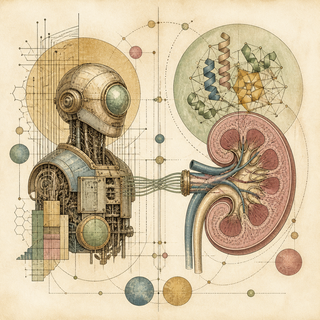
The Kidney Is Not Just a Filter, Rude
The paper focuses on kidney proteins because kidneys are absurdly busy organs. They filter blood, balance salt and water, regulate acid-base chemistry, help manage blood pressure, and quietly do logistics at a level that would make a shipping company cry into a spreadsheet.
A lot of that work depends on protein complexes: channels, transporters, receptors, scaffolds, and structural assemblies. The authors highlight examples like podocyte slit diaphragm complexes, membrane transporters, and polycystin channels involved in kidney diseases. These are not just “some proteins.” They are tiny mechanical systems. When they bend, dock, open, close, or fail to meet their molecular friends, the downstream effects can show up as protein leaking into urine, cyst formation, electrolyte problems, or inherited kidney disorders.
Before modern AI structure prediction, researchers often needed X-ray crystallography, NMR, or cryo-electron microscopy to see protein structures. Those methods are powerful, but slow and difficult, especially for floppy proteins, membrane proteins, and big protein assemblies that behave like they know they are being watched.
AlphaFold Walks Into Nephrology
AlphaFold changed the mood in structural biology by predicting protein shapes from amino acid sequences with startling accuracy for many proteins [1]. RoseTTAFold offered another major route into the same territory [2]. More recently, AlphaFold 3 and RoseTTAFold All-Atom pushed toward modeling broader biomolecular interactions, including complexes with ligands, nucleic acids, ions, and modifications [3,4].
For kidney research, that means scientists can ask: what might this renal protein look like? Where might a mutation distort it? Could this transporter have multiple conformations? Does this toxin or drug plausibly fit into a binding pocket, or is it just loitering nearby with suspicious intent?
The review’s main argument, I think, is not “AI solved kidney biology, everyone go home.” Thank goodness, because then this would be both wrong and socially awkward. The argument is more useful: AI models can generate strong structural hypotheses fast, then experimental methods can test and refine them in real biological context.
That pairing matters. AlphaFold can give you a beautiful predicted structure, but cells are not PowerPoint slides. Proteins wiggle. Membranes matter. Binding partners matter. Post-translational modifications matter. Local chemistry matters. The kidney, because it enjoys complexity like a hobby, adds tissue-specific environments and disease states on top.
The Static Selfie Problem
Here is the catch, and it is a big one: many AI protein models are better at predicting likely structures than at capturing full biological motion. A protein prediction can be like a dating profile photo: informative, possibly flattering, and not the whole personality.
The authors emphasize that kidney proteins often need dynamic modeling. Transporters shift between inward-facing and outward-facing states. Channels open and close. Protein complexes assemble and rearrange. Disease mutations might not destroy the whole structure; they might subtly change flexibility, binding, trafficking, or timing. That is much harder than predicting one elegant 3D pose and calling it a day.
This is where cellular cryogenic electron tomography and related experimental methods come in. They can help place AI-predicted models into native cellular environments, giving researchers a better shot at seeing how these proteins behave where they actually live. Correct me if I am wrong, but the paper’s emotional thesis is basically: “Please do not confuse a confident model with a complete mechanism.” Honestly, fair. I should put that on a mug.
Why This Could Matter
If these approaches hold up, the payoff is very practical. AI-guided kidney protein modeling could help researchers interpret genetic variants, identify disease mechanisms, screen drugs or toxins, and design more targeted experiments. For rare kidney diseases, where a mutation may be known but its effect is mysterious, structure predictions can provide a first map. Not the treasure, maybe, but at least a “dig somewhere in this county” situation.
It could also make nephrology more molecularly precise. Instead of treating some kidney disorders as broad clinical categories, researchers may be able to connect particular mutations to particular structural changes and then to particular therapeutic strategies. That is the dream, anyway. The responsible version of the dream. The one wearing safety goggles.
Still, the review is careful about limits. AI predictions need validation. Confidence scores are not magic truth stickers. Models can struggle with disorder, alternative conformations, binding specificity, and cellular context. The future is probably hybrid: AI prediction plus molecular dynamics, cryo-EM, cryo-ET, omics data, functional assays, and clinicians asking the deeply annoying but necessary question: “Does this actually explain the patient?”
The Bottom Line, After I Re-Read It Again
This paper is a map of where AI protein modeling is already helping kidney research and where it still needs adult supervision. AlphaFold and RoseTTAFold give nephrology a faster way to reason about protein structure, mutations, channels, transporters, and drug interactions. But the kidney is not a clean little simulation box. It is wet, crowded, dynamic biology with consequences.
So, if I am reading this right, the breakthrough is not that AI now “understands” kidneys. It is that researchers have a new microscope-like reasoning tool - one that can sketch molecular possibilities quickly enough to change which experiments get done next.
And for a field where the machinery is microscopic, flexible, and often hidden inside membranes, that is a pretty useful trick for autocomplete’s weird cousin.
References
-
Wu S, Wang W, Zhou ZH, Scalzo F, Kurtz I. “Bridging structure and function: artificial intelligence-based modelling of kidney proteins.” Nature Reviews Nephrology 2026. DOI: 10.1038/s41581-026-01060-6. PubMed: PMID 41781721.
-
Jumper J et al. “Highly accurate protein structure prediction with AlphaFold.” Nature 2021;596:583-589. DOI: 10.1038/s41586-021-03819-2.
-
Baek M et al. “Accurate prediction of protein structures and interactions using a three-track neural network.” Science 2021;373:871-876. DOI: 10.1126/science.abj8754.
-
Abramson J et al. “Accurate structure prediction of biomolecular interactions with AlphaFold 3.” Nature 2024;630:493-500. DOI: 10.1038/s41586-024-07487-w.
-
Krishna R et al. “Generalized biomolecular modeling and design with RoseTTAFold All-Atom.” Science 2024;384:eadl2528. DOI: 10.1126/science.adl2528.
-
Thornton JM, Laskowski RA, Borkakoti N. “AlphaFold heralds a data-driven revolution in biology and medicine.” Nature Medicine 2021;27:1666-1669. DOI: 10.1038/s41591-021-01533-0.
Disclaimer: This blog post is a simplified summary of published research for educational purposes. The accompanying illustration is artistic and does not depict actual model architectures, data, or experimental results. Always refer to the original paper for technical details.