Meanwhile, in Rochester, Minnesota, a kidney pathologist is doing something medicine desperately loves to postpone: taking a messy, overstuffed category and giving it labels that normal humans can actually use. In “Tubulointerstitial Diseases: An Updated Framework for Diverse and Emerging Entities,” Lynn D. Cornell argues that tubulointerstitial kidney diseases have spent way too long living in the diagnostic equivalent of a junk drawer - lots of important stuff in there, but good luck finding the batteries when you need them most (Cornell, 2026).
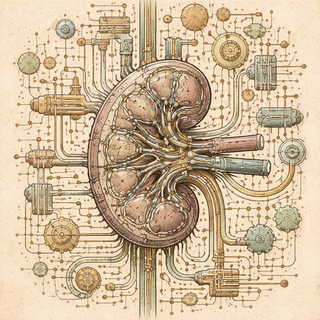
If you have not heard of tubulointerstitial disease, that is not a personal failing. The kidney has two celebrity zones. The glomeruli get all the attention because they are the fancy filters. The tubules and interstitium are more like the plumbing, insulation, and backstage wiring. Not glamorous. Extremely important. When these parts get inflamed or injured, kidney function can slide fast, and the cause is not always obvious.
The problem with “looks like nephritis”
Cornell’s big point is that tubulointerstitial nephritis, or TIN, has often been classified too vaguely. Two biopsies can look similar under the microscope while coming from very different underlying problems. That is a bit like seeing smoke in a kitchen and treating every situation as “probably toast,” when one case is burnt bread, another is a grease fire, and another is your roommate attempting flambé after watching one cooking show.
This review proposes eight etiologic buckets: drug effect, autoimmune or immune-mediated disease, infection-associated disease, hereditary or genetic disease, toxic or metabolic injury, monoclonal protein-associated disease, mimics of TIN, and idiopathic or other causes (Cornell, 2026). The categories overlap, which is annoying but honest. Biology rarely respects our filing systems.
Why does this matter? Because “inflamed kidney tissue” is not a treatment plan. If the trigger is a drug, you stop the culprit. If it is IgG4-related disease, you may be dealing with a systemic immune condition that can hit multiple organs. If it is a newly recognized inflammatory syndrome, the whole workup changes. Same hallway, different burglars.
New suspects keep showing up
One reason this field feels newly lively is that doctors keep finding distinct disease entities hiding inside what used to look like one blurry crowd.
A good example is immune checkpoint inhibitor-associated nephritis. These cancer drugs help the immune system attack tumors, which is great until the immune system decides the kidneys are also suspicious. Recent reviews show that acute tubulointerstitial nephritis is the most common biopsy pattern in this setting, and sorting it out matters because it affects both cancer treatment and kidney rescue strategy (Barbir et al., 2024; Belliere et al., 2023).
Another standout is IgG4-related kidney disease, especially IgG4-related TIN. This is one of those diagnoses that sounds like it was named by a committee trapped in an elevator, but the biology is real. It is a fibro-inflammatory disease that can mimic other conditions and is probably underrecognized. Recent reviews and clinicopathologic series have sharpened the picture of how it shows up in biopsies, labs, and imaging (Towheed et al., 2024; Buglioni et al., 2024).
Cornell also highlights IgM plasma cell TIN and VEXAS syndrome, which sounds less like a renal diagnosis and more like a supervillain acronym. Unfortunately, it is a real adult-onset autoinflammatory syndrome with multi-organ effects, and kidney involvement is part of the expanding picture (Padureanu et al., 2024).
Why this is worth your attention
The practical value here is simple: better labels lead to better decisions. Tubulointerstitial disease has historically lacked the tidy disease naming that glomerular pathology enjoys. Cornell is basically saying the kidney deserves better than “well, something bad happened in the walls and pipes.”
That matters for patients because biopsy interpretation, serology, medication history, imaging, and clinical context all need to line up. Personalized medicine is not just a Silicon Valley phrase wearing a stethoscope. In nephrology, it can mean the difference between stopping a drug, starting immunosuppression, hunting for a hidden systemic disease, or avoiding treatment that makes things worse.
The paper is also refreshingly clear about what comes next: biopsy-based technologies, digital pathology, and AI may improve classification and even help discover disease subtypes we are currently lumping together like unmatched socks. A 2024 systematic review of AI in nephropathology found rapid growth in tools for kidney biopsy image analysis, although these systems are still mostly research-stage rather than routine clinical practice (Cazzaniga et al., 2024).
So no, this review does not offer a magic fix. It offers something medicine often needs more: a better map. And when you are navigating kidney disease, a better map beats confident hand-waving every time.
References
- Cornell LD. Tubulointerstitial Diseases: An Updated Framework for Diverse and Emerging Entities. Kidney International. 2026. DOI: 10.1016/j.kint.2026.02.042
- Barbir EB, Kitchlu A, Herrmann SM. Immune checkpoint inhibitor-associated nephritis-treatment standard. Nephrology Dialysis Transplantation. 2024;39(11):1785-1798. DOI: 10.1093/ndt/gfae184
- Belliere J, et al. Biopsy-proven acute tubulointerstitial nephritis in patients treated with immune checkpoint inhibitors: a pooled analysis of case reports. Frontiers in Oncology. 2023;13:1221135. DOI: 10.3389/fonc.2023.1221135
- Towheed ST, Clements-Baker M, et al. Renal Manifestations of IgG4-Related Disease: A Concise Review. International Journal of Nephrology. 2024;2024:4421589. DOI: 10.1155/2024/4421589, PMCID: PMC11217581
- Buglioni A, Jenkins SM, Nasr SH, et al. Clinicopathologic Features of IgG4-Related Kidney Disease. Kidney International Reports. 2024. DOI: 10.1016/j.ekir.2024.05.011
- Padureanu V, Marinaș CM, Bobirca A, et al. Clinical Manifestations in Vacuoles, E1 Enzyme, X-Linked, Autoinflammatory, Somatic (VEXAS) Syndrome: A Narrative Review. Cureus. 2024;16(1):e53041. DOI: 10.7759/cureus.53041
- Cazzaniga G, Rossi M, Eccher A, et al. Time for a full digital approach in nephropathology: a systematic review of current artificial intelligence applications and future directions. Journal of Nephrology. 2024;37:65-76. DOI: 10.1007/s40620-023-01775-w
Disclaimer: This blog post is a simplified summary of published research for educational purposes. The accompanying illustration is artistic and does not depict actual model architectures, data, or experimental results. Always refer to the original paper for technical details.