The forecast in Tokyo calls for clearing skies, light winds, and a 100% chance that a two-armed robot is quietly feeding stem cells while the humans are off doing something suspiciously luxurious, like sleeping.
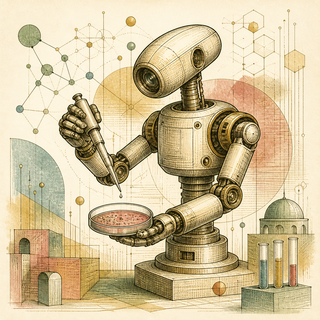
Rachel Fieldhouse’s Nature news piece, “Robots run this laboratory in Japan - and are changing how scientists work,” reports on the Robotics Innovation Center at the Institute of Science Tokyo, where ten lab robots are doing real biology work: handling liquids, growing cells, operating instruments, and babysitting cell cultures like tiny, high-maintenance houseplants with grant funding attached (Nature, DOI: 10.1038/d41586-026-01625-2).
Think of it like a science kitchen. Humans still choose the recipe, inspect the food, and notice when the oven makes a sad noise. But the robots can measure, stir, plate, photograph, and repeat. Again. And again. Without sighing dramatically into a lab notebook.
Tiny Lab Coats, Big Loop
The magic phrase here is self-driving laboratory. It does not mean the lab has wheels and is merging poorly onto the highway. It means the system can close a loop:
- Pick an experiment.
- Run it with robots.
- Measure the result.
- Let machine learning suggest what to try next.
Think of it like a very patient child learning which cookie recipe works best. More flour? Too dry. More butter? Delicious but structurally chaotic. The child learns. The robot learns too, except instead of cookies, it may optimize stem-cell culture conditions.
In the Tokyo lab, Kanda and colleagues previously used AI-guided automation to test 144 experimental conditions over 111 days to improve human stem-cell culture. In another experiment, software watched cell images, predicted how the cells would grow, and helped choose when to harvest them. That is not “robot scientist becomes Einstein overnight.” It is more like “robot lab assistant becomes eerily good at remembering every tiny detail.” Honestly, many labs would pay just for that.
Why This Is More Than Fancy Plumbing
Lab work is full of repetitive steps. Pipette this. Incubate that. Move plate from here to there. Check cells. Repeat until your wrist files a complaint with management.
Robots are good at boring repetition. Humans are good at asking better questions, spotting weird patterns, and saying, “Wait, that result looks wrong in an interesting way.” The promise is not that machines replace scientists. It is that machines take over the parts of science that feel like doing dishes in a thunderstorm.
That matters because biology is messy. Cells behave like tiny divas. Conditions change. Timing matters. A robot that can run careful experiments around the clock could make results more reproducible, especially when paired with active learning or Bayesian optimization - methods that help software decide which experiment is worth trying next rather than testing every possible option like a toddler pressing every elevator button.
Recent work shows this idea spreading. A 2024 Nature Chemical Engineering study used a self-driving lab to navigate protein engineering experiments (DOI: 10.1038/s44286-023-00002-4). A 2025 Science Robotics perspective laid out challenges for AI and robotics in natural-science labs (DOI: 10.1126/scirobotics.adv7932). Reviews in Chemical Reviews and Digital Discovery describe how self-driving labs are moving through chemistry, materials, and Japan’s research ecosystem (DOI: 10.1021/acs.chemrev.4c00055, DOI: 10.1039/D4DD00387J).
The Robots Still Need Snack Refills
Now, deep breath. This is not a fully independent science factory yet.
Humans still prepare reagents, refill supplies, clean up, troubleshoot errors, and handle the classic lab problem of “the machine did exactly what I told it to do, which was unfortunately not what I meant.” Physical AI is hard because the real world has sticky lids, cloudy liquids, weird bubbles, bent tips, and instruments that behave like they were assembled during a group project.
Think of a language model writing a protocol. Fine. Now think of a robot physically opening a tube without dropping it, identifying the liquid level, choosing the right pipette angle, avoiding contamination, and recovering gracefully when something goes wrong. That is the difference between “write a recipe” and “cook dinner in a stranger’s kitchen while blindfolded and judged by peer review.”
Also, cost is a thunderhead. Nature reports that Kanda’s team spent about $1 million per robot, while even simpler single-arm systems can run tens of thousands of dollars before accessories. Shared robot facilities may help, like cloud computing did for AI, but “just buy a robot lab” is not exactly a casual line item next to printer toner.
What Changes for Scientists?
The most interesting change may be cultural. If robots handle more routine work, scientists might spend more time designing experiments, interpreting results, and building better hypotheses. Graduate students might spend fewer nights making sure cells are happy, which sounds nice unless your personality has become 40% incubator anxiety.
But training still matters. If nobody understands the wet lab basics, nobody can tell when the robot is confidently doing nonsense. Automation without judgment is just a very expensive way to make mistakes faster. Think of it like giving a calculator to a kid: wonderful tool, but someone still needs to know when “banana plus seven” is not a valid equation.
The hopeful version is simple. Robots do the steady, careful, repeatable work. Humans do the wondering, doubting, connecting, and occasional coffee-powered insight. The lab of the future may not be empty. It may just be quieter, cleaner, and less dependent on a tired person remembering whether they already changed the media.
Pretty neat, right?
References
- Rachel Fieldhouse, “Robots run this laboratory in Japan - and are changing how scientists work,” Nature, 2026. DOI: 10.1038/d41586-026-01625-2
- Self-driving laboratories to autonomously navigate the protein fitness landscape, Nature Chemical Engineering, 2024. DOI: 10.1038/s44286-023-00002-4
- Accelerating discovery in natural science laboratories with AI and robotics: perspectives and challenges, Science Robotics, 2025. DOI: 10.1126/scirobotics.adv7932
- Self-driving laboratories for chemistry and materials science, Chemical Reviews, 2024. DOI: 10.1021/acs.chemrev.4c00055
- Self-driving laboratories in Japan, Digital Discovery, 2025. DOI: 10.1039/D4DD00387J
Disclaimer: This blog post is a simplified summary of published research for educational purposes. The accompanying illustration is artistic and does not depict actual model architectures, data, or experimental results. Always refer to the original paper for technical details.