One does, from time to time, decide to train a diffusion model to generate amorphous materials - which is a pleasantly understated way of saying the authors aimed machine learning at one of chemistry's messiest cupboards and asked it to return with useful new stuff.
Meet the wild glasslands
Here we observe the amorphous material in its natural habitat: disordered, unruly, and refusing to line up like a respectable crystal. Crystalline materials are the neat freaks of the materials world - atoms arranged in tidy repeating patterns, every neighbor exactly where the seating chart said they'd be. Amorphous materials, like glass, are more like a party after midnight. The guests are still in the room, but nobody is standing on a grid.
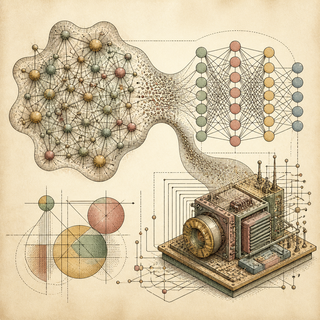
That chaos is not a bug. It is the whole appeal. Amorphous materials matter for energy storage, catalysis, and nonlinear optics because their local atomic arrangements can produce useful properties that ordered materials do not. The catch is obvious: if the structure is messy, the design space is enormous. You are not searching for one neat Lego build. You are rummaging through a cosmic bin of semi-melted Lego and hoping one shape stores ions better than the others.
That is the setup for Finkler et al. and their paper on AMDEN, short for Amorphous Material DEnoising Network DOI: 10.1002/adma.202522493, PubMed: 42261630.
What the researchers actually built
The basic goal is inverse design: instead of asking, "What properties does this material have?", you ask, "Can you give me a material with these properties?" It is the difference between browsing a hardware store and walking in with a very specific grudge against thermal instability.
AMDEN uses a diffusion model, the same broad family of models that became famous for image generation. In pictures, diffusion models learn to turn noise into cats, castles, or a suspicious number of cinematic astronauts. Here, the model learns to turn noise into candidate atomic structures for amorphous materials.
The tricky part is that amorphous materials are not just random atom soups. Useful structures tend to be low-energy, relaxed configurations. And the authors found that standard denoising alone struggles with this. Which makes sense, in a slightly annoying way. In the wild, low-energy structures emerge through thermal motion and energy minimization - a wandering, physically constrained search. A plain denoising network does not naturally reproduce that process any more than a cookbook reproduces the experience of burning onions in real time.
So the team added an energy-based variant of AMDEN that uses Hamiltonian Monte Carlo refinement. That extra step helps push generated structures toward physically plausible, relaxed states. In documentary terms: the young candidate structure leaves the nest noisy and confused, then undergoes a stern physical selection process until it stops flailing and settles into something nature might actually tolerate.
Why this is harder than crystal design
Crystals have structure with a capital S. Their repeating patterns make them easier to represent, simulate, and benchmark. Amorphous materials are a different beast. They lack long-range order, and their properties depend not only on composition but also on thermal and pressure history. In other words, the atoms remember how they got there. Materials science, as usual, declines to keep things simple.
The authors also point out a practical headache: datasets are limited, and amorphous systems often require larger simulation cells than crystalline ones. For machine learning, that is like trying to train a very hungry animal on a diet of three crackers and a complicated anecdote.
To help with that, the paper introduces several new amorphous material datasets covering different compositions and properties. That may end up being one of the most useful parts of the work, because fields move faster when people can argue over the same benchmark instead of lovingly reinventing incompatible pipelines in separate corners of the internet.
Why you should care, even if you are not currently designing glass
If this line of work holds up, it could speed up the search for materials used in batteries, optics, and catalysts. Instead of brute-forcing candidate structures through endless simulation and experiment, researchers could generate promising options more directly, then test the best ones. That does not eliminate lab work - chemistry still insists on existing in the physical world - but it could narrow the search dramatically.
This is also part of a broader trend: generative AI leaving the land of chatbots and image memes to do actual scientific scouting. Similar ideas have appeared in molecules, proteins, and crystals, with diffusion models becoming oddly good at proposing structured objects under constraints. A recent review on generative AI for molecules and materials captures that wider movement well Merchant et al., 2023, arXiv:2306.08014. For diffusion methods in materials specifically, see also recent benchmark and review discussions in generative materials design Pyzer-Knapp et al., 2024, arXiv:2402.02828.
And yes, if your mind wandered to image enhancement while reading "diffusion model," that is not entirely random. The same broad modeling family shows up in practical tools too. In a much less atom-intensive corner of life, tools like combb2.io use related ideas to sharpen and upscale images in the browser. Different domain, fewer silica networks, same general dream of turning messy inputs into something cleaner.
The part where we do not pretend the problem is solved
The paper is careful about the limits, and that is refreshing. Generating amorphous structures that are both diverse and physically realistic remains hard. Low-energy relaxation is not a cosmetic detail - it is central to whether the generated structure means anything. Dataset scarcity is still a bottleneck. And even strong generative models need downstream validation through simulation or experiment.
So no, this does not mean an AI now dreams up miracle glass on command like a wizard with a GPU budget. But it does show a credible route toward inverse design for one of the more stubborn classes of materials. That alone is worth paying attention to.
Out on the computational savannah, the diffusion model sniffs the air, proposes a structure, gets corrected by physics, and tries again. Evolution, but with tensors.
References
-
Finkler JA, Lin Y, Du T, Hu J, Smedskjaer MS. Inverse Design of Amorphous Materials With Targeted Properties. Advanced Materials. 2025. DOI: 10.1002/adma.202522493. PubMed: 42261630
-
Merchant A, Batzner S, Schoenholz SS, Aykol M, Cheon G, Cubuk ED. Scaling deep learning for materials discovery. Nature. 2023;624:80-85. DOI: 10.1038/s41586-023-06735-9
-
Xie T, Fu X, Ganea O-E, Barzilay R, Jaakkola T. Crystal Diffusion Variational Autoencoder for Periodic Material Generation. arXiv: 2110.06197
-
Gebauer NWA, Gasteiger J, Hessmann SSP, et al. Inverse design of 3d molecular geometry with diffusion generative models. International Conference on Machine Learning (ICML). 2022. arXiv: 2203.17003
-
Pyzer-Knapp EO, et al. Generative AI for materials design: progress, challenges, and benchmarks. arXiv: 2402.02828
Disclaimer: This blog post is a simplified summary of published research for educational purposes. The accompanying illustration is artistic and does not depict actual model architectures, data, or experimental results. Always refer to the original paper for technical details.