Two years ago, researchers tried making medical AI reason like a careful clinician. It didn't work. This paper explains why and fixes it.
Well, "fixes it" in the responsible scientific sense, meaning: "Here is a map, not a magic wand, please do not hand it the hospital pager yet."
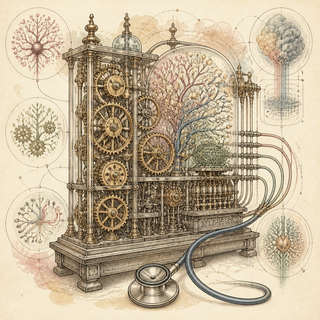
The paper, "Large reasoning models as thinking machines for medicine" by Hong-Yu Zhou, Adam Rodman, Peng Liu, Pranav Rajpurkar, Tony Y. Hu, Tien Yin Wong, and Eric J. Topol, is less a lab report than a field guide for where medical AI may be headed next. The authors argue that medicine needs to move beyond AI that spots patterns and toward AI that can help reason through messy clinical reality: symptoms, lab results, imaging, prior notes, patient preferences, uncertainty, and that one medication list that looks like it was assembled during a thunderstorm.
The Old AI Was Good at Spotting Stripes
Traditional medical AI has done useful work. It can detect tumors on scans, predict risk, flag abnormal lab patterns, and sift through records faster than a human who has not slept since Tuesday.
But much of that AI is correlation machinery. It learns that certain inputs tend to match certain outputs. That works nicely when the task is narrow: "Does this image contain diabetic retinopathy?" or "Is this ECG suspicious?"
Clinical medicine, though, is not just pattern matching. It is closer to detective work in a building where the lights flicker, half the witnesses are coughing, and the clues arrive out of order. A doctor often asks: What else could this be? Which test would actually change the plan? What diagnosis is dangerous to miss? What story explains all the weird bits without pretending the weird bits are not there?
That is the gap this paper calls out. The authors describe medical reasoning artificial intelligence, or MRAI, as systems that do more than produce an answer. They would gather evidence, use tools, explain uncertainty, learn from clinician feedback, and update as patient outcomes arrive. Less "autocomplete with a stethoscope," more "clinical thinking partner with a very large notebook."
Enter the Models That Show Their Work
Large reasoning models grew out of a broader shift in AI. Chain-of-thought prompting showed that big language models often perform better when nudged to break problems into intermediate steps rather than blurting out the first confident answer like a game-show contestant who has had too much espresso (arXiv:2201.11903). Later reasoning-focused models, including DeepSeek-R1, used reinforcement learning to encourage behaviors like verification, self-reflection, and trying alternate strategies (DOI:10.1038/s41586-025-09422-z).
In medicine, that matters because the answer is often less useful than the path. A model that guesses "pulmonary embolism" might be right, but if it ignored the oxygen saturation, skipped medication history, and invented a guideline from vibes, we have a problem. Hallucinations in a chatbot are annoying. Hallucinations near a patient chart are the sort of thing that makes hospital lawyers stand up very slowly.
Recent benchmarks back up this caution. The PrIME-LLM study in JAMA Network Open found that reasoning-optimized models did better than many nonreasoning models, but still struggled badly with differential diagnosis, the early messy stage where clinicians decide what possibilities belong on the board (JAMA Network Open). MedThink-Bench, published in npj Digital Medicine, pushed evaluation beyond final answers by comparing model rationales with expert-written reasoning, because a correct answer reached by bad logic is still wearing a fake mustache (DOI:10.1038/s41746-025-02208-7).
The Dream: A Clinical Co-Pilot With Humility
The best version of MRAI is not "robot doctor replaces everyone." That is lazy sci-fi and bad staffing policy.
The interesting version is quieter. Imagine an AI that reads a decade of records before the visit, notices a possible drug interaction, summarizes the strongest evidence, drafts several diagnostic possibilities, and says, "I am uncertain here, and this missing lab would help." It could help clinicians manage evidence overload, especially in complex patients with multiple conditions. It could also support rural or under-resourced clinics where specialist access is thin.
For medical education, it could act like a patient tutor that never gets tired of asking, "Why did you choose that diagnosis?" For research, it could connect clinical patterns across papers, datasets, and patient outcomes. Tools like mapb2.io are already useful for visually organizing reasoning chains, and medicine may need that same kind of structured thinking at industrial scale.
The Catch, Because Medicine Always Has One
The paper is optimistic, but not careless. MRAI faces serious problems.
First, reasoning text is not always true reasoning. A model can produce a beautiful explanation after the fact, the way a teenager explains why the lamp broke only after you point at the soccer ball. Second, medical data are fragmented, biased, incomplete, and often trapped inside electronic health record systems designed by people who apparently consider "three clicks" a spiritual minimum.
Third, feedback loops are dangerous. If models learn from clinician behavior, they may also learn clinician biases. If they learn from outcomes, they need careful causal thinking, because patients do not arrive as randomized controlled trials with shoes.
And finally, accountability matters. When an AI suggests a plan, who is responsible? The clinician? The hospital? The vendor? The model's overworked GPUs, who were just trying to multiply matrices in peace?
The Twist
The real twist is that "thinking machines" in medicine may not need to think like humans at all. They need to be useful in the places human thinking strains: too much evidence, too little time, too many interacting risks, too many tabs open in the clinical brain.
Zhou and colleagues are asking for a new kind of medical AI: one that reasons with clinicians, not around them. If future systems can prove their reliability in real settings, explain their uncertainty, and survive contact with actual patient care, they could become one of the better tools medicine has built.
Not a doctor in a box. More like a second brain that knows when to raise its hand and when to shut up.
References
-
Zhou H-Y, Rodman A, Liu P, Rajpurkar P, Hu TY, Wong TY, Topol EJ. Large reasoning models as thinking machines for medicine. Nature Biomedical Engineering. 2026. DOI:10.1038/s41551-026-01701-y. PubMed:42337060
-
Wei J, Wang X, Schuurmans D, et al. Chain-of-Thought Prompting Elicits Reasoning in Large Language Models. NeurIPS 2022. arXiv:2201.11903
-
Guo D, Yang D, Zhang H, et al. DeepSeek-R1 incentivizes reasoning in LLMs through reinforcement learning. Nature. 2025;645:633-638. DOI:10.1038/s41586-025-09422-z
-
Zhou S, Xie W, Li J, et al. Automating expert-level medical reasoning evaluation of large language models. npj Digital Medicine. 2026. DOI:10.1038/s41746-025-02208-7
-
Ren X, Fan C, Ma W, et al. Medical Reasoning with Large Language Models: A Survey and MR-Bench. 2026. arXiv:2604.08559
Disclaimer: This blog post is a simplified summary of published research for educational purposes. The accompanying illustration is artistic and does not depict actual model architectures, data, or experimental results. Always refer to the original paper for technical details.