Hot take: the most promising liver-cancer screening machine may not be a glittering new blood test, but the humble clinical record, that dusty cabinet of blood counts, diagnoses, and lifestyle notes physicians already possess and occasionally persuade computers to read.
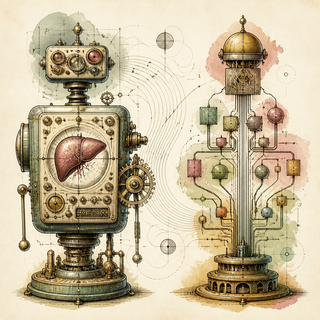
Dr. Zachariah H. Foda's commentary, The Promise of Machine Learning-Based Population Screening for Hepatocellular Carcinoma, surveys a rather curious specimen: PRE-Screen-HCC, a machine-learning framework from Clusmann and colleagues built to spot people at elevated risk for hepatocellular carcinoma, or HCC, before they wander into danger unannounced.
HCC is the most common primary liver cancer, and globally it remains one of the great villains of oncology: often quiet, often late, and entirely too pleased with itself. Current surveillance mostly watches people already known to be high risk, especially those with cirrhosis or chronic hepatitis B. The usual method is ultrasound, with or without alpha-fetoprotein testing, every six months, as recommended in modern liver-cancer guidance Singal et al., 2023.
The trouble, dear reader, is that the beast frequently enters by the side door.
The Missing-Persons Problem
Foda's central point is simple enough to put on a tavern napkin: screening only helps the people invited to screening.
That sounds obvious, but medicine has a talent for making obvious things administratively elaborate. Many patients who develop HCC were not previously identified as having cirrhosis or another qualifying risk condition. Meanwhile, metabolic dysfunction-associated steatotic liver disease, the modern liver's response to abundance, inactivity, and our collective devotion to snacks, is producing more HCC in people who may not have cirrhosis at all. Foda notes that nearly 40% of MASLD-related HCC can occur without cirrhosis, which is medically alarming and socially rude.
So the grand question becomes: can we find risk before the label "high risk" has already been stamped on the patient?
Behold, a Forest That Does Arithmetic
PRE-Screen-HCC approaches the matter like a Victorian naturalist given a lantern and a spreadsheet. The model used data from more than 900,000 people and 983 HCC cases across two population-scale cohorts: UK Biobank for development and the All of Us Research Program for external testing Clusmann et al., 2026.
Its machinery is a random forest, which is not, regrettably, a grove where laptops grow on trees. It is a crowd of decision trees that each vote on risk. One tree may weigh platelet counts, another age, another prior diagnoses, and together they behave like a committee where at least someone read the paperwork.
The authors tested layers of information: demographics, lifestyle, electronic health records, routine blood tests, genomics, and metabolomics. The delightful twist is that the practical version, using routine clinical data, performed strongly enough that fancy molecular data added only modest benefit. The expensive monocle was nice, but the spectacles already worked.
Why This Is Not Merely Clever
If reproduced in other health systems, PRE-Screen-HCC could become a prescreening tool in primary care. Not a diagnosis. Not a tiny oracle in a lab coat. More like a triage instrument that says, "This person may deserve closer liver-cancer surveillance."
That could matter because ultrasound surveillance can improve early-stage detection and access to curative treatment, but only when patients are actually routed into it. The model also reportedly outperformed existing public risk scores and showed robustness across ethnic subgroups, which is heartening, though one must never let a single validation cohort strut about like it owns the museum.
There is a broader lesson here for clinical AI. Sometimes the best machine-learning trick is not discovering a mysterious new biomarker. Sometimes it is combining ordinary measurements at a scale no human clinic could reasonably juggle without coffee, despair, and a second monitor.
For researchers sketching the model's moving parts, a visual map helps: tools like mapb2.io are handy for laying out how demographics, labs, diagnoses, and screening decisions feed into one another without turning the whole thing into a diagram that looks like a railway accident.
The Cautionary Plaque Beneath the Specimen
Now we must place a brass plaque beside the exhibit: promising does not mean ready for universal deployment.
Clinical models can fail when moved between hospitals, countries, coding systems, and populations. UK Biobank participants are not the world in miniature, no matter how much statisticians might wish them to stand still and behave. Calibration matters: if a model says "high risk," clinicians need to know how high, over what time, and what action follows.
False positives can create anxiety, extra imaging, cost, and the occasional bureaucratic swamp. False negatives are worse. And Foda notes another limitation: PRE-Screen-HCC was not directly compared with emerging HCC detection biomarkers such as GALAD-style panels, which remain active competitors in the surveillance menagerie Marsh et al., 2025.
The most sensible future is probably not "AI replaces screening guidelines." Perish the melodrama. The better version is "AI helps identify who should enter the screening pathway earlier." Less thunderbolt, more well-trained clerk with excellent eyesight.
References
-
Foda ZH. The Promise of Machine Learning-Based Population Screening for Hepatocellular Carcinoma. Cancer Discovery. 2026;16(7):1252-1254. DOI: 10.1158/2159-8290.CD-26-0955. PMID: 42381462
-
Clusmann J, Koop PH, Zhang DY, et al. Machine Learning Predicts Hepatocellular Carcinoma Risk from Routine Clinical Data: A Large Population-Based Multicentric Study. Cancer Discovery. 2026. DOI: 10.1158/2159-8290.CD-25-1323. PMID: 41881847
-
Singal AG, Llovet JM, Yarchoan M, et al. AASLD Practice Guidance on Prevention, Diagnosis, and Treatment of Hepatocellular Carcinoma. Hepatology. 2023;78(6):1922-1965. DOI: 10.1097/HEP.0000000000000466.
-
Rich NE, Villanueva A, Marrero JA, Kanwal F. AGA Clinical Practice Update on Risk Stratification and Emerging Surveillance Strategies for Hepatocellular Carcinoma: Expert Review. Gastroenterology. 2026. DOI: 10.1053/j.gastro.2026.03.006.
-
Marsh TL, Parikh ND, Roberts LR, et al. A Phase 3 Biomarker Validation of GALAD for the Detection of Hepatocellular Carcinoma in Cirrhosis. Gastroenterology. 2025;168(2):316-326.e6. DOI: 10.1053/j.gastro.2024.09.008. PMID: 39293548
Disclaimer: This blog post is a simplified summary of published research for educational purposes. The accompanying illustration is artistic and does not depict actual model architectures, data, or experimental results. Always refer to the original paper for technical details.