An ant colony does not need one genius ant barking orders. It gets somewhere by combining lots of tiny signals, and this stroke paper has that same energy - except the ants are MRI slices, clinical variables, and a machine learning trick with a very fancy name [1].
Stroke outcome prediction is one of those jobs where medicine would really love a crystal ball and instead gets partial scans, messy timelines, and a lot of uncertainty. Doctors want to know how a patient might be doing 90 days later, usually measured with the modified Rankin Scale, or mRS. That matters for treatment plans, rehab, and hard conversations with families. The problem is that brains are not tidy, and MRI data is about as low-maintenance as a toddler with scissors.
This new study from npj Digital Medicine tries a clever workaround. Instead of feeding giant raw MRI volumes straight into one giant deep network and hoping for enlightenment, the researchers first compress the MRI into learned representations, then combine those with clinical data and imaging biomarkers to predict outcome in ischemic stroke patients [1].
Think of it like packing a suitcase, not moving house
The key move here is representation learning. Think of it like this: an MRI contains a ridiculous amount of detail, but not every pixel matters equally for predicting recovery. So the authors use an autoencoder, which is basically a neural network that learns how to squeeze an image into a smaller summary and then reconstruct it again. If it does that well, the smaller summary probably kept the useful stuff [1].
That matters because raw medical images are huge, noisy, and expensive to model. A compressed embedding is easier to combine with normal clinical features like age, stroke severity, and other bedside information. If you have ever used combb2.io to clean up or sharpen an image, the instinct is similar: keep the signal, lose the junk. Different task, same basic vibe.
The paper also uses something called privileged learning, which sounds like the AI went to boarding school, but it is actually practical. Think of it like a student who gets access to the teacher's notes while studying, then has to take the test without them. During training, the model can use extra features that may not be available at the bedside later. At inference time, it predicts without needing those extras [1,6]. That is a big deal in medicine, where the perfect dataset often exists only in research land, while the real hospital has whatever was actually collected before lunch.
Why this is more interesting than "another model got a decent AUC"
The authors trained on a public dataset of 974 patients and tested on an external validation cohort of 738 patients. That external validation part matters. A lot. Medical AI papers love to look brilliant on their home turf and then trip over their own shoelaces elsewhere. Here, the model reached a test AUC of 0.801, F1 of 0.699, and mean absolute error of 1.179 for ordinal prediction, which puts it in the same neighborhood as stronger convolutional approaches while staying more modular [1].
That modularity is the sneaky nice part. Instead of one monolithic black box that demands every possible input every time, this setup is more flexible. You can swap components, handle missing information better, and potentially adapt it to what a hospital actually has. In healthcare, "works with imperfect inputs" is not a bonus feature. It is the whole game.
This paper also lands in a research area that is heating up fast. A 2023 meta-analysis found pooled stroke-outcome prediction performance around AUC 0.872 across seven studies, suggesting these models can be useful, but with plenty of variation by method and setting [2]. A 2023 Stroke paper fused imaging and clinical data in a deep learning model and showed strong performance, including prediction of exact mRS categories, not just good-versus-bad outcomes [3]. Other 2024 studies using multimodal MRI radiomics plus clinical features also reported gains from combining image-derived signals with standard clinical information [4,5].
The catch, because there is always a catch
Think of stroke recovery like gardening, not billiards. You cannot just look at the first impact and perfectly predict the final shape three months later. Rehab quality, complications, new illnesses, and access to care all matter. Even strong imaging models are still making early guesses about a very human, very messy process.
Reviews of the field keep pointing to the same headaches: small datasets, inconsistent validation, limited real-world testing, and the need for larger public benchmarks [2,5,7]. That is exactly why this paper's use of external validation and its focus on bedside realism are worth paying attention to.
So no, this is not a magic oracle in a lab coat. But it is a sensible step toward models that learn from rich imaging during development without demanding every expensive detail when deployed. Think of it like teaching the model with the full orchestra, then asking it to play the melody with fewer instruments and still stay in tune. Pretty neat, right?
References
-
Wittrup E, Reavey-Cantwell J, Pandey AS, Rivet II DJ, Daou BJ, Najarian K, et al. Multi-dimensional MRI representation and privileged learning approaches to functional outcome prediction for ischemic stroke patients. npj Digital Medicine. 2026. DOI: https://doi.org/10.1038/s41746-026-02708-0
-
Yang Y, Tang L, Deng Y, Li X, Luo A, Zhang Z, et al. The predictive performance of artificial intelligence on the outcome of stroke: a systematic review and meta-analysis. Front Neurosci. 2023;17:1256592. DOI: https://doi.org/10.3389/fnins.2023.1256592
-
Liu Y, Yu Y, Ouyang J, Jiang B, Yang G, Ostmeier S, et al. Functional Outcome Prediction in Acute Ischemic Stroke Using a Fused Imaging and Clinical Deep Learning Model. Stroke. 2023;54(9):2316-2327. DOI: https://doi.org/10.1161/STROKEAHA.123.044072. PMCID: https://pmc.ncbi.nlm.nih.gov/articles/PMC11229702/
-
Wei L, Pan X, Deng W, Chen L, Xi Q, Liu M, et al. Predicting long-term outcomes for acute ischemic stroke using multi-model MRI radiomics and clinical variables. Front Med. 2024;11:1328073. DOI: https://doi.org/10.3389/fmed.2024.1328073. PMCID: https://pmc.ncbi.nlm.nih.gov/articles/PMC10940383/
-
Guo K, Zhu B, Li R, Xi J, Wang Q, Chen K, et al. Machine learning-based nomogram: integrating MRI radiomics and clinical indicators for prognostic assessment in acute ischemic stroke. Front Neurol. 2024;15:1379031. DOI: https://doi.org/10.3389/fneur.2024.1379031
-
Yan S, Odom P, Pasunuri R, Kersting K, Natarajan S. Learning with privileged and sensitive information: a gradient-boosting approach. Front Artif Intell. 2023;6:1260583. DOI: https://doi.org/10.3389/frai.2023.1260583. PMCID: https://pmc.ncbi.nlm.nih.gov/articles/PMC10679679/
-
Reyes M, Ouyang J, and colleagues. Deep Learning Applications in Imaging of Acute Ischemic Stroke: A Systematic Review and Narrative Summary. Radiology. 2025. DOI: https://doi.org/10.1148/radiol.240775
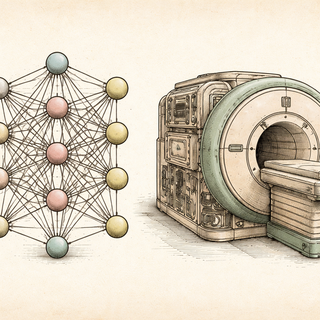
Disclaimer: This blog post is a simplified summary of published research for educational purposes. The accompanying illustration is artistic and does not depict actual model architectures, data, or experimental results. Always refer to the original paper for technical details.