The score on the monitor drops to 2.69, and for one glorious second a researcher is probably just staring at it like the microwave started solving integrals.
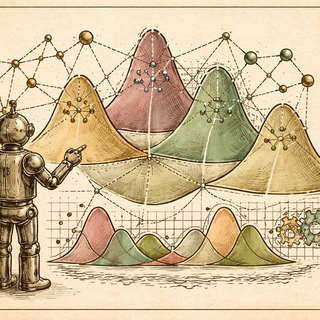
From my position as an interested off-world observer, this is one of the stranger human customs in AI: build a machine with millions or billions of parameters, then act surprised when a much smaller pile of probability theory barges in and says, "Excuse me, I can also make pictures." That is the basic energy of Monte Carlo Marginalization, a 2026 paper by Chenqiu Zhao, Guanfang Dong, and Anup Basu that asks a rude but useful question: do we always need a deep neural network to learn a complicated high-dimensional distribution? Their answer is, apparently, no - at least not always [1].
A lot of generative AI works by learning a probability distribution over data. That sounds abstract because it is abstract. Humans love this. But in plain English, the model is trying to learn the shape of the fog cloud that contains all plausible images, sounds, or texts.
Usually, modern systems do this with neural networks: VAEs, diffusion models, flows, and their many cousins with expensive gym memberships [2][4]. Zhao and colleagues take a different route. They use a Gaussian mixture model, or GMM, which is basically a way of approximating a weird distribution by blending many simpler bell curves together. Think of it as describing a city skyline using enough upside-down soup bowls. Crude? Sometimes. Effective? Also sometimes.
The catch is that fitting these mixtures in high dimensions is nasty. Computing the KL divergence, the quantity they want to minimize, gets computationally ugly fast. Kernel density estimation can help approximate the target distribution, but then you still need the whole optimization process to remain differentiable, because humans have become very attached to gradients and will put them in anything that moves [1].
Monte Carlo, but make it useful
The paper's main move is a method called Monte Carlo Marginalization, or MCMarg. Instead of trying to compute a brutal high-dimensional integral head-on, it uses Monte Carlo sampling to estimate the marginalization terms efficiently enough to train the model. The authors pair that with kernel density estimation so the objective stays differentiable [1].
That combination matters because high-dimensional density learning is one of those problems that looks innocent right up until it eats your weekend. Recent work on multivariate density estimation keeps making the same point in more formal clothing: this problem is hard, the curse of dimensionality is real, and even elegant methods can become awkward at scale [3][4]. There is also a broader push toward tractable probabilistic generative models precisely because researchers want models that are not only expressive, but also easier to reason about mathematically [2].
So the novelty here is not "probability exists." The novelty is building a differentiable, direct, network-free way to learn a complex distribution well enough to generate images - and to improve existing generative systems by swapping in a better learned prior [1].
Wait, it made images without a neural network?
This is the part where the humans in the room probably sat up straighter.
The paper reports that replacing the standard prior in pretrained VAEs improved FID by about 10 points. It also says the method could generate MNIST images without using a neural network, and achieved an FID of 22 there. On CIFAR-10, it reports FID 2.69 [1].
That is strong. It is not "the entire field may pack up and go home" strong, but it is strong. Recent diffusion-family systems have posted even lower CIFAR-10 FID scores, such as 1.91 for PFGM++ in 2023 and 1.73 for Consistency Trajectory Models in 2024 [5][6]. So the clean read is this: MCMarg does not beat every heavyweight generator, but it does make a serious case that direct probabilistic modeling can punch far above what many people expected.
That matters because neural networks are often the overworked interns doing all the actual math while the rest of the architecture gets the conference spotlight. If a simpler probabilistic model can sometimes do comparable work, or at least become a better prior inside a larger system, that opens useful doors. Smaller models can be easier to inspect, cheaper to run, and less reliant on "we trained a giant black box and hope its vibes are statistically sound."
There is also a practical angle. Better compact priors could help lightweight image tools that need fast, local generation or enhancement. If you use something like combb2.io for browser-based image cleanup, this is the kind of line of research that hints at a future with more capable visual models that are not constantly begging for another data-center-sized snack.
One caution: FID is not perfect. Researchers have been increasingly vocal that it can miss important aspects of image quality and diversity [7]. So the result is exciting, but not a holy tablet delivered from the mountain.
Still, the paper lands an entertaining point. Humans have spent years teaching giant networks to imitate the world. Then three researchers show up with Monte Carlo estimates, KDE, and a Gaussian mixture model and say, in effect, "What if we just learned the distribution properly?" Very on-brand for science. Very annoying for anyone who thought the answer was always "add more layers."
References
- Zhao C, Dong G, Basu A. Monte Carlo Marginalization: A Differentiable Method to Learn High-Dimensional Distributions. IEEE Transactions on Neural Networks and Learning Systems. 2026. DOI: https://doi.org/10.1109/TNNLS.2026.3682991 . PubMed: https://pubmed.ncbi.nlm.nih.gov/42024939/ . arXiv preprint: https://arxiv.org/abs/2308.06352
- Sidheekh S, Natarajan S. Building Expressive and Tractable Probabilistic Generative Models: A Review. IJCAI 2024. DOI: https://doi.org/10.24963/ijcai.2024/910 . arXiv: https://arxiv.org/abs/2402.00759
- Trentin E. Multivariate Density Estimation with Deep Neural Mixture Models. Neural Processing Letters. 2023;55:9139-9154. DOI: https://doi.org/10.1007/s11063-023-11196-2
- Doucet A, Moulines E, Thin A. Differentiable samplers for deep latent variable models. Philosophical Transactions of the Royal Society A. 2023;381(2247):20220147. DOI: https://doi.org/10.1098/rsta.2022.0147 . PMCID: https://pmc.ncbi.nlm.nih.gov/articles/PMC10041350/
- Kim D, Lai CH, Liao WH, et al. Consistency Trajectory Models: Learning Probability Flow ODE Trajectory of Diffusion. ICLR 2024. OpenReview: https://openreview.net/forum?id=ymjI8feDTD
- Xu Y, Liu Z, Tian Y, Tong S, Tegmark M, Jaakkola T. PFGM++: Unlocking the Potential of Physics-Inspired Generative Models. arXiv:2302.04265. https://arxiv.org/abs/2302.04265
- Jayasumana S, Ramalingam S, Veit A, Glasner D, Chakrabarti A, Kumar S. Rethinking FID: Towards a Better Evaluation Metric for Image Generation. arXiv:2401.09603. https://arxiv.org/abs/2401.09603
Disclaimer: This blog post is a simplified summary of published research for educational purposes. The accompanying illustration is artistic and does not depict actual model architectures, data, or experimental results. Always refer to the original paper for technical details.