Somewhere in a lab in Wuhan, a researcher watched a voltage readout spike every time a mechanical press bit down on a tiny titanium implant - and the number didn't drop after a million cycles. That's when the "what if" became "oh, this actually works."
The Problem Nobody Talks About at the Dentist
Here's a stat that'll make you clench your jaw (ironic, given the topic): over a third of the world's population has dental defects, and osseointegrated implants - the titanium screws dentists thread into your jawbone - are the gold standard fix. But about 22% of implant patients develop peri-implantitis, a nasty inflammatory condition where bacteria colonize the tissue around the implant and start eating away at the bone holding it in place (Galarraga-Vinueza et al., 2025). It's like termites moving into the foundation of your newly renovated house, except the house is your face.
Current treatments? Antibiotics (hello, resistance), surgical scraping (ouch), or just... hoping your immune system figures it out. Not exactly a lineup of winners.
Enter the Implant That Fights Back Every Time You Chew
A team led by Annan Chen and colleagues at Huazhong University of Science and Technology and City University of Hong Kong just published something wild in Nature Communications: a dental implant that generates its own electricity from your bite force and uses it to kill bacteria, calm inflammation, AND grow new bone (Chen et al., 2026).
The secret ingredient? Piezoelectric materials - stuff that converts mechanical stress into electric charge. Every time you chew, bite, or clench, the implant harvests that force and turns it into therapeutic voltage. No batteries. No wires. No external gadgets. Just you, eating a sandwich, accidentally doing medicine.
Three Therapies, Zero Batteries
The implant pulls off what the researchers call "tri-modal therapeutic integration," which sounds like a prog rock album title but is actually three separate healing mechanisms running simultaneously:
1. Bacterial assassination via ROS. The piezoelectric charge catalyzes the generation of reactive oxygen species - molecular wrecking balls that punch holes in bacterial membranes. Think of it as your implant generating tiny lightning bolts that fry the bacteria trying to set up camp. Unlike antibiotics, bacteria can't easily develop resistance to being oxidized into oblivion (Shang et al., 2025).
2. Immune system diplomacy. The electrical stimulation flips macrophages - your body's first-responder immune cells - from their angry, pro-inflammatory mode (M1) to their chill, tissue-repair mode (M2). It's like the implant is a mediator convincing your immune system to stop setting fires and start rebuilding.
3. Bone growth on demand. Electrical stimulation also kicks osteogenesis into gear, outperforming conventional titanium alloys at encouraging new bone formation. The implant doesn't just defend its territory; it actively makes the neighborhood nicer.
The Machine Learning Plot Twist
Here's where it gets properly sci-fi. Because everyone chews differently - force, angle, frequency - the team integrated machine learning models to predict patient-specific voltage responses. The ML system maps your personal bite mechanics and modulates the implant's therapeutic output accordingly. Your implant basically learns how you eat and adjusts its treatment dose in real time.
This isn't a gimmick, either. Personalized voltage modulation means a gentle chewer and a jaw-clenching stress-eater both get optimized therapy. The field of AI in implant dentistry has been heating up fast, with everything from implant survival prediction to real-time complication monitoring (JCM, 2026), but embedding ML directly into the therapeutic feedback loop of a self-powered implant is a genuinely novel move.
Will It Last? (Spoiler: A Million Times Yes)
Durability was the obvious question, and the team went hard on it. The implant sustained consistent bioelectric output through over 1,000,000 loading-unloading cycles and maintained stable electrical performance in simulated body conditions for over 30 days. For context, the average person chews about 600-800 times per meal. A million cycles is a LOT of sandwiches.
The Bigger Picture
This isn't just a clever dental gadget. It's a proof of concept for an entire class of autonomous bioelectronic platforms - self-powered devices that sense, adapt, and treat without external intervention. The same principles could theoretically apply to orthopedic implants (knees and hips generate plenty of mechanical force), spinal hardware, or any implanted device where movement-driven self-powering makes sense.
The piezoelectric biomaterials field has been gaining momentum, with recent work on everything from antibacterial nanocoatings (Pan et al., 2024) to artificial peri-implant tissues that combine piezoelectric and conductive elements (Advanced Fiber Materials, 2025). But combining all three therapeutic modes with ML-driven personalization in a single, fully autonomous device? That's a new benchmark.
Of course, this is still early-stage. The jump from lab bench to your dentist's chair involves clinical trials, regulatory approval, manufacturing scale-up, and answering the question every patient will ask: "So my tooth is... electric now?" But the foundation is solid - literally, it survived a million bites.
If you're the kind of person who likes mapping out how complex systems connect, tools like mapb2.io are great for visualizing how research like this branches across materials science, immunology, and AI.
References
-
Chen, A., Li, K., Li, Y., et al. (2026). Occlusion-activated autonomous piezoelectric implants for adaptive prevention of peri-implantitis. Nature Communications. DOI: 10.1038/s41467-026-71556-z. PMID: 41951599.
-
Galarraga-Vinueza, M.E., et al. (2025). Prevalence, incidence, systemic, behavioral, and patient-related risk factors and indicators for peri-implant diseases: An AO/AAP systematic review and meta-analysis. Journal of Periodontology. DOI: 10.1002/JPER.24-0154. PMID: 40489307.
-
Shang, S., Zheng, F., Tan, W., et al. (2025). Piezoelectric Biomaterial with Advanced Design for Tissue Infection Repair. Advanced Science. DOI: 10.1002/advs.202413105. PMID: 39887897.
-
Pan, Y., et al. (2024). Doping Engineering of Piezo-Sonocatalytic Nanocoating Confer Dental Implants with Enhanced Antibacterial Performances and Osteogenic Activity. Advanced Functional Materials. DOI: 10.1002/adfm.202313553.
-
Zeng, K., Lin, Y., Liu, S., et al. (2024). Applications of piezoelectric biomaterials in dental treatments: A review of recent advancements and future prospects. Materials Today Bio. DOI: 10.1016/j.mtbio.2024.101288. PMID: 40018432.
-
AI-Powered Predictive Models in Implant Dentistry (2026). Journal of Clinical Medicine, 15(1):228.
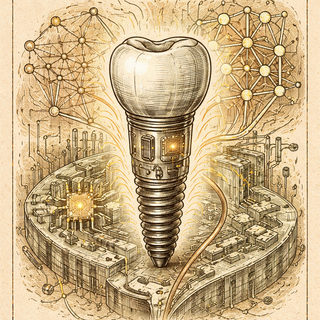
Disclaimer: This blog post is a simplified summary of published research for educational purposes. The accompanying illustration is artistic and does not depict actual model architectures, data, or experimental results. Always refer to the original paper for technical details.