Since Darwin started poking at animal expression in 1872, the speech-origin job site has burned through more blueprints than a contractor with a bad tape measure. Fossils? Useless for sound. Ancient throats? Gone. Early language? No tape backup, because apparently Homo erectus did not maintain a GitHub repo.
So researchers have had to inspect whatever load-bearing beams are still standing. One of them, weirdly enough, is laughter.
A recent Nature Briefing Chat by Nick Petrić Howe and Maren Hunsberger points listeners toward a new Communications Biology study with a wonderfully specific premise: if you tickle great apes and measure the rhythm of their laughter, you may learn something about the scaffolding that made human speech possible. Not the words, mind you. Nobody is claiming a gorilla is one foot-tickle away from filing a zoning complaint. The question is more basic: how did primates get the vocal control needed to produce rhythmic, flexible sounds?
The Foundation: Laughter Before Language
The main study, led by Chiara De Gregorio, Marina Davila-Ross, and Adriano R. Lameira, analyzed laughter from all living great ape branches: orangutans, gorillas, bonobos, chimpanzees, and humans. The dataset was small but carefully framed: 17 individuals total, including four humans, and 140 laughter bouts recorded during play and tickling.
The key finding: across great apes, laughter tends to show isochrony, meaning the vocal bursts come at roughly regular intervals. That is the acoustic version of evenly spaced studs in a wall. You may not see them once the drywall goes up, but good luck building anything stable without them.
The researchers argue that this regular rhythm probably existed in the last common ancestor of living great apes, around 15 million years ago. That does not mean speech is 15 million years old. It means one piece of the speech-support structure - rhythmic vocal timing - may be much older than human language.
The Tickling Test Has Specs
Here is where the construction inspection gets interesting. Laughter during tickling was more rhythmically regular than laughter during rough social play. That makes practical sense. During play, bodies are twisting, bumping, rolling, and generally behaving like a poorly secured wheelbarrow on a ramp. The chest and breathing system get knocked around, which messes with timing.
Tickling, by contrast, gives researchers a cleaner view of the respiratory-vocal system. It is not pristine lab concrete, but it is less cracked than the play condition. In the study, tickle laughter better captured the evolutionary trend toward faster laughter rhythms.
Humans showed the most flexible timing. We laugh differently when tickled, when joking, when nervous, or when pretending that the boss’s story was funny. That last one is advanced social engineering, and sometimes a structural hazard. Non-human great apes did not show the same context-sensitive tempo shift in this dataset.
What This Tells Us About Speech
Speech needs breath control, timing, and flexible sound production. You have to coordinate lungs, vocal folds, mouth, tongue, and social intent. That is not a shed. That is a mixed-use development with plumbing.
The study does not say laughter “became” speech. It says laughter offers a surviving model for studying vocal control across hominid evolution. Because laughter is shared across great apes, researchers can compare species alive today and infer what parts of the vocal blueprint are ancient versus newer renovations.
This fits with recent work showing that primate communication has more rhythmic and social complexity than the old “humans got all the good tools” story allowed. Gibbons adjust rhythms to coordinate songs. Titi monkeys show context-sensitive rhythmic duets. Bonobos seem to respond emotionally to laughter. Orangutans and chimpanzees can mirror laugh faces with surprising precision. The old foundation is busier than expected.
Where the Beam Still Needs Bracing
This is good work, but do not hang a chandelier from it yet. The sample size is modest: four orangutans, two gorillas, three bonobos, four chimpanzees, and four children. Many recordings came from controlled interactions with familiar humans, mostly in captive settings, and some were collected years ago. The authors are upfront about this. Species-level estimates need larger samples.
There is also the usual problem in evolutionary reconstruction: living apes are not time machines. They are modern species with their own histories. Comparing them helps, but it is still inference, not a security-camera recording from 15 million years ago.
Still, the foundation looks solid. The study gives researchers a measurable feature - laughter rhythm - that links animal communication, vocal timing, and speech evolution without reaching for sci-fi glue. For AI and machine-learning people, the lesson is familiar: before you model the fancy output, inspect the timing signal. Sometimes the load-bearing layer is not the glamorous one. It is the quiet beam doing its job while everyone admires the paint.
References
-
Howe, N. P. & Hunsberger, M. “Briefing Chat: What tickling a chimpanzee can tell us about the evolution of speech.” Nature (2026). DOI: 10.1038/d41586-026-02059-6. PMID: 42373839
-
De Gregorio, C., Davila-Ross, M. & Lameira, A. R. “Rhythm and timing in laughter reveal that human vocal plasticity falls on a hominid continuum.” Communications Biology 9, 824 (2026). DOI: 10.1038/s42003-026-10499-z
-
Winkler, S. L. et al. “Bonobos tend to behave optimistically after hearing laughter.” Scientific Reports 15, 20067 (2025). DOI: 10.1038/s41598-025-02594-8
-
Austry, D. A. et al. “Towards the complexity of laugh communication in great apes: exact facial replications in laugh faces of orangutans and chimpanzees.” Scientific Reports 16, 11758 (2026). DOI: 10.1038/s41598-026-43992-w
-
Ma, H. et al. “Small apes adjust rhythms to facilitate song coordination.” Current Biology 34, 935-945.e3 (2024). DOI: 10.1016/j.cub.2023.12.071
-
De Gregorio, C. et al. “Isochrony in titi monkeys duets: social context as a proximate cause of duets’ rhythm and regularity.” Proceedings of the Royal Society B 292, 20242805 (2025). DOI: 10.1098/rspb.2024.2805
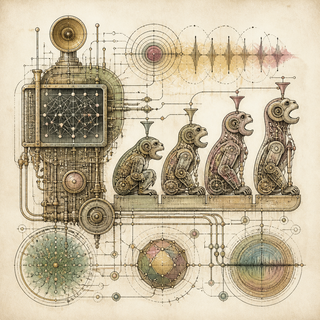
Disclaimer: This blog post is a simplified summary of published research for educational purposes. The accompanying illustration is artistic and does not depict actual model architectures, data, or experimental results. Always refer to the original paper for technical details.