The trick is modularity: DNAsight first learns to trace DNA, then lets separate measuring gadgets ask different biological questions without rebuilding the whole contraption.
To the visiting alien anthropologist, this is sensible. The humans have invented atomic force microscopy, a ritual in which a tiny mechanical needle strokes molecules and produces topographic maps of things too small for ordinary light to politely acknowledge. Then, after obtaining these rare nanoscale portraits, the humans often ask a graduate student to manually trace the biological spaghetti. This appears inefficient, though perhaps emotionally formative.
The new paper by Sørensen and colleagues introduces DNAsight, a framework for analyzing AFM images of DNA and chromatin automatically, with machine learning doing the first pass at segmentation and modular tools turning those traces into measurements: DNA length, compaction, loops, nucleosome spacing, and protein clusters (PMID: 42328787, DOI: 10.1093/nar/gkag632).
The Needle Sees, But Who Measures?
Chromatin is DNA plus proteins, packed into cells with the cheerful density of a suitcase closed by sitting on it. Its basic unit is the nucleosome, where DNA wraps around histone proteins like thread around a spool. The spacing, bending, looping, and clustering of these units affects which genes are accessible and when.
AFM is wonderful here because it can image molecules directly, often without fluorescent labels. No glowing tags. No interpretive light show. Just surface topology. The tiny probe moves across the sample and records height changes, like a blind cartographer mapping a mountain range made of DNA.
But seeing is not the same as measuring. AFM images contain noise, variable contrast, overlapping molecules, substrate artifacts, and the occasional molecular tangle that looks like it lost a fight with a headphone cable. Manual tracing can work, but it scales badly and varies between humans, who are famously inconsistent biological instruments.
DNAsight attacks that bottleneck.
The Machine Learns the Noodle
Instead of asking a neural network to label every pixel as “DNA” or “not DNA,” DNAsight trains a U-Net model to predict backbone-proximity maps. That means pixels near the DNA centerline get stronger values, while background pixels fade away. This is clever because DNA occupies only about 1 percent of many AFM images. A plain classifier might learn the lazy answer: “Everything is background.” A classic machine-learning student move. Wrong, but computationally cozy.
The proximity-map design gives the model more useful learning signal. DNAsight then refines the output into skeletonized DNA traces. From there, the modules take over. One module calibrates DNA length in base pairs. Another measures shape features like compaction, crossings, curvature, tortuosity, and strong bends. Another looks for loop-like structures. Another links protein clusters to DNA.
This modularity matters because chromatin researchers do not always ask the same question. One lab may care about nucleosome spacing. Another may care about whether a protein bends circular DNA more than linear DNA. The framework lets each group assemble the analysis workflow they need, which is very civilized behavior from a species that still names files “final_final_v7.”
What Did It Find?
The authors tested DNAsight across several chromatin-related systems. It detected topology-dependent compaction by integration host factor. It found condition-dependent changes in loop-like DNA structures in reactions involving cohesin, CTCF, and PDS5A. It also measured promoter-dependent clustering by GAGA factor.
Most importantly, DNAsight extracted nucleosome spacing distributions directly from raw AFM images. In one di-nucleosome case, the measured spacing centered near the expected 80 base-pair linker length. In more complex nucleosome arrays, the distributions became broader and more heterogeneous, which is exactly the sort of messy biological truth one expects after watching humans discover that genomes are not tidy filing cabinets.
This connects nicely with recent chromatin work showing that nucleosome spacing can tune higher-order chromatin assembly and phase behavior (Chen et al., 2025). Small spacing changes can matter, though DNAsight’s authors are careful: AFM image quality, pixel size, tip effects, surface chemistry, and calibration still limit precision. The framework is best for robust population-level differences, not declaring victory over every single base pair like a microscopic accountant with a crown.
Why This Is Useful
The larger trend is clear. Machine learning is becoming the lab assistant that never sleeps, though it still needs supervision and should not be left alone with ambiguous data. Recent reviews describe how ML is improving AFM instrumentation, image analysis, and autonomous microscopy workflows (Masud et al., 2024; Lee et al., 2026). In chromatin research, deep learning is also helping with super-resolution reconstruction, segmentation, and tracking (Rotkevich et al., 2025).
Tools like combb2.io show the everyday version of this instinct: use AI to clean up, sharpen, or restore images. DNAsight is the scientific cousin wearing a lab coat and muttering about calibration constants.
If DNAsight proves reproducible across more labs and sample types, it could help researchers mine existing AFM datasets, compare chromatin architectures more consistently, and connect nanoscale structure to gene regulation. The humans appear to be teaching their machines not merely to look at DNA, but to measure its posture.
A curious ritual. A useful one.
References
- Sørensen EW, Pangeni S, Merino Urteaga R, et al. “A modular framework for automated segmentation and analysis of AFM imaging of chromatin organization.” Nucleic Acids Research 54(12), gkag632, 2026. DOI: 10.1093/nar/gkag632
- Masud N, Rade J, Hasib MHH, Krishnamurthy A, Sarkar A. “Machine learning approaches for improving atomic force microscopy instrumentation and data analytics.” Frontiers in Physics 12:1347648, 2024. DOI: 10.3389/fphy.2024.1347648
- Chen L, Maristany MJ, Farr SE, et al. “Nucleosome spacing can fine-tune higher-order chromatin assembly.” Nature Communications 16, 6315, 2025. DOI: 10.1038/s41467-025-61482-x
- Rotkevich M, Viana C, Neguembor MV, Cosma MP. “Deep learning in chromatin organization: from super-resolution microscopy to clinical applications.” Cellular and Molecular Life Sciences 82, 323, 2025. DOI: 10.1007/s00018-025-05837-z
- Lee S, Roh S, Woo H, et al. “AI in Atomic Force Microscopy: Advancing Biological Nanoscale Imaging and Autonomous Discovery.” ACS Nano, 2026. DOI: 10.1021/acsnano.6c02895
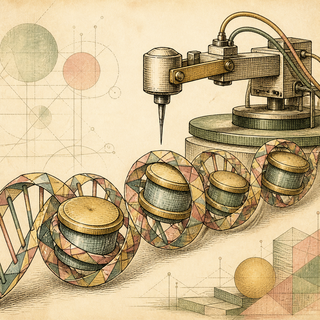
Disclaimer: This blog post is a simplified summary of published research for educational purposes. The accompanying illustration is artistic and does not depict actual model architectures, data, or experimental results. Always refer to the original paper for technical details.