Five years ago, the front line of AI looked almost cozy: chessboards, Go boards, racing simulators, and giant server rooms where the only thing taking incoming fire was the electric bill. Today the fight has spilled onto an Olympic-size table tennis court in Tokyo, where a robotic arm called Ace is ripping serves, reading spin in milliseconds, and forcing elite human players into strategic retreat under official rules [1][2].
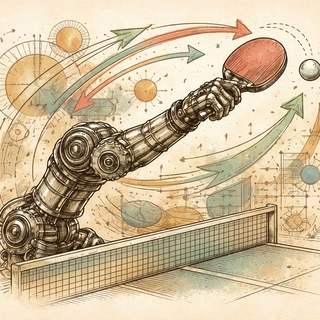
That matters because table tennis is not a polite little demo. It is chaos in a tiny rectangle. The ball comes screaming in, the spin lies to your eyes, the table and net leave no room for clumsy corrections, and your decision window is basically one nervous inhale. If AI was comfortable dominating digital battlefields, this is the moment it got deployed into mud, noise, and incoming fire.
Why Ping-Pong Is Robotics' Nasty Little War Zone
Robots are already great at repeating the same motion in factories. That is not this. Table tennis is adversarial, fast, and rude. Your opponent is actively trying to make you fail. The ball can hit the net, kick sideways off spin, or show up with the kind of trajectory that makes even professionals mutter things not suitable for a Nature paper.
In the published Nature study, Ace beat three of five elite players and stayed competitive against two professionals, though it lost those pro matches overall and won one game out of seven against them [2]. That detail matters. The clean headline is "robot beats humans." The honest version is better: this thing has crossed from lab curiosity into legitimate high-level competition, but it has not annexed the whole sport.
Sony says later matches in December 2025 and March 2026 went further, including wins over professional players, but those results are outside the core published dataset [7]. Translation from battlefield press office language: the official paper is already strong enough without the victory lap.
How Ace Sees the Incoming Fire
Ace is not just a fast arm with Main Character Energy. It is a stacked system built for millisecond warfare. According to the Nature paper, it uses nine high-speed APS cameras to triangulate the ball in 3D at 200 Hz, plus event-based vision sensors to estimate spin. Average perception latency clocks in at 10.2 milliseconds, and the actuators are synchronized at 1 millisecond intervals [2]. That is not "good for a robot." That is "please stop blinking or you will miss the plot."
Then comes reinforcement learning, the branch of AI where you do not hand-code every move like an exhausted puppet master. Instead, you let the system learn from trial, error, reward, and enormous amounts of simulated experience. Think of it as training a soldier by running drills until the response becomes automatic, except the soldier is an eight-jointed robot arm and the drill instructor is math with a bad sleep schedule [2][3].
Sony's team also leaned on a hierarchical design, splitting strategy from low-level control. That matters because deciding what shot to play and deciding how to move the racket at terrifying speed are two different wars happening at once. If you want to sketch that command chain without covering a napkin in arrows, something like mapb2.io is actually handy for turning the architecture into something your brain can parse.
This Was Not a Lone Charge
Ace did not appear out of the fog fully assembled like table tennis Athena. Recent work has been steadily pushing the line forward. In 2024, DeepMind researchers reported amateur human-level competitive robot table tennis using a hierarchical policy and zero-shot sim-to-real transfer [4]. In 2025 and 2026, other teams pushed humanoid table tennis with hierarchical planning, whole-body control, predictive augmentation, and RL-based footwork [5][6].
The broader robotics community has been saying the same thing for a while: real-world reinforcement learning works, but only when the supply lines are solid. You need better sensors, better simulators, carefully designed training distributions, and hardware that does not panic when reality stops behaving like a neat benchmark [3]. Ace looks less like a random miracle and more like a well-planned offensive after years of smaller advances.
Why This Battle Matters Outside the Arena
No, your toaster is not joining a professional league.
But if a robot can track a tiny spinning ball, predict its future path, react safely near obstacles, and adapt to a skilled human in real time, you are looking at the kind of capability that spills into manufacturing, service robotics, and any setting where machines need quick hands instead of just strong motors [2][7]. Warehouses, assembly lines, assistive robotics, dynamic inspection tasks - these are all less glamorous than ping-pong, but much more useful.
The caution flag still matters. Jan Peters, one of the long-time researchers in robot table tennis, told The Guardian the result was "truly impressive" while also warning that success in ping-pong does not automatically solve the broader messier world of manipulation [8]. Fair point. Winning a rally is not the same thing as folding laundry, which remains civilization's most stubborn unsolved benchmark.
Still, the strategic picture has changed. For years, physical AI lagged behind screen-based AI because the real world is full of friction, latency, uncertainty, and surprise. Ace just showed that with enough sensing, training, and engineering discipline, the machine can hold the line in one of the nastiest environments we could pick on purpose.
And honestly, that is the funniest part. Humanity spent decades worrying about robots taking over boring jobs. Meanwhile the machines showed up wanting smoke at the ping-pong table.
References
- [1] Bundell S. This robot can beat you at table tennis. Nature. 2026. DOI: https://doi.org/10.1038/d41586-026-01343-9
- [2] Dürr P, El Gheche M, Maeda GJ, et al. Outplaying elite table tennis players with an autonomous robot. Nature. 2026;652:886-891. DOI: https://doi.org/10.1038/s41586-026-10338-5
- [3] Tang C, Abbatematteo B, Hu J, Chandra R, Martín-Martín R, Stone P. Deep Reinforcement Learning for Robotics: A Survey of Real-World Successes. Annu Rev Control Robot Auton Syst. 2025;8:153-188. DOI: https://doi.org/10.1146/annurev-control-030323-022510
- [4] D'Ambrosio DB, Abeyruwan S, Graesser L, et al. Achieving Human Level Competitive Robot Table Tennis. arXiv. 2024. arXiv:2408.03906. DOI: https://doi.org/10.48550/arXiv.2408.03906
- [5] Su Z, Zhang B, Rahmanian N, et al. HITTER: A HumanoId Table TEnnis Robot via Hierarchical Planning and Learning. arXiv. 2025. arXiv:2508.21043. DOI: https://doi.org/10.48550/arXiv.2508.21043
- [6] Hu M, Chen W, Li W, et al. PACE: Physics Augmentation for Coordinated End-to-end Reinforcement Learning toward Versatile Humanoid Table Tennis. arXiv. 2025. arXiv:2509.21690. DOI: https://doi.org/10.48550/arXiv.2509.21690
- [7] Sony AI. Ace Research Project and Sony AI Announces Breakthrough Research in Real-World Artificial Intelligence and Robotics. April 22-23, 2026. https://ace.ai.sony/ ; https://ai.sony/news/sony-ai-announces-breakthrough-research-in-real-world-artificial-intelligence-and-robotics
- [8] Sample I. AI-powered robot beats elite table tennis players. The Guardian. April 22, 2026. https://www.theguardian.com/science/2026/apr/22/ai-powered-robot-beats-elite-table-tennis-players-milestone-robotics
Disclaimer: This blog post is a simplified summary of published research for educational purposes. The accompanying illustration is artistic and does not depict actual model architectures, data, or experimental results. Always refer to the original paper for technical details.