Published on April 23, 2026, this new ISME Journal paper asks a question that matters far beyond a lab bench: when microbial communities get shoved around by repeated disturbance, do they respond randomly, or do they follow recognizable survival strategies? Santillan, Neshat, and Wuertz make the case that the answer is the second one, which is mildly rude to anyone who has built a career around saying "microbiomes are too messy to predict" (Santillan et al., 2026).
Tiny creatures, big drama
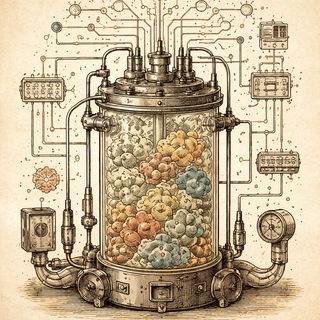
The stage here is not a rainforest or coral reef. It is a set of wastewater bioreactors, which sounds less cinematic until you remember that they are full of microscopic organisms competing, scavenging, panicking, and adapting like a prestige wildlife documentary with worse lighting.
The researchers exposed microbial communities to six disturbance regimes by repeatedly doubling the organic loading rate, from calm, undisturbed conditions all the way to constant pressure. Then they watched what happened over 42 days using 16S sequencing, genome-resolved metagenomics, biomass measurements, effluent chemistry, network analysis, and machine learning. In other words, they did not just peek into the pond. They brought binoculars, satellite imaging, and a suspiciously caffeinated statistician.
Their framework borrows from classic ecology: the CSR model, short for competitor, ruderal, and stress-tolerant. The idea came from plant ecology, where species often survive by being great at competing in stable environments, sprinting into disturbed environments, or enduring miserable ones. This paper argues microbes do something similar.
And honestly, that tracks. Some microbes are the tidy suburban homeowners of the ecosystem. Some are raccoons with a business plan. Some are the bunker people.
The three survival moves
Under undisturbed conditions, the community leaned toward competitor strategies. These organisms did well when the environment stayed relatively stable, and the system’s function looked correspondingly steady.
At intermediate disturbance frequencies, the community shifted toward ruderal-associated strategies. These are the quick responders, the ecological equivalent of startups that thrive in chaos right up until accounting arrives. They can move fast, exploit changing conditions, and take advantage of repeated disruption.
Under sustained high-frequency disturbance, the system favored stress-tolerant strategies. These microbes are not trying to win a sprint. They are trying to survive the apocalypse with their enzymes still attached.
That pattern matters because it was not just a taxonomic reshuffle. The shifts showed up in community composition, functional trade-offs, and genomic trait distributions. In plain English, the microbes did not merely swap name tags. Their collective behavior changed in organized ways.
Why this is a bigger deal than one wastewater tank
The lovely part of this paper is that it nudges microbial ecology away from pure description and toward prediction. That has been the dream for a while: not just "look what happened," but "given this kind of disturbance, here is the kind of community you should expect."
That idea lines up with other recent work. A 2023 Nature Microbiology study found broad life-history patterns across global soil bacterial communities, suggesting these strategies are not a one-off bioreactor quirk (Martiny et al., 2023). A 2024 synthesis in Microbiome showed that disturbance responses across microbiomes often follow repeatable recovery patterns rather than pure ecological free jazz (Brislawn et al., 2024; PMCID: PMC11071242). And in 2025, researchers linked life-history strategies to crash and recovery dynamics in anammox bioreactors, which is exactly the sort of applied headache wastewater engineers would prefer to avoid (White et al., 2025).
If this trait-based approach keeps holding up, it could help people manage wastewater treatment, soil systems, bioremediation, and maybe eventually other microbiomes where disturbance is routine. That includes environments where you really do not want the microbial cast improvising too hard.
The catch, because there is always a catch
The authors are not claiming a universal law of all microbes everywhere forever. This was a controlled experiment in replicated bioreactors using synthetic wastewater, which is useful but not the whole planet. Real ecosystems bring extra complications: immigration, predators, seasonal shifts, host effects, and all the other gremlins ecology keeps in the basement.
There is also the classic genome-to-behavior problem. A genome can hint at what an organism is equipped to do, but it does not guarantee what it will do on Thursday.
Still, the paper’s main point survives those caveats: microbial communities may be messy, but not hopelessly mysterious. With the right trait lens, they show recognizable survival logic. The wilderness is still wild, but now we can at least tell which creature is built for a feast, which one is built for a stampede, and which one survives by glaring at adversity until it blinks.
References
-
Santillan E, Neshat SA, Wuertz S. Predicting microbial community responses to disturbance using genome-resolved trait-based life-history strategies. The ISME Journal. Published April 23, 2026. DOI: 10.1093/ismejo/wrag099
-
Martiny AC, Martiny JBH, colleagues. Life history strategies of soil bacterial communities across global terrestrial biomes. Nature Microbiology. 2023. DOI: 10.1038/s41564-023-01465-0
-
Brislawn CJ, et al. Synthesis of recovery patterns in microbial communities across environments. Microbiome. 2024;12:79. DOI: 10.1186/s40168-024-01802-3. PMCID: PMC11071242
-
White CA, Antell EH, Schwartz SL, et al. Life history strategies determine response to SRT driven crash in anammox bioreactors. Water Research. 2025;268(Pt B):122727. DOI: 10.1016/j.watres.2024.122727
-
Li Z, Riley WJ, Marschmann GL, et al. A framework for integrating genomics, microbial traits, and ecosystem biogeochemistry. Nature Communications. 2025;16:2186. DOI: 10.1038/s41467-025-57386-5
-
Li S, Müller S. Ecological forces dictate microbial community assembly processes in bioreactor systems. Current Opinion in Biotechnology. 2023;81:102917. DOI: 10.1016/j.copbio.2023.102917
Disclaimer: This blog post is a simplified summary of published research for educational purposes. The accompanying illustration is artistic and does not depict actual model architectures, data, or experimental results. Always refer to the original paper for technical details.