The seed was just sitting there, minding its own business.
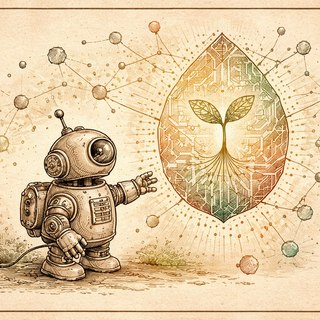
That is usually how these cases begin. A tiny biological capsule. Quiet. Dry. Unimpressed by your grant proposal. Then Zhang and colleagues walk into the room with artificial intelligence, multi-omics, digital twins, intelligent agents, robots, genome editing, and the general energy of a detective pinning red string across an entire greenhouse wall.
Their review, “Integrating AI in seed science: Toward an intelligent design paradigm,” argues that seed science is entering a new phase: not just selecting better seeds, not just measuring them faster, but designing them with the help of AI systems that can connect genes, traits, environments, and farming decisions into one feedback loop. The victim? Slow, trial-and-error crop improvement. The suspect? A world that needs more food from worse weather and tired land.
Exhibit A: The Seed Is Not Simple
A seed looks simple because it has excellent branding. In reality, it is a compact biological conspiracy.
Inside that little speck are genetic instructions, chemical reserves, dormancy programs, stress responses, and the early paperwork for an entire plant. Change the seed, and you may change yield, drought tolerance, nutrition, shelf life, germination, and whether a farmer has a good season or starts muttering at the sky like a noir detective in a cornfield.
The paper starts from a blunt premise: global agriculture faces climate change, population growth, land degradation, and a projected 9.7 billion people by 2050. Current productivity gains are not moving fast enough. Seeds sit at the beginning of the whole food chain, which makes them less like “plant babies” and more like the opening scene where the clues are already on the table.
The Usual Suspects: Genomes, Phenotypes, and Weather
Traditional breeding has always been smart. Farmers and breeders have been running field experiments for thousands of years, long before anyone asked a GPU to identify a soybean.
But the hard part is the triangle of genotype, environment, and phenotype. Genotype is the seed’s genetic script. Phenotype is what actually shows up: height, yield, root shape, disease resistance, seed size, oil content, and the rest of the plant’s public behavior. Environment is the chaotic roommate: heat, soil, pests, rainfall, management, and whatever climate change decided to improvise this week.
AI enters because the data has become too weird, wide, and interconnected for simple spreadsheets to handle gracefully. Modern seed research can include genomics, transcriptomics, proteomics, metabolomics, imaging, field sensors, weather streams, and management logs. That is not a dataset. That is a filing cabinet falling down a staircase.
The Digital Twin Enters the Interrogation Room
One of the paper’s central ideas is the seed digital twin: a computational representation of a seed that integrates multi-scale, multi-modal data. In plain English, it is a living-ish model of what the seed is, what it might become, and how it might behave under stress.
This does not mean researchers are building tiny seed avatars that pay rent in the cloud. It means they want models that can simulate relationships among genes, traits, and environments before breeders spend years testing every possibility in the field.
This is where tools for visual thinking start to make sense. If you have ever tried to map gene-trait-environment relationships on a whiteboard, you know it can turn into spaghetti with citations. A browser-based mind mapping tool like mapb2.io is the kind of thing that helps humans keep the logic visible while the AI does the heavy pattern-matching in the basement.
The Accomplice: Intelligent Agents
The review also points toward intelligent agents: AI systems that do more than predict. They perceive, decide, and act.
Imagine an agent that reads seed imaging data, checks genomic signals, compares environmental conditions, recommends breeding crosses, triggers robotic phenotyping, updates its model, and then asks, with unsettling calm, “Would you like to test drought stress next?” It is not HAL 9000. It is more like an extremely caffeinated lab manager who never forgets a metadata field.
This matters because breeding is slow. Field trials take seasons. Some traits only reveal themselves under specific stress. Some gene edits behave differently depending on the genetic background. The dream is a closed loop: measure, model, design, test, learn, repeat.
The case-breaking evidence is not that AI magically solves biology. Biology has been refusing to be tidy since before mammals had opinions. The evidence is that AI can help connect signals across scales, from molecular mechanisms to field performance, faster than humans can do by hand.
The Cold Cases Still Open
The paper is a review, not a magic seed vending machine. Its strongest move is also its most honest: it spends real time on bottlenecks.
Data quality is a major one. If training data is the textbook material nobody proofread, the model may become very good at learning yesterday’s mistakes in high definition. Seed datasets can be fragmented, inconsistent, biased toward certain crops, or missing environmental context. A model trained on one region may not behave well in another. Very dramatic. Very “the alibi falls apart under cross-examination.”
Interpretability is another problem. Breeders and biologists need to know why a model recommends a trait combination, not just receive a mysterious score from the algorithmic oracle. Then there is validation: a seed that looks excellent in simulation still has to survive soil, weather, disease, supply chains, and farmers with zero patience for demo-day nonsense.
Why This Case Matters
If this paradigm works, the payoff could be practical: faster breeding cycles, better stress resilience, more precise trait design, improved seed quality testing, and crop varieties tuned to local conditions. That could help farmers handle drought, heat, salinity, disease pressure, and changing growing seasons without treating every field like a fresh crime scene.
But the most intriguing part is philosophical. Zhang and colleagues are asking seed science to move from “observe and select” toward “model and design.” Not replacing breeders, agronomists, or plant scientists, but giving them sharper instruments. A microscope showed us hidden structures. Sequencing showed us hidden code. AI may help show hidden relationships.
The seed was just sitting there.
Then the data started talking.
References
-
Zhang, Y., Du, J., Huang, G., Zhao, Y., Man, P., Song, A., Zhao, Y., Men, Q., Wang, C., Guo, M., Guo, X., & Zhao, C. “Integrating AI in seed science: Toward an intelligent design paradigm.” Plant Communications 7, 101820, 2026. https://doi.org/10.1016/j.xplc.2026.101820
-
“Digital techniques and trends for seed phenotyping using optical sensors.” PMC, 2024. PMCID: PMC11380022
-
Li et al. “Genomic selection in plant breeding: Key factors shaping two decades of progress.” Molecular Plant, 2024. https://doi.org/10.1016/j.molp.2024.03.007
-
“Machine learning for multi-omics data integration in crop improvement: a systematic review.” BMC Bioinformatics, 2026. https://doi.org/10.1186/s12859-026-06438-8
-
“SeedBench: A Multi-task Benchmark for Evaluating Large Language Models in Seed Science.” arXiv, 2025. https://arxiv.org/abs/2505.13220
Disclaimer: This blog post is a simplified summary of published research for educational purposes. The accompanying illustration is artistic and does not depict actual model architectures, data, or experimental results. Always refer to the original paper for technical details.