If you've ever tried to make a jacket swallow radar and terahertz chatter, you know how frustrating electromagnetic noise is. This paper fixes electromagnetic noise. Well, not all of it, because physics still has a union contract, but Luo and colleagues just made a flexible fabric that absorbs an absurdly wide stretch of millimeter-wave and terahertz radiation while staying bendy, breathable, and water-hating in the smug way only superhydrophobic materials can manage.
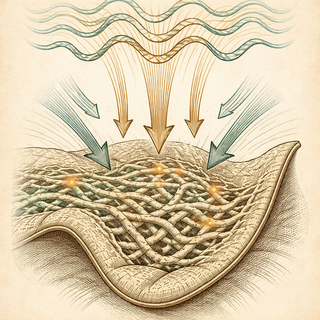
The material is called WPU-MXene@FC, which sounds like a soccer club sponsored by a chemistry department. Underneath the acronym is a fabric coated with MXene, a family of two-dimensional materials made from transition metal carbides, nitrides, or carbonitrides. Think graphene’s metallic, slightly more chemically complicated cousin, the one who shows up to dinner with excellent conductivity and a suspicious number of surface functional groups.
MXenes have become popular for electromagnetic interference shielding because they conduct electricity well, can be processed from solution, and interact with waves from gigahertz up into terahertz territory Iqbal et al., 2024. That matters because our world is filling with higher-frequency wireless systems: 5G, 6G dreams, radar sensors, wearable devices, AI hardware, edge computing gadgets, and all the tiny electronic divas that throw tantrums when stray radiation wanders through the room.
On one hand, this is technological progress. On the other hand, we are slowly wrapping civilization in invisible radio spaghetti and then acting surprised when the spaghetti touches the wrong circuit.
The Nest Trick
The core move in this paper is not just “put MXene on fabric.” That would be like solving traffic by adding one more lane and then congratulating yourself for inventing Los Angeles.
Instead, the researchers first used surface plasma treatment to give the fabric fibers positively charged active sites. The MXene sheets carry negative charge. Opposites attract, as every rom-com and electrostatic assembly process has warned us. The MXene self-assembles onto the modified fibers, forming what the authors call a “nest-like” network.
That nest structure matters because electromagnetic waves do not simply hit the surface and vanish like a bad group chat. They enter, scatter, bounce, lose energy, and get converted into heat through conductive loss, interfacial polarization, and multiple internal pathways. The more clever the internal maze, the more chances the wave has to get mugged by material physics before it escapes.
The result: a fabric only 1.8 mm thick with an effective absorption bandwidth from 25.3 to 1200 GHz. In the 0.2 to 1.0 THz range, its reflection loss stayed below -30 dB, reaching a minimum of -45.2 dB Luo et al., 2026. Translation: in that tested range, the material reflects very little energy back. It is less “metal wall” and more “electromagnetic memory foam.”
Why Terahertz Is the Weird Middle Child
Terahertz radiation sits between microwaves and infrared light. It is useful for imaging, sensing, spectroscopy, security screening, communications, and probably several future gadgets that will make us say, “That cannot possibly need an app,” right before it gets an app.
But terahertz absorbers are hard. Recent work has shown that MXene films can approach theoretical absorption limits across broad THz bands when their impedance and electron behavior are tuned correctly Li and Luo, 2023. The trick is matching the material to incoming waves so energy enters instead of bouncing off, then giving that energy enough lossy pathways to die quietly inside.
This new fabric adds another practical layer: flexibility. After 500 bending cycles, it still kept reflection loss below -30 dB. That is not a small detail. A material for wearable electronics cannot perform beautifully only while lying flat on a lab bench like a Victorian fainting couch. It has to bend, breathe, survive handling, and ideally not become gross the second humidity enters the conversation.
The Raincoat Side Quest
The researchers coated the MXene-fabric network with waterborne polyurethane, or WPU. This does several jobs. It helps protect MXene from oxidation, stabilizes the coating, and gives the material superhydrophobic behavior: a water contact angle of 151.3 degrees and a sliding angle of 1.2 degrees.
In normal-person terms, water beads up and rolls away with almost theatrical disdain.
That is useful because MXenes can be chemically sensitive, and wearable or outdoor absorbers will meet sweat, rain, bending, dust, and the general chaos of existing outside a materials characterization instrument. A fabric that absorbs broadband electromagnetic waves but falls apart when reality sneezes on it is not a product. It is a lab anecdote with nice graphs.
Why This Feels Hopeful and Slightly Cursed
On one hand, materials like this could help protect wearable sensors, communication devices, radar systems, flexible electronics, and stealth structures from electromagnetic interference. They could make future clothing and device skins that manage radiation without thick, rigid metal shielding.
On the other hand, “electromagnetic camouflage fabric for an AI-connected world” sounds like a prop from a cyberpunk movie where the city has excellent Wi-Fi and terrible labor laws.
The honest limitation is scale. We need to know how reliably this can be manufactured, washed, aged, repaired, recycled, and integrated into actual devices. We also need independent replication across messy real-world conditions, because “worked in the paper” and “worked after six months in someone’s backpack” are different planets.
Still, the idea is elegant: use electrostatic attraction to organize MXene into a tiny nest around fibers, then let that nest turn unwanted waves into harmless heat. It is soft armor for the frequency soup we keep cooking around ourselves. I do not know if that makes me relieved or unsettled. Possibly both. Definitely both.
References
Luo, M., Chen, Z., Li, H., Li, K., Wang, W., Jiao, W., Wang, D., & Wen, Q. “Electrostatic Self-Assembly Induced Nest-Like MXene Networks on Fabric for Ultra-Broadband Flexible Absorption.” Advanced Science, 2026. DOI: 10.1002/advs.75438. PMID: 42101098
Iqbal, A., Hassan, T., Naqvi, S. M., et al. “MXenes for multispectral electromagnetic shielding.” Nature Reviews Electrical Engineering 1, 180-198, 2024. DOI: 10.1038/s44287-024-00024-x
Li, X., & Luo, H. “Maximizing Terahertz Energy Absorption with MXene Absorber.” Nano-Micro Letters 15, 198, 2023. DOI: 10.1007/s40820-023-01167-6
Gan, Y., & Xiong, Y. “Review of MXene synthesis and applications in electromagnetic shielding.” RSC Advances 15, 9555-9568, 2025. DOI: 10.1039/D4RA08030K
Disclaimer: This blog post is a simplified summary of published research for educational purposes. The accompanying illustration is artistic and does not depict actual model architectures, data, or experimental results. Always refer to the original paper for technical details.