The old approach was the leaky roof: cancer nanomedicine kept looking brilliant in preclinical models, then dripping disappointment when the weather turned into actual patients; this paper is the fix, or at least the contractor with a moisture meter and a suspiciously expensive van.
Wu and colleagues’ review in Molecular Cancer argues that tumor organoids, especially tumor organoid-on-a-chip systems, could become the missing diligence layer between “our nanoparticle crushed it in a dish” and “please explain this Phase II faceplant to the board” [1]. If this were a startup deck, the problem slide would be brutal: cancer nanomedicine has elegant payloads, targeting tricks, imaging-plus-treatment combos, and a TAM that is basically every solid tumor. But the go-to-market motion has been weak because the test environments are often too fake.
Flat cancer cells in a plastic dish are the biomedical equivalent of testing a snow tire on a conference table. Mice are better, but they are still mice, which is inconvenient because most patients continue to be human.
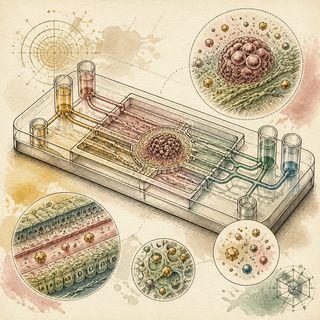
The Tiny Tumor Board Meeting
Organoids are three-dimensional mini-tissues grown from stem cells or patient tumor samples. They can preserve some of the architecture, genetics, and weird local politics of the original tumor. Think of them as tiny tumor neighborhoods, complete with zoning disputes, bad plumbing, and one very aggressive HOA.
That matters because nanoparticles do not just “go to the cancer.” They have to survive circulation, cross barriers, penetrate dense tissue, avoid getting trapped, release their cargo, and ideally not redecorate the liver with side effects. The tumor microenvironment - immune cells, fibroblasts, blood vessels, extracellular matrix, oxygen gradients - is not background scenery. It is the bouncer, the logistics network, and sometimes the arsonist.
Wu et al. frame organoids as a more realistic evaluation platform for efficacy, safety, and clinical correlation [1]. That is the business model upgrade: stop asking whether a nanomedicine works in a cartoon version of cancer, and start asking whether it works in something that behaves more like the messy patient-specific market.
Add a Chip, Get a Flywheel
The “on-a-chip” part adds microfluidics: controlled fluid flow, gradients, mechanical forces, and sometimes vascular-like channels. Organ-on-a-chip systems are basically tiny lab plumbing with ambition. They let researchers model drug transport, shear stress, nutrient delivery, and cell-to-cell interactions in ways static organoids cannot always capture.
Recent reviews have been converging on the same thesis. Li et al. describe spheroids, organoids, and tumor-on-a-chip systems as a new generation of 3D preclinical models for recreating tumor microenvironments and predicting drug response [2]. Other work on tumor-microenvironment-on-chip platforms highlights why old models struggle: they often miss the cell-cell and cell-matrix interactions that drive invasion, resistance, and treatment response [3].
For nanomedicine, this is not academic garnish. It changes what you can measure. Can the nanoparticle actually penetrate a dense tumor organoid? Does it release drug where it should? Does the immune-like microenvironment change the result? Does a different patient’s organoid produce a totally different answer, because biology loves making spreadsheets emotionally unstable?
The AI Angle: Less Oracle, More Ops Team
The paper also points to artificial intelligence as part of the next stack [1]. That sounds like a pitch deck slide titled “AI-Native Organoid Intelligence Layer,” which I regret to say would probably raise money. But the useful version is grounded: AI could analyze imaging readouts, multi-omics data, nanoparticle properties, and patient-specific responses to predict which formulations deserve more testing.
This is where tools for visual reasoning actually matter. If you are mapping how nanoparticle size, tumor stiffness, immune context, and drug release kinetics interact, a visual workspace like mapb2.io is not replacing the lab. It is helping humans keep the causal spaghetti from becoming biomedical lasagna.
Still, AI will not magically fix weak data. A model trained on messy organoid experiments can become a very confident spreadsheet goblin. The moat is not “we added AI.” The moat is standardized, reproducible, clinically linked organoid data.
The Hard Parts Investors Ask About
This review is not pretending the future ships next quarter. Organoids still struggle with immune-system realism, vascularization, reproducible culture conditions, and material compatibility. Chip materials such as PDMS can absorb hydrophobic molecules, which is awkward when your entire business depends on accurately measuring drug behavior [3]. Organoids can also vary by lab protocol, extracellular matrix, passage number, and sample quality.
And there is the clinical translation question: do organoid responses actually predict patient outcomes at scale? Some patient-derived organoid work is encouraging, and 2025 reviews of nanoparticle development argue that organoids can help evaluate delivery efficiency, therapeutic effects, and safety profiles [4]. But “promising platform” is not the same as “validated clinical decision engine.” That is the difference between a Series A story and revenue.
Why This Paper Has a Real Shot
The compelling part of Wu et al.’s argument is the evaluation framework. They are not just saying “organoids are cooler than cell culture,” which is true but not a strategy. They are asking for a structured way to compare nanomedicine efficacy, safety, and clinical relevance across organoid systems [1].
If that works, cancer nanomedicine gets a better filter. Fewer gorgeous nanoparticles die late. More patient-specific therapies get tested in models that remember patients are not uniform beige lab mice with grant funding. The flywheel is obvious: better models produce better readouts, better readouts improve AI predictions, better predictions guide better nanomedicine design, and suddenly the roof stops leaking into the cap table.
Not a guaranteed exit. But definitely a better building inspection.
References
-
Wu C, Chen J, Zhang C, et al. “Tumor organoids as a revolutionary platform for advancing cancer nanomedicine.” Molecular Cancer. 2026. DOI: 10.1186/s12943-026-02702-w. PMID: 42265674
-
Li W, Zhou Z, Zhou X, et al. “3D Biomimetic Models to Reconstitute Tumor Microenvironment In Vitro: Spheroids, Organoids, and Tumor-on-a-Chip.” Advanced Healthcare Materials. 2023;12(18):e2202609. DOI: 10.1002/adhm.202202609. PMID: 36917657
-
Wang Y, et al. “Tumor-microenvironment-on-a-chip: the construction and application.” Cell Communication and Signaling. 2024;22:515. DOI: 10.1186/s12964-024-01884-4. PMID: 39438954
-
Chen L, Luo X, Zhang J, et al. “Harnessing Organoid Platforms for Nanoparticle Drug Development.” Drug Design, Development and Therapy. 2025. Full text: DovePress
-
Wikipedia contributors. “Organoid” and “Organ-on-a-chip.” Background references accessed June 10, 2026. Organoid, Organ-on-a-chip
Disclaimer: This blog post is a simplified summary of published research for educational purposes. The accompanying illustration is artistic and does not depict actual model architectures, data, or experimental results. Always refer to the original paper for technical details.