Since the 1950s, when researchers learned to grow cancer cells in flat lab dishes, oncology has been haunted by the same annoying problem: tumors in real bodies do not behave like polite little pancakes. Attempt one was 2D cell culture. Attempt two was animal models. Attempt three was "surely this slightly fancier version will work." And then, over and over, promising drugs strutted through the lab like action heroes and face-planted in clinical trials.
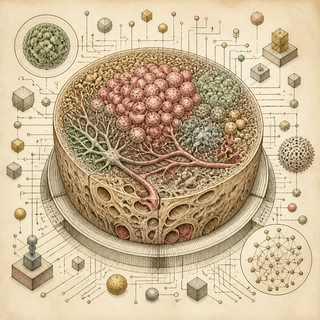
The review by Huang and colleagues, "Deconstructing cancer in 3D: models, mechanisms, and personalized solutions" (DOI: 10.1186/s12943-026-02704-8), argues that the fix is not just better chemistry. It is better scenery. Cancer needs to be studied in three dimensions, where cells can crowd, hide, starve, gossip chemically, and generally behave like the tiny biological neighborhood dispute that tumors actually are.
Flat Cancer Was Lying To Us
A 2D cancer dish is useful. It is cheap, fast, and easy to measure. It is also a bit like studying New York City by looking at a parking lot.
Real tumors have architecture. Cells sit at different distances from blood vessels. Some get oxygen and nutrients. Others live in low-oxygen misery, like interns during conference deadline week. Some cells are wrapped in extracellular matrix, surrounded by fibroblasts, immune cells, and signaling molecules. This whole mess is called the tumor microenvironment, and it can decide whether a therapy reaches its target or gets blocked at the door by cellular bouncers.
That is why 3D models matter. Spheroids are simple clumps of tumor cells that can form nutrient and oxygen gradients. Patient-derived organoids, or PDOs, are grown from a patient's own tumor tissue and can preserve parts of the tumor's structure and genetic weirdness. Organ-on-a-chip systems add fluid flow. 3D bioprinting can place cells and matrix materials into planned arrangements. And then researchers add co-cultures with immune or stromal cells, because apparently cancer biology was not already enough of a group project.
Meet The Tumor Avatar
The most sci-fi-sounding idea here is also one of the most practical: grow a miniature version of a patient's tumor, test drugs on it, and use the results to guide treatment decisions.
This is called functional precision medicine. Instead of only sequencing a tumor and asking, "Which mutation is driving this disaster?", researchers can ask, "Which drug actually slows this patient's tumor cells in a realistic-ish model?" That second question has a certain blunt charm. It is the lab equivalent of "stop explaining your vibe and show me the receipts."
Recent work has been pushing exactly this direction. A 2023 BMC Cancer paper described patient-derived organoids as a platform for clinical decision-making and highlighted how organoids can capture variable drug sensitivity across patients (DOI: 10.1186/s12885-023-11078-9). Reviews in 2024 have also emphasized that organoids are especially valuable when they include the immune side of the microenvironment, because immunotherapy is not just cancer versus drug. It is cancer, immune cells, stromal cells, signaling gradients, and then the drug walks in wearing a tiny referee shirt.
Resistance Is The Villain With A Backup Plan
Cancer therapy often fails because tumors evolve. A drug kills the vulnerable cells, and then resistant clones expand. And then those clones recruit help from nearby stromal cells. And then the extracellular matrix gets denser. And then the immune system may get exhausted. And then you realize the tumor has been running a hostile startup with better contingency planning than most corporations.
Huang and colleagues focus heavily on this point: 3D models can help researchers watch resistance form instead of merely discovering it after relapse. Scientists can expose organoids to therapy, isolate resistant cells, profile them with single-cell omics, perturb genes with CRISPR, and test combination therapies. The result is not magic. It is a better interrogation room.
This connects to recent spatial biology too. A 2024 Nature study mapped tumor evolution and microenvironment interactions across 2D and 3D space, showing that tumor regions can differ genetically, metabolically, and immunologically depending on where they sit (DOI: 10.1038/s41586-024-08087-4). Location matters. In cancer, real estate is not just expensive. It is molecularly dramatic.
Where AI Enters Without Wearing A Cape
The review also points to artificial intelligence as part of the future toolkit. That does not mean a chatbot will prescribe chemotherapy while misquoting Shakespeare. It means machine learning may help integrate messy data: drug screens, microscopy, single-cell sequencing, spatial maps, CRISPR results, and clinical outcomes.
That is a lot of variables. Humans can reason through some of it, but at a certain point the spreadsheet starts looking like a cursed family tree. AI models could help identify which organoid features predict response, which resistance pathways matter, and which drug combinations deserve testing first. Useful, yes. Omniscient, no. The overworked GPUs still need good data, careful validation, and researchers who do not confuse pattern matching with prophecy.
The Catch: Tiny Tumors Are Still Tiny Models
PDOs are powerful, but they are not full patients in a dish. Some lack blood vessels, nerves, immune complexity, microbiome effects, metabolism, and the full chaos of a living body. Standardization is also a problem. Labs may grow organoids differently, measure responses differently, and define "drug sensitivity" differently. If everyone brings their own ruler, the height contest gets weird fast.
Still, the direction is compelling. Better 3D models could reduce wasted drug development, reveal why therapies fail, and help doctors choose treatments based on living tumor behavior instead of guesswork alone. The big promise is not that organoids replace clinical trials. It is that they make preclinical testing less like tossing darts in a dark room while wearing oven mitts.
References
-
Huang Z, Duan X, Ji J, Cai Q, Jin P, Yu B, Zhang J. Deconstructing cancer in 3D: models, mechanisms, and personalized solutions. Molecular Cancer. 2026. DOI: 10.1186/s12943-026-02704-8. PMID: 42249357
-
Nelson L, et al. Patient-derived organoids for precision oncology: a platform to facilitate clinical decision making. BMC Cancer. 2023. DOI: 10.1186/s12885-023-11078-9
-
Polak R, Zhang ET, Kuo CJ. Cancer organoids 2.0: modelling the complexity of the tumour immune microenvironment. Nature Reviews Cancer. 2024. DOI: 10.1038/s41568-024-00706-6
-
Mo CK, Liu J, Chen S, et al. Tumour evolution and microenvironment interactions in 2D and 3D space. Nature. 2024. DOI: 10.1038/s41586-024-08087-4
-
Pandya HJ, et al. Engineered 3D ex vivo models to recapitulate the complex stromal and immune interactions within the tumor microenvironment. Biomaterials. 2024. DOI: 10.1016/j.biomaterials.2023.122428
Disclaimer: This blog post is a simplified summary of published research for educational purposes. The accompanying illustration is artistic and does not depict actual model architectures, data, or experimental results. Always refer to the original paper for technical details.