It turns out that if the little neighborhood of blood vessels and support cells around your neurons starts falling apart, the brain does not, strictly speaking, thrive.
That is the big idea in a 2026 review by Lifang Wang, Lei Han, and Shiping Liu: in Alzheimer’s disease, trouble in the neurovascular unit, or NVU, may show up early enough that it is not just collateral damage from amyloid plaques. It might be helping light the fuse in the first place (Wang et al., 2026). If you grew up on the classic Alzheimer’s script, the villain was mostly amyloid-beta, with tau barging in later like a second-act menace. This paper says, politely but firmly, that we may also need to inspect the pipes, the gates, and the whole maintenance crew.
The Brain Is Not Just Neurons Being Dramatic
The neurovascular unit is the brain’s tiny civic government. You have endothelial cells lining blood vessels, pericytes wrapped around them, astrocytes doing support duty, microglia causing trouble when alarmed, and neurons trying to keep the whole town functional. Together they regulate blood flow, keep the blood-brain barrier tight, and help clear waste. Very glamorous work. Little applause.
When that system slips, you can get reduced cerebral blood flow, leaky barriers, inflamed support cells, and stressed neurons. Wang and colleagues argue this matters because decreased blood flow is often observed before major amyloid buildup, which makes the timeline a lot more interesting. In plain English: the brain may be getting under-watered before the usual pathological fireworks really get going.
Back in my day, and by that I mean the older era of Alzheimer’s research, a lot of people treated blood vessels like the side characters in a detective show. Nice to have around, probably not the killer. These days the side characters are looking awfully suspicious.
Plaques, Vessels, and a Very Rude Feedback Loop
The review leans on a vascular view of Alzheimer’s that has been gathering steam for years. Once the NVU starts malfunctioning, amyloid clearance gets worse, inflammation rises, and the blood-brain barrier gets leakier. Then amyloid itself can further injure vascular cells. That is less a tidy pathway than a miserable group project where every bad participant makes the others worse.
Recent work fits that picture. A 2023 review in Frontiers in Molecular Neuroscience summarized how neurovascular dysfunction and amyloid-beta can reinforce each other, worsening hemodynamics, barrier permeability, and cell stress (Li et al., 2023). A 2025 study using VINE-seq, a single-nucleus approach focused on vascular cells, reported that vascular transcriptional changes appear as early as mild cognitive impairment, with endothelial cells and smooth muscle cells especially affected (Yang et al., 2025). That is the sort of result that makes you put your drink down for a second.
So no, this paper is not claiming amyloid is irrelevant. It is saying the story is more like a house fire where the wiring, the insulation, and the smoke alarm are all failing at once.
The New Toys Are Ridiculously Better
Where this review gets especially interesting is in the toolbox. The authors highlight spatial transcriptomics and 3D NVU organoids as the technologies that can finally make this vascular-first question testable in detail.
Spatial transcriptomics lets researchers measure gene activity while preserving where cells sit in tissue. That matters because brain disease is all about location, location, location. A neuron two microns from a plaque is living a different life from one across the block. A 2023 Nature Reviews Neurology article laid out why spatial methods matter so much in brain disorders: they keep the tissue map intact instead of turning the brain into molecular soup (Piwecka et al., 2023). A 2025 spatial study of human Alzheimer’s tissue found distinct plaque-glia niches, which is science-speak for “the cells around plaques are not all reacting the same way, and the local neighborhood matters” (Vahedi-Faridi et al., 2025).
Then there are organoids, those tiny lab-grown brainlike structures that look, conceptually, like biology decided to prototype on a countertop. Traditional brain organoids have a problem, though: they usually lack proper vasculature. That is a bit like studying city traffic using a map with no roads. Reviews from 2024 and 2025 argue that vascularized brain organoids and NVU-focused models could give researchers more faithful ways to study Alzheimer’s mechanisms and test therapies (Abati et al., 2024); (Kumari et al., 2025).
Where the AI Part Quietly Enters the Room
Now, the paper is not an AI paper in the “behold our giant transformer” sense. Thank heavens. But AI and machine learning matter here because these experiments generate absurdly large, messy datasets. Spatial transcriptomics, organoid imaging, cell-state classification, vascular network modeling - this is exactly the kind of work where machine learning earns its keep instead of just writing suspiciously confident emails.
Databases such as ssREAD already collect Alzheimer’s single-cell and spatial RNA-seq data for reuse and comparison (Wang et al., 2024). And if you were trying to keep track of all these cell neighborhoods, pathways, and who is yelling at whom, a visual mapping tool like mapb2.io would honestly not be the worst companion. Better that than the traditional method of twelve tabs, one notebook, and a slowly deteriorating sense of self.
The paper’s real message is a simple one: maybe Alzheimer’s is not just a story about bad proteins piling up. Maybe it is also a story about the brain losing its ability to regulate blood, barriers, and cleanup early on. If that holds up, then treating the disease may require less tunnel vision and more appreciation for the cranky little infrastructure that keeps neurons alive.
References
Wang L, Han L, Liu S. Dysfunction of the neurovascular unit as a temporal driver in Alzheimer’s pathogenesis. Translational Neurodegeneration. 2026;15:17. DOI: 10.1186/s40035-026-00548-2. PubMed: https://pubmed.ncbi.nlm.nih.gov/42021347/
Li M, et al. Cooperation between neurovascular dysfunction and Aβ in Alzheimer’s disease. Frontiers in Molecular Neuroscience. 2023;16:1227493. DOI: 10.3389/fnmol.2023.1227493
Piwecka M, Rajewsky N, Rybak-Wolf A. Single-cell and spatial transcriptomics: deciphering brain complexity in health and disease. Nature Reviews Neurology. 2023;19:346-362. Article: https://www.nature.com/articles/s41582-023-00809-y
Abati E, et al. Shaping the Neurovascular Unit Exploiting Human Brain Organoids. Molecular Neurobiology. 2024. DOI: 10.1007/s12035-024-03998-9
Kumari S, et al. Three-dimensional human brain organoids: A next-generation model to decode Alzheimer’s disease. Ageing Research Reviews. 2025;102928. DOI: 10.1016/j.arr.2025.102928
Vahedi-Faridi A, et al. Uncovering plaque-glia niches in human Alzheimer’s disease brains using spatial transcriptomics. Molecular Neurodegeneration Advances. 2025;1(1):2. DOI: 10.1186/s44477-025-00002-z
Wang C, et al. A single-cell and spatial RNA-seq database for Alzheimer’s disease (ssREAD). Nature Communications. 2024;15:4710. Article: https://www.nature.com/articles/s41467-024-49133-z
Yang AC, et al. Angiopoietin signalling is a central axis of amyloid-driven vascular dysfunction in Alzheimer’s disease. 2025. PMCID: PMC12407677
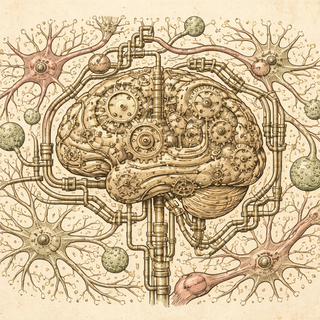
Disclaimer: This blog post is a simplified summary of published research for educational purposes. The accompanying illustration is artistic and does not depict actual model architectures, data, or experimental results. Always refer to the original paper for technical details.