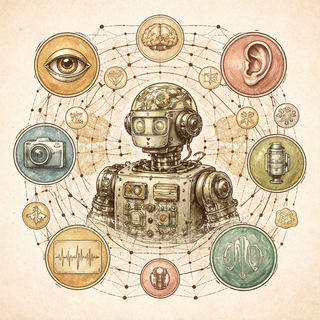
A robot that can see, hear, and read walks into a bar. The bartender asks, "What'll it be?" The robot freezes - it just learned to recognize cocktails from pictures, but in doing so, completely forgot how to understand spoken drink orders. Welcome to catastrophic forgetting, and it's way more common in AI than you'd think.
The Memory Problem Nobody Talks About
Here's the dirty secret of modern AI: most models are terrible at learning new things without forgetting old ones. Train a model to recognize cats, then train it on dogs, and suddenly it thinks every cat is a very weird-looking dog. This is catastrophic forgetting, and it's been haunting machine learning researchers for decades.
Now multiply that problem by the number of ways humans actually experience the world - sight, sound, text, touch - and you've got multimodal continual learning (MMCL). A new comprehensive survey by Yu et al. [1] just mapped out this entire research landscape, and honestly, it's both messier and more exciting than I expected.
Why Can't We Just Stack Solutions?
The intuitive approach would be: "Hey, we solved forgetting for image models and text models separately. Let's just... combine those solutions!"
Reader, it does not work that way.
When you're juggling multiple modalities, new gremlins emerge. There's modality imbalance - where your model gets really good at one input type while ignoring others (like that friend who only communicates via memes). There's complex modality interaction - the way visual and textual information need to dance together, not just coexist. And there's the computational nightmare of keeping all these balls in the air without melting your GPU cluster.
The survey categorizes current solutions into four flavors:
Regularization-based methods add penalties to prevent the model from changing too drastically. Think of it as putting guardrails on learning - "you can update these weights, but not too much."
Architecture-based methods grow or modify the network structure itself. New task? New neurons. It's like adding rooms to a house instead of redecorating.
Replay-based methods keep a memory bank of old examples and mix them into new training. Essentially, periodic pop quizzes to keep old knowledge fresh.
Prompt-based methods - the new kid on the block - use clever input modifications to steer large pretrained models without changing their core weights. It's like giving the model different glasses to look through rather than rewiring its brain.
The Zero-Shot Problem
Here's where things get spicy. Modern multimodal models like CLIP come with a superpower: zero-shot capability. They can recognize things they've never explicitly been trained on because they learned general relationships between images and text. But continual learning can accidentally break this.
Imagine spending years learning to understand the world broadly, then someone forces you to become an expert on 17th-century Dutch pottery. Great for pottery. Terrible for everything else you used to know. The survey highlights this "pretrained zero-shot degradation" as a key challenge - how do you keep learning specific things without losing your general intelligence?
The Benchmark Situation
One refreshing aspect of this survey is its honesty about the current state of MMCL benchmarks. Most existing datasets were designed for unimodal continual learning, then awkwardly retrofitted for multimodal scenarios. It's like testing a car's off-road capability by driving it through a parking lot - technically you're moving, but you're not really stress-testing anything.
The authors call for more diverse benchmarks that actually capture real-world multimodal complexity. Fair point. If we want AI systems that can genuinely learn continuously from the messy, multimedia firehose of real life, we need to test them on something closer to that chaos.
Why Should You Care?
Beyond the academic interest, MMCL matters because it's the gap between current AI and the adaptable systems we actually want. Your phone's assistant can answer questions, recognize faces, and transcribe speech - but it can't really learn from your corrections without a massive retraining cycle. Continual learning is how we get from "impressive demo" to "actually useful over time."
The survey points toward promising future directions: better theoretical understanding of why multimodal forgetting happens, more efficient methods that don't require storing everything forever, and approaches that leverage the complementary nature of different modalities rather than treating them as separate problems glued together.
For anyone working with tools that process documents, images, or mixed media - the kind of real-world inputs that pdfb2.io handles with browser-based PDF processing - these advances could eventually mean systems that improve with use rather than requiring periodic replacement.
The Bottom Line
MMCL is still early days. The survey maps a field that's rapidly evolving, with no single dominant approach. But that's exactly what makes it interesting. The researchers have done the community a service by organizing this chaos and pointing toward what needs solving next.
The GitHub repository they've created [2] is worth bookmarking if you're in this space. And if you're not? Just know that somewhere, researchers are working hard so that future AI can walk, talk, see, and remember - all at the same time, without getting confused.
References
-
Yu, D., Zhang, X., Chen, Y., Liu, A., Zhang, Y., Yu, P. S., & King, I. (2026). Recent Advances of Multimodal Continual Learning: A Comprehensive Survey. IEEE Transactions on Neural Networks and Learning Systems. DOI: 10.1109/TNNLS.2026.3658485
-
Awesome-Multimodal-Continual-Learning Repository: https://github.com/LucyDYu/Awesome-Multimodal-Continual-Learning
Disclaimer: This blog post is a simplified summary of published research for educational purposes. The accompanying illustration is artistic and does not depict actual model architectures, data, or experimental results. Always refer to the original paper for technical details.