Medical AI has a dirty secret: most of the models that "read" your chest X-ray were trained on datasets from a handful of large Western hospitals. Show them an image from a different machine, a different patient population, or a slightly different angle, and they fall apart like a house of cards in a stiff breeze. Enter zero-shot transfer learning - the idea that an AI model can look at a type of medical image it has literally never seen before and still say something useful about it.
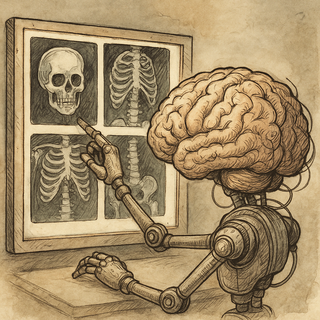
What Even Is Zero-Shot Transfer Learning?
In normal machine learning, you train a model on thousands of labeled examples. "Here's a chest X-ray with pneumonia. Here's one without. Here's another 50,000." The model learns patterns, and then you test it on similar images. Zero-shot transfer flips this on its head. The model encounters a new task - say, identifying a collapsed lung on a type of scan it's never seen - and attempts to figure it out from its general understanding of medical imagery.
It's like hiring a chef who trained exclusively in French cuisine and asking them to make sushi. They've never rolled a maki in their life, but they understand knife skills, ingredient quality, and flavor balance. Sometimes they nail it. Sometimes you get a croissant wrapped around salmon.
How It Actually Works
The trick relies on foundation models - massive neural networks pre-trained on enormous datasets of paired images and text. Models like BiomedCLIP or Med-PaLM learn to associate visual features with medical descriptions across millions of examples. They don't just memorize "this blob pattern equals pneumonia." They develop something closer to a general visual vocabulary for medicine.
When these models encounter a new imaging modality - maybe pediatric echocardiograms when they were trained on adult CT scans - they can draw on that vocabulary. They know what "enlarged" looks like, what "fluid collection" looks like, what "normal anatomy" looks like, even if the specific view is unfamiliar.
Recent work shows these models achieving decent accuracy on imaging tasks they were never trained for. Not "replace the radiologist" good - but "flag this for a human to look at" good, which is a very different and useful threshold.
Why Radiologists Should Care (But Not Panic)
The practical implications are enormous for healthcare in under-resourced settings. A hospital in rural Nepal doesn't have the luxury of waiting for someone to curate a training dataset of 100,000 local chest X-rays. If a foundation model can provide useful preliminary reads on imaging data it's never specifically trained on, that's the difference between "no AI assistance at all" and "imperfect but helpful screening."
There's also the data diversity problem. Models trained only on data from large academic medical centers learn the biases of those centers. Zero-shot transfer from diverse foundation models could actually reduce bias, since the model isn't overfitting to one institution's equipment, protocols, or patient demographics.
The Obvious Limitations
Let's not get carried away. Zero-shot performance is consistently lower than supervised performance - typically 10-20 percentage points behind models trained specifically for the task. For rare conditions, the gap is even wider. And there's a calibration problem: these models are often confidently wrong, which is arguably worse than being uncertain.
The other issue is validation. If a model has never been tested on a specific imaging type, how do you know when to trust it? This is an active area of research, and the honest answer right now is "carefully."
Where This Is Heading
The trajectory is clear: we're moving toward general-purpose medical vision models that can handle a wide range of imaging tasks out of the box, with optional fine-tuning for specific use cases. Think of it like how a general-purpose language model can write poetry, code, and legal briefs - not as well as a specialist in each, but well enough to be useful.
For medical professionals building presentations or reports with imaging data, having tools that can handle multiple image formats efficiently matters. Something like combb2.io can help when you need to process, resize, or convert batches of medical images for research papers or teaching materials.
The real win won't be AI that replaces radiologists. It'll be AI that makes radiology expertise accessible in places that have never had it. - ## References
- Based on emerging research in zero-shot transfer learning for medical imaging. Related context: Sarac U, et al. Comparative evaluation of multimodal large language models for diagnostic accuracy in pediatric electrocardiography. European Journal of Pediatrics. 2026. DOI: 10.1007/s00431-026-06874-x | PMID: 41872525
- General topic references: Huang Z, et al. A visual-language foundation model for pathology image analysis using medical Twitter. Nature Medicine. 2023. DOI: 10.1038/s41591-023-02504-3