Guess how many genes you need to read before you really understand a tumor. Wrong. Some of the juiciest clues are not genes at all, but the tiny chemicals cells make, burn, hoard, and fling at their neighbors like passive-aggressive office emails. Those chemicals are metabolites, and the new review by Zhu, Huang, Tian, Shao, and Xiao argues that better tools for measuring them could make cancer diagnosis and treatment a lot less like reading tea leaves and a lot more like actual science [1].
If you look closely, this is what makes metabolomics so appealing. Genomics tells you what could happen. Metabolomics tells you what the cell is doing right now, in the biochemical equivalent of catching someone with flour on their shirt and cookie crumbs on the counter. Wikipedia’s background summary on metabolomics puts it plainly: metabolites offer a more direct snapshot of physiological state than upstream omics layers like DNA or RNA [7].
The Exhibit Hall of Tiny Molecules With Big Egos
The review’s main point is that metabolites are not just background noise or cellular exhaust fumes. They help drive tumor behavior. They feed growth, reshape gene regulation, influence protein function, and meddle with the tumor microenvironment [1]. Cancer metabolism has been moving past the old cartoon version of the Warburg effect, where every tumor is just a glucose-chugging goblin. As newer reviews note, tumor metabolism is wildly context-dependent and heterogeneous across cells, tissues, and immune neighborhoods [2,3].
Notice how that changes the whole game. If tumors use metabolites to communicate, adapt, and hide, then measuring those molecules is not a side quest. It is part of the plot.
The paper walks through the tools doing that measuring: mass spectrometry, nuclear magnetic resonance, and newer methods like surface-enhanced Raman spectroscopy, plus spatial and isotope-tracing approaches that show not just what metabolites are present, but where they are and how they move [1]. That matters because a tumor is less like a uniform blob and more like a badly run city with different neighborhoods, weird supply chains, and at least one district making everyone else miserable.
Better Cameras, Better Maps, Better Odds
A big theme in the review is that old-school metabolomics often gave us static snapshots. Useful, yes, but still a bit like judging a baseball game from one blurry photo. Newer methods are starting to capture dynamics and location.
Spatial metabolomics can map molecules across tissue architecture. Metabolic flux analysis, especially with stable isotope tracing, can follow where nutrients actually go. Recent methodological reviews say these approaches are especially useful for exposing tumor heterogeneity and the tug-of-war between cancer cells and immune cells in the microenvironment [3,4]. If you look closely, that is the difference between knowing a town has traffic and knowing exactly which bridge is jammed and why.
This is also where AI barges into the gallery carrying a stack of unlabeled charts. Metabolomics data are high-dimensional, noisy, and full of variables with names that sound like a chemistry final exam. Machine learning helps sort signal from chaos, whether the goal is tumor subtyping, biomarker discovery, prognosis, or treatment response prediction [5,6]. A 2024 review in MedComm summarized how supervised learning, unsupervised clustering, and deep learning are already being used to connect metabolite patterns with clinically useful cancer categories [5].
The Part Where Real Life Interrupts the Hype
Now for the bit every museum tour needs: the cracked vase in the corner.
The promise is real, but so are the problems. Zhu and colleagues emphasize methodological limits and metabolic heterogeneity as major barriers to clinical translation [1]. Different labs use different sample handling, instruments, preprocessing pipelines, and validation strategies. Small molecule identification is still annoyingly hard. Two tumors with the same name can behave like biochemical distant cousins who only meet at funerals.
Other recent papers make the same point. Reviews of liquid-biopsy metabolomics and AI-assisted metabolomics both stress that reproducibility, standardization, and interpretability remain stubborn bottlenecks [4,6]. You can build a model with a lovely AUC, but if nobody trusts how it works or can reproduce it at another hospital, that model is basically a very expensive horoscope.
Still, the translational momentum is hard to ignore. In 2026, a Nature Communications study reported PanMETAI, an AI system using NMR metabolomics and clinical variables for pancreatic cancer detection, a nice example of where the field wants to go: blood-based metabolic signals turned into clinically useful risk predictions [8]. That does not mean we should start throwing confetti at every ROC curve. It does mean the bridge from metabolite discovery to patient care is no longer imaginary.
Why This Review Is Worth Your Attention
What makes this review interesting is not just that it catalogs shiny instruments. It argues for a fuller workflow: detect metabolites better, map them in space, track them over time, and then use smarter algorithms to connect those patterns to diagnosis, stratification, and therapy [1]. That is a much more mature vision than “find weird molecule, publish heatmap, disappear into the fog.”
If you look closely, the field is inching toward something powerful: cancer care that listens not only to the genome’s long-term plans, but also to the metabolome’s live commentary. Tumors are constantly improvising. Metabolites are the improvised lines.
And for once, the scientists brought microphones.
References
-
Zhu XH, Huang L, Tian P, Shao ZM, Xiao Y. Deciphering tumor metabolites: emerging technologies shaping clinical implications. Trends in Cancer. 2026. doi:10.1016/j.trecan.2026.04.004
-
Finley LWS, Vander Heiden MG. What is cancer metabolism? Cell. 2023;186(8):1670-1688. doi:10.1016/j.cell.2023.01.038
-
Peng Q, Yu D, Wen X, et al. Spatiotemporal metabolomic approaches to the cancer-immunity panorama: a methodological perspective. Molecular Cancer. 2024;23:32. doi:10.1186/s12943-024-02113-9
-
Wang W, Zhen S, Ping Y, Wang L, Zhang Y. Metabolomic biomarkers in liquid biopsy: accurate cancer diagnosis and prognosis monitoring. Frontiers in Oncology. 2024;14:1331215. doi:10.3389/fonc.2024.1331215. PMCID:PMC10879439
-
Rida PCG, et al. Machine Learning-Driven Insights in Cancer Metabolomics: From Subtyping to Biomarker Discovery and Prognostic Modeling. MedComm. 2023;4:e218. doi:10.1002/mco2.218
-
Bifarin OO, Fernández FM. Automated Machine Learning and Explainable AI (AutoML-XAI) for Metabolomics: Improving Cancer Diagnostics. Journal of the American Society for Mass Spectrometry. 2024;35(6):1089-1100. doi:10.1021/jasms.3c00403
-
Wikipedia contributors. Metabolomics. Wikipedia. Accessed May 17, 2026. https://en.wikipedia.org/wiki/Metabolomics
-
Chang YT, et al. PanMETAI - a high performance tabular foundation model for accurate pancreatic cancer diagnosis via NMR metabolomics. Nature Communications. 2026. doi:10.1038/s41467-026-69426-9
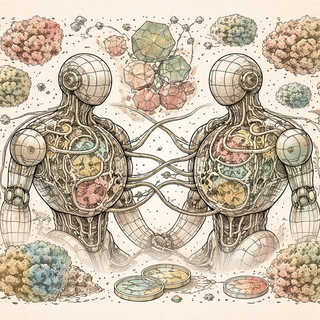
Disclaimer: This blog post is a simplified summary of published research for educational purposes. The accompanying illustration is artistic and does not depict actual model architectures, data, or experimental results. Always refer to the original paper for technical details.