A few years from now, your AR glasses may stop pretending depth exists and actually put tiny glowing objects at different distances from your eyes, like a courtroom exhibit floating over your coffee. No more flat sticker-world. No more digital dinosaur that looks pasted onto reality by an exhausted intern with Photoshop and a deadline.
Ladies and gentlemen of the jury, today’s evidence concerns a paper with the delightfully sci-fi title: “Snapshot 3D image projection using a diffractive decoder” by Işıl, Chen, Li, Ardic, Chen, Shen, and Ozcan, published in Light: Science & Applications in 2026 (DOI: 10.1038/s41377-026-02378-3).
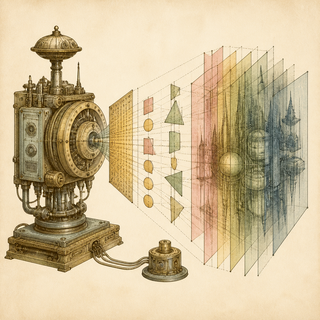
The charge: conventional holographic displays struggle when asked to project many sharp image layers close together in depth.
The proposed remedy: make the light itself do some of the decoding.
Exhibit A: Depth Is Messy
Computer-generated holography sounds simple until physics enters the room wearing a powdered wig. A hologram controls a light wavefront so that, after propagation, it reconstructs an image in space. A spatial light modulator, or SLM, acts like a programmable transparency that changes the phase or intensity of light pixel by pixel. In normal human terms: it is a tiny stage manager telling light where to go.
But 3D displays need more than one image plane. They need many depth slices, stacked like transparent pancakes. The trouble is diffraction. When planes get close together, light meant for one slice leaks into its neighbors. This is cross-talk, and it is the optical equivalent of everyone in a group chat replying to the wrong thread.
The evidence shows this is not a minor annoyance. Holographic AR and VR need accurate focal cues so your eyes can focus naturally. That matters for comfort, depth perception, and not feeling like your headset is quietly arguing with your eyeballs.
Exhibit B: The Decoder Is a Piece of Hardware
The new system pairs two trained parts.
First, a digital encoder takes a stack of target images, each assigned to a depth, and turns them into one phase pattern for the SLM. It uses Fourier-style neural network ideas, which means it pays attention to both local image structure and frequency patterns. If normal pixels are witness statements, Fourier features are the forensic accountant who notices the suspicious repeating expenses.
Second, the light passes through a diffractive decoder: one or more passive optical layers whose microscopic phase patterns were optimized during training. These layers do not run software at display time. They just sit there, bending and reshaping the wavefront as light passes through.
I submit to you that this is the neat part: the model is not only learning what image to send to the projector. It is learning how that projected light will be decoded by physical optics. The digital network and the passive decoder are trained together, like a magician and a trapdoor crew who actually rehearsed.
Exhibit C: Twenty-Eight Slices, One Snapshot
The headline result is that the system can project different images onto multiple axial planes in a single shot. The paper reports simulations with very tight axial spacing, down to separations on the order of a wavelength, and a volumetric example with 28 axial slices encoded into one phase pattern.
That does not mean your living room gets a perfect Star Wars chess table tomorrow. The authors also show trade-offs. Decoder depth matters. SLM resolution matters. Diffraction efficiency matters. Axial density matters. The middle slices in the 28-plane volume showed more trouble than the outer ones, because they get photobombed from both sides. Physics, as usual, has read the contract and found the loophole.
They also built an experimental two-plane prototype using a single-layer physical decoder in visible light. The measured projections matched the targets and simulations reasonably well, and the diffractive decoder beat a free-space baseline. That is a modest but meaningful hardware validation, not just a numerical victory lap.
Why the Jury Should Care
Recent work has been pushing holographic displays from several angles: better neural hologram generation, metasurface waveguides for compact AR glasses, neural étendue expanders for wider fields of view, and optical neural networks that use light propagation as computation. This paper fits that trend, but with a specific argument: if dense depth planes are hard to separate computationally, build a learned optical decoder into the system.
Consider the possible impact if this scales. Compact 3D displays could help AR glasses show content at more natural focal depths. Volumetric microscopy could project or manipulate image planes more efficiently. Optical computing systems might use similar ideas to route information through depth. And yes, someday your “floating spreadsheet” may actually float, which is both technically impressive and spiritually troubling.
The limits still matter. The paper leans heavily on simulations for the most ambitious 28-slice results. Real devices will need fabricated multilayer decoders, color operation, alignment tolerance, brightness, field of view, manufacturability, and all the other engineering chores that turn beautiful lab optics into products. The overworked GPUs can train the design, but the factory still has to make the thing.
The Verdict
The evidence shows a clever hybrid: neural encoding on the digital side, learned diffractive decoding on the optical side, both optimized together so light lands where it is supposed to land. Not magic. Not hype. Just a careful attempt to make physics carry more of the workload.
Verdict: promising, with conditions. The court requests more experiments, color demonstrations, larger physical prototypes, and fewer photons wandering into the wrong depth plane like confused party guests.
References
-
Işıl, Ç., Chen, A., Li, Y., Ardic, F. O., Chen, S., Shen, C.-Y., & Ozcan, A. “Snapshot 3D image projection using a diffractive decoder.” Light: Science & Applications 15, 270 (2026). https://doi.org/10.1038/s41377-026-02378-3
-
Gopakumar, M. et al. “Full-colour 3D holographic augmented-reality displays with metasurface waveguides.” Nature 629, 791-797 (2024). https://doi.org/10.1038/s41586-024-07386-0
-
Tseng, E. et al. “Neural étendue expander for ultra-wide-angle high-fidelity holographic display.” Nature Communications 15, 2907 (2024). https://doi.org/10.1038/s41467-024-46915-3
-
Li, Y. et al. “Propagation-adaptive 4K computer-generated holography using physics-constrained spatial and Fourier neural operator.” Nature Communications 16, 7761 (2025). https://doi.org/10.1038/s41467-025-62997-z
-
Hu, J. et al. “Diffractive optical computing in free space.” Nature Communications 15, 1525 (2024). https://doi.org/10.1038/s41467-024-45723-z
Disclaimer: This blog post is a simplified summary of published research for educational purposes. The accompanying illustration is artistic and does not depict actual model architectures, data, or experimental results. Always refer to the original paper for technical details.