Somewhere right now, an organic electrochemical transistor the size of a fingernail is sitting in a petri dish, quietly converting ions into electrons, helping researchers read the faint electrical whispers of living brain tissue. It runs on less power than a watch battery. It bends without breaking. And until last week, nobody had a good way to design the polymers that make it tick - at least not without years of chemistry-lab roulette.
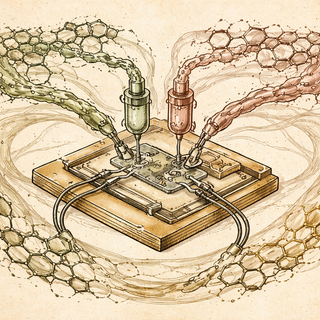
That changes with a new study from Shuang-Yan Tian, Ting Lei, and colleagues, published in Nature Communications (DOI: 10.1038/s41467-026-71381-4). Their trick? Teaching a machine learning model to predict polymer performance using barely any training data - by borrowing knowledge from an entirely different domain first.
The "Not Enough Data" Problem (A.K.A. Every Materials Scientist's Nightmare)
Here's the catch with using AI to discover new materials: you need data. Lots of it. GPT-4 got trillions of words. AlphaFold had hundreds of thousands of protein structures. But organic electrochemical transistor (OECT) materials? There are maybe a few hundred well-characterized examples in the entire scientific literature. Try training a neural network on that, and it'll basically shrug at you.
This is where transfer learning enters the chat. The concept is borrowed from computer vision - where a model trained on millions of cat photos can quickly learn to identify rare skin cancers - and applied to materials science. Previous work, like Yamada et al.'s "shotgun transfer learning" approach (DOI: 10.1021/acscentsci.9b00804), showed you could pretrain on abundant proxy properties and then fine-tune with tiny datasets. But the team here went further: they built what they call Physical-Knowledge-Undergirded Transfer Learning, or PKU-TL - because apparently the model needs to understand physics, not just pattern-match.
How It Actually Works (Without the Math Migraine)
Think of it this way. You want to predict how well a new polymer will perform in an OECT, but you only have 50 examples to learn from. That's like trying to learn French from a pamphlet. So instead, you first learn Spanish (a related language with tons of textbooks), then use that foundation to pick up French way faster.
PKU-TL pretrains on related, data-rich polymer properties - things like electrical conductivity and molecular orbital energies that have thousands of known values. The model absorbs the deep structural patterns connecting polymer chemistry to electronic behavior. Then it transfers that knowledge to the data-starved OECT task. The "physical knowledge" part means the researchers didn't just throw data at it blindly; they embedded domain expertise about how molecular structure actually drives device performance. The AI gets the equivalent of a chemistry degree before it starts predicting.
N-Type Polymers: The Underdogs Get Their Moment
Most OECT research has focused on p-type (hole-transporting) polymers. N-type materials - the ones that shuttle electrons instead - have lagged behind, partly because they're harder to design and partly because there's even less data on them. The team specifically targeted this gap, using their AI framework to screen candidates and generate hypotheses about what molecular features matter most.
The payoff: they identified and synthesized new n-type conjugated polymers that hit the sweet spot of low operating voltage and high transconductance (the OECT equivalent of "responsiveness"). More importantly, the model's predictions matched the experimental results, validating that PKU-TL isn't just curve-fitting noise - it's actually learning real structure-property relationships.
Why Should You Care About Transistors That Run on Ions?
OECTs are quietly becoming the darlings of bioelectronics. They operate at sub-1V (your neurons would approve), work in wet biological environments, and can detect everything from glucose levels to neural signals (DOI: 10.1038/s41528-025-00383-x). They're the bridge between silicon and skin. Better OECT materials means better brain-computer interfaces, smarter biosensors, and wearable health monitors that don't need a battery the size of a brick.
And the broader methodology - using transfer learning to navigate data-scarce materials spaces - isn't limited to OECTs. Any emerging materials field where you're data-poor but physics-rich could benefit. Recent work on machine-learning-assisted polymer design (DOI: 10.1021/accountsmr.5c00151) and autonomous experimentation platforms (Nature Chemical Engineering, 2025) suggests this AI-plus-physical-insight approach is becoming the new playbook. If you're interested in how AI tools are already enhancing visual and analytical workflows, tools like mapb2.io offer mind-mapping capabilities that can help researchers visually organize exactly these kinds of complex structure-property relationships.
The Bottom Line
This isn't a story about AI replacing chemists. It's about AI making chemists faster and more targeted - especially when they're exploring uncharted territory with barely enough data to fill a spreadsheet. By teaching a model physics first and chemistry second, the team turned a data desert into a discovery engine. The polymers they found are real, synthesized, and working. And the approach is open for anyone to adapt to their own materials moonshot.
That OECT in the petri dish just got a serious upgrade path. And it only needed 50 data points to get there.
References:
-
Tian, S.-Y., Ren, Z., Zheng, Y., Wang, J., Deng, X.-Y., Li, Q., Mo, F., & Lei, T. (2026). Transfer-learning guided design of high-performance conjugated polymers for low-voltage electrochemical transistors. Nature Communications. DOI: 10.1038/s41467-026-71381-4
-
Yamada, H., Liu, C., Wu, S., Koyama, Y., Ju, S., Shiomi, J., Morikawa, J., & Yoshida, R. (2019). Predicting Materials Properties with Little Data Using Shotgun Transfer Learning. ACS Central Science, 5(10), 1717-1730. DOI: 10.1021/acscentsci.9b00804
-
Xiang, L. et al. (2026). Organic Electrochemical Transistors for Neuromorphic Devices and Applications. Advanced Materials. DOI: 10.1002/adma.202515532
-
Machine-Learning-Assisted Molecular Design of Innovative Polymers. (2025). Accounts of Materials Research. DOI: 10.1021/accountsmr.5c00151
-
Biomolecule sensors based on organic electrochemical transistors. (2025). npj Flexible Electronics. DOI: 10.1038/s41528-025-00383-x
-
Small data machine learning in materials science. (2023). npj Computational Materials. DOI: 10.1038/s41524-023-01000-z
Disclaimer: This blog post is a simplified summary of published research for educational purposes. The accompanying illustration is artistic and does not depict actual model architectures, data, or experimental results. Always refer to the original paper for technical details.