Back in 2013, The Cancer Genome Atlas cracked open acute myeloid leukemia with a serious genomic map: 200 cases, mutations, methylation, expression, the whole beige-tower server rack of molecular profiling. It was a landmark paper, but it mostly told us what was written in the cancer’s source code. This new Nature Cancer study asks the nastier 90s sysadmin question: what is the leukemia actually running in production?
The answer, naturally, is a mess. A useful mess.
Chu and colleagues profiled 173 treatment-naive people with acute myeloid leukemia (AML) using 13 different molecular “omics” layers: genomics, proteomics, phosphoproteomics, metabolomics, lipidomics, acetylomics, and friends. If the TCGA paper was cat genome.txt, this one is closer to attaching a debugger, packet sniffer, power meter, and thermal camera while the machine is on fire.
Why DNA Alone Is Not the Whole Hack
AML is not one disease wearing a trench coat. It is a pile of related blood cancers that can look similar under a microscope while behaving like wildly different daemons in the bone marrow. Clinicians already use mutations such as FLT3, NPM1, CEBPA, IDH1, and IDH2 to guide treatment, but mutations do not always predict what the leukemia cell is doing downstream.
That matters because cells do not die from having a mutation listed in a PDF. They die when a drug hits the pathway they actually depend on.
This is where multiomics earns its ridiculous name. Genomics tells you the wiring diagram. Transcriptomics tells you which messages got typed. Proteomics tells you which proteins showed up for work. Metabolomics tells you what fuel the cell is burning. Lipidomics tells you what membranes and fat-like molecules are doing. It is basically a LAN party for biology, except everyone brought a mass spectrometer and nobody slept.
Recent AML reviews have made the same point: DNA-level changes are powerful, but RNA, proteins, metabolites, and single-cell states often explain prognosis, resistance, and drug response more directly than mutations alone [2,3].
The Study’s Big Move: Stack the Omics
The researchers integrated 13 modalities across the AML samples and found molecular subtypes that cut across older categories. That is the good hack here. Instead of treating each omics layer like a separate bulletin board thread, they stitched the layers into a combined map of AML behavior.
A few signals jumped out.
First, AML cells showed broad metabolic and lipidomic rewiring tied to MYC and mTOR activity. MYC is the classic growth-and-chaos transcription factor, while mTOR is the cell’s nutrient-sensing command center. Together they are basically two root users arguing over whether the leukemia should spend everything on growth now or hoard resources for later.
Second, CEBPA-mutant AML showed striking hyperacetylation of mitochondrial proteins. Translation: the cell’s little power plants were covered in chemical sticky notes that may change how energy metabolism behaves. That is not just molecular trivia. Metabolism can create drug vulnerabilities, especially in cancers that have painted themselves into a biochemical corner.
Third, protein-focused subtyping revealed a distinct NPM1-mutant subset with outlier expression of FOXC1 and HOXB8/9. NPM1-mutant AML is already a known clinical category, but this suggests there are meaningful neighborhoods inside that category. Same ZIP code, different underground scene.
Machine Learning Enters, Wearing a Black Hoodie
The paper also built a multiomic machine-learning approach to nominate therapy targets across subtypes. That sounds corporate until you look at the actual goal: take a pile of molecular signals and ask which ones might explain drug sensitivity or resistance.
The team validated MTA1 as a contributor to resistance to panobinostat, an HDAC inhibitor. That is the sort of result worth paying attention to because it connects the model’s prediction to a functional drug phenotype. Machine learning in cancer biology too often behaves like a fortune teller with a GPU budget. Here, the model makes a claim, and the biology gets dragged into the alley for verification.
This fits with other recent work. Pino and colleagues mapped proteomic and phosphoproteomic AML landscapes, linked molecular subtypes to drug response, and predicted shifts in sensitivity from venetoclax to panobinostat during quizartinib resistance [4]. Single-cell multiomics studies have also shown that AML drug resistance is not one switch flipping, but a moving crowd of clones, states, and escape routes [5,6].
If you are trying to keep these layers straight, this is exactly the kind of tangled system where a visual map helps. A tool like mapb2.io is not going to cure leukemia, obviously, but mapping genes, proteins, metabolites, drugs, and subtypes as linked nodes is the right mental shape for this problem. Biology keeps refusing to be a spreadsheet. Rude, but consistent.
What This Could Change
If these results reproduce in larger cohorts, the payoff is cleaner AML stratification and smarter therapy selection. Not “one mutation, one drug,” which has always been too tidy for this swamp. More like: this patient’s leukemia has this mutation, this protein state, this metabolic wiring, and this resistance pattern, so maybe this combination makes more sense than the default protocol.
That is the real promise. Not AI magic. Not precision medicine as a glossy conference booth. Just better routing tables for treatment decisions.
The caution flag stays up. The study profiled 173 patients, which is substantial for deep multiomics but still not enough to settle clinical practice. Multiomics pipelines are expensive, technically fussy, and vulnerable to batch effects. Machine-learning models also need independent validation before anyone lets them near a real treatment decision without adult supervision.
Still, this paper pushes AML research in the right direction: away from static labels and toward live system behavior. The old genomic maps told us where the landmarks were. This study listens to the traffic.
References
-
The Cancer Genome Atlas Research Network. “Genomic and epigenomic landscapes of adult de novo acute myeloid leukemia.” New England Journal of Medicine 368, 2059-2074 (2013). DOI: https://doi.org/10.1056/NEJMoa1301689
-
Zhang Z. et al. “Application of omics in the diagnosis, prognosis, and treatment of acute myeloid leukemia.” Biomarker Research 12, 59 (2024). DOI: https://doi.org/10.1186/s40364-024-00600-1
-
Samarkhazan H.S. “Integrating multi-omics approaches in acute myeloid leukemia (AML): Advancements and clinical implications.” Clinical and Experimental Medicine 25, 311 (2025). DOI: https://doi.org/10.1007/s10238-025-01858-x
-
Pino J.C. et al. “Mapping the proteogenomic landscape enables prediction of drug response in acute myeloid leukemia.” Cell Reports Medicine 5, 101359 (2024). DOI: https://doi.org/10.1016/j.xcrm.2023.101359
-
Leppä A.M. et al. “Single-cell multiomics analysis reveals dynamic clonal evolution and targetable phenotypes in acute myeloid leukemia with complex karyotype.” Nature Genetics 56, 2790-2803 (2024). DOI: https://doi.org/10.1038/s41588-024-01999-x
-
“Single-cell landscape of innate and acquired drug resistance in acute myeloid leukemia.” Nature Communications (2024). DOI: https://doi.org/10.1038/s41467-024-53535-4
-
Chu S.C.A. et al. “Integrated proteogenomic and metabolomic profiling of acute myeloid leukemias to identify molecular subtypes and associated therapy targets.” Nature Cancer (2026). DOI: https://doi.org/10.1038/s43018-026-01175-6. PMID: 42286338
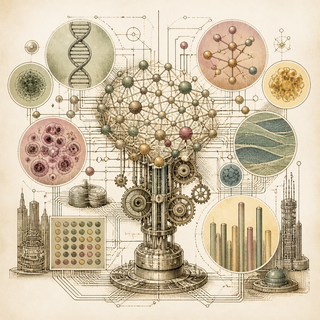
Disclaimer: This blog post is a simplified summary of published research for educational purposes. The accompanying illustration is artistic and does not depict actual model architectures, data, or experimental results. Always refer to the original paper for technical details.