Back in my day, if you wanted to design an electromagnetic device, you picked a shape, ran a simulation, squinted at the results, changed the shape, ran it again, and repeated until your coffee became a legally recognized co-author. This new paper by Dong and colleagues asks a much cheekier question: what if the machine could start with the behavior you want and work backward to the device geometry?
That is the heart of Deep Learning Inverse Design of Phase-Change Reconfigurable Terahertz Metadevices for Multidimensional Secure Communication in Advanced Materials (DOI: 10.1002/adma.73630). The team built a deep-learning inverse-design framework for terahertz metadevices: tiny engineered structures that boss around terahertz waves, which live between microwaves and infrared light in the famous “terahertz gap,” that awkward middle child of the electromagnetic family.
The Terahertz Neighborhood Is Weird Real Estate
Terahertz waves are attractive for future 6G-style communication because they can carry lots of data and travel in narrow, directional beams. Think of them less like shouting across a room and more like whispering through a laser pointer, if the laser pointer had a graduate degree in electromagnetics.
The problem is that making terahertz devices do several tricks at once - steer beams, alter phase, handle polarization, encode depth, and switch states - gets messy fast. Traditional design often means searching through large libraries of “meta-atoms,” the little building blocks of a metasurface. It works, but it has the vibe of finding a lost earring in shag carpet.
Dong’s team uses a residual neural network, or ResNet, to predict how candidate structures behave across the 0.2-1.2 THz range. Then they use that learned model inside an optimization loop to design devices that match target electromagnetic responses. In plain English: the model becomes a fast stand-in for expensive physics simulations, like hiring a very nerdy village elder who remembers how every little silicon pillar behaves.
The Magic Ingredient: Material With a Memory
The hardware uses GST, short for Ge₂Sb₂Te₅, a phase-change material. GST can switch between amorphous and crystalline states, and those states change how it interacts with electromagnetic waves. Better yet, it is nonvolatile, meaning it can hold a state without constant power. Old optical discs used related phase-change ideas, so yes, the future of secure terahertz communication has a faint whiff of rewritable DVD technology. History has jokes.
That switchability matters because security here happens at the physical layer. Instead of relying only on software encryption, the device itself can reconfigure how it sends or reconstructs information. The paper describes multidimensional multiplexing over polarization, depth, frequency, and material phase state. That means different observers, channels, or device states can reveal different information. It is like a lockbox where the key is not just a password, but also the viewing angle, the wave polarization, the material state, and whether the device woke up crystalline or amorphous that morning.
Why Let Deep Learning Near the Toolbox?
Inverse design is not new, and neither are metasurfaces. What is interesting here is the combination: a data-driven design engine tied to reconfigurable terahertz hardware. Recent work has been pushing in the same direction. Xu et al. used physics-informed inverse design for programmable terahertz metasurfaces and beam steering (DOI: 10.1002/advs.202406878, PMCID: PMC11538652). Yin et al. showed deep-learning design for high-Q terahertz metamaterials, reporting large speedups over full-wave simulation (arXiv:2312.13986, DOI: 10.1016/j.optlastec.2024.111684). A 2025 review by Si et al. frames AI-driven inverse design as a way to cut down brute-force parameter sweeps in THz metamaterials (DOI: 10.15918/j.jbit1004-0579.2024.122).
So the broader story is clear: engineers are tired of hand-tuning microscopic electromagnetic furniture one chair leg at a time.
The Catch, Because There Is Always a Catch
A neural network can speed up design, but it only knows the world it was trained on. If fabrication errors, thermal effects, material fatigue, or real-world channel noise wander outside the training assumptions, the elegant model may start looking less like an oracle and more like your GPS sending you into a lake.
Scaling also matters. A lab demonstration of reconfigurable secure communication is not the same thing as rugged 6G infrastructure. Devices need repeatable manufacturing, stable switching, low loss, fast reconfiguration, and integration with actual communication hardware. That is a long grocery list, and none of the items are “buy more vibes.”
Still, the paper points toward a useful future: communication systems where the physical hardware helps protect the message, adapt to channels, and maybe even perform simple optical logic. If this line of work matures, future networks may not just transmit data. They may reshape themselves around the message, like a lock learning the shape of its own key.
References
-
Yisheng Dong et al., “Deep Learning Inverse Design of Phase-Change Reconfigurable Terahertz Metadevices for Multidimensional Secure Communication,” Advanced Materials, 2026. DOI: 10.1002/adma.73630. PMID: 42249641.
-
Yucheng Xu et al., “Physics-Informed Inverse Design of Programmable Metasurfaces,” Advanced Science, 2024. DOI: 10.1002/advs.202406878. PMCID: PMC11538652.
-
Shan Yin et al., “Deep Learning Enabled Design of Terahertz High-Q Metamaterials,” Optics & Laser Technology, 2025. DOI: 10.1016/j.optlastec.2024.111684. arXiv:2312.13986.
-
Liming Si et al., “Systematic Review of Artificial Intelligent-Driven Inverse Design for Terahertz Metamaterials,” Journal of Beijing Institute of Technology, 2025. DOI: 10.15918/j.jbit1004-0579.2024.122.
-
Maoliang Wei et al., “Inverse Design of Compact Nonvolatile Reconfigurable Silicon Photonic Devices with Phase-Change Materials,” Nanophotonics, 2024. DOI: 10.1515/nanoph-2023-0637.
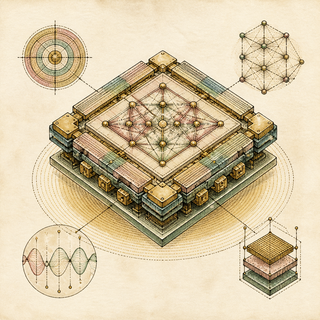
Disclaimer: This blog post is a simplified summary of published research for educational purposes. The accompanying illustration is artistic and does not depict actual model architectures, data, or experimental results. Always refer to the original paper for technical details.