Two types of people sit at the molecular bar: those who know that ZDHHC5 is quietly greasing the hinges of cell signaling, and those about to find out.
ZDHHC5 is not the kind of biological name that rolls off the tongue unless your tongue has tenure. It sounds like a Wi-Fi password assigned by a router with commitment issues. But beneath that alphabet soup is a serious idea: cells do not merely make proteins and send them into the world like tiny employees with laminated badges. They keep editing them, tagging them, relocating them, and sometimes giving them lipid sidecars so they know which membrane party to attend.
That lipid sidecar is called S-palmitoylation, a reversible post-translational modification where a fatty acid, usually palmitate, gets attached to cysteine residues on proteins. Think of it as molecular Velcro dipped in olive oil. The modification can help proteins cling to membranes, move through cellular neighborhoods, stabilize themselves, or join signaling complexes. ZDHHC5 is one of the enzymes that performs this attachment, and the new review by Wang and colleagues argues that it may be one of the more interesting conductors in this greasy little orchestra (DOI: 10.1186/s40364-026-00921-3).
The Cell Has a Logistics Department
If DNA is the script and proteins are the actors, post-translational modifications are the stage directions scribbled in the margins: stand here, speak louder, exit left, do not touch the mitochondria. Phosphorylation gets much of the fame, probably because it has the branding instincts of a tech startup, but palmitoylation has a quieter philosophical elegance. It changes where a protein belongs.
And belonging, in biology as in life, is not decorative. A protein in the wrong place can become useless, dangerous, or both. ZDHHC5 sits largely at the plasma membrane and endosomal system, where it can influence proteins involved in signaling, trafficking, synaptic activity, cardiac ion handling, immune responses, metabolism, and cancer biology. Recent reviews describe ZDHHC5 as enriched in tissues such as brain, liver, and heart, and as unusually shaped for the DHHC family because of its long regulatory tail, which helps recruit substrates and tune specificity (DOI: 10.1016/j.jlr.2025.100793; DOI: 10.1016/j.ijbiomac.2025.148281).
That tail matters. If every DHHC enzyme had the same active site, then designing a drug that hits only ZDHHC5 would be like trying to remove one violin from an orchestra by throwing a blanket over the string section. Researchers are increasingly interested in blocking substrate recruitment instead of just jamming the catalytic machinery, because recruitment sites may offer more selectivity. The dream is not "turn off palmitoylation everywhere," which sounds biologically equivalent to unplugging the refrigerator to stop one suspicious yogurt. The dream is precision.
Cancer, Signaling, and the Ancient Question of Control
The Wang review spends particular time on cancer, where ZDHHC5 appears in several uncomfortable plotlines: oncogenic signaling, tumor progression, immune modulation, and metabolic rewiring. Other recent work on palmitoylation in cancer paints the broader picture: ZDHHC enzymes and depalmitoylating enzymes help regulate pathways tied to proliferation, metastasis, immune evasion, and cell death (DOI: 10.1016/j.clnves.2025.100032; DOI: 10.1016/j.bbcan.2025.189509).
The philosophical part, if you will allow a lipid enzyme to wear a little black turtleneck, is this: disease often looks less like a broken part and more like misgoverned context. The same cellular tools that enable growth, repair, signaling, and adaptation can become harmful when timing, location, or intensity shifts. ZDHHC5 does not seem to be a simple villain twirling a mustache in the nucleus. It is more like a traffic controller whose instructions can keep the city alive or cause a five-car pileup at rush hour.
That makes therapy hard. A selective ZDHHC5 inhibitor could be useful, but only if we know which substrates, tissues, and disease states we are nudging. Biology has a habit of turning "just inhibit the enzyme" into "congratulations, you have annoyed six other pathways and one of them is very vindictive."
Where AI Enters, Wearing a Lab Coat Slightly Too Large
The review also gestures toward artificial intelligence as a way to accelerate discovery. This is not the sci-fi version where the model stares meaningfully at a protein and whispers, "I understand life now." It is the practical version: use machine learning to predict substrates, discover enzyme candidates, map molecular networks, and prioritize compounds before spending months in the experimental trenches.
A 2026 Oncogene paper introduced iPalmT, a deep learning framework that identifies palmitoyltransferases from amino acid sequence alone, reporting strong test-set performance and releasing large-scale predictions across millions of proteins (DOI: 10.1038/s41388-026-03802-z). That kind of tool will not replace wet-lab validation, because cells remain the original peer reviewers and they reject manuscripts rudely. But it can narrow the search space, which matters when the search space is basically "all the molecular spaghetti."
For researchers trying to reason through these tangled pathways, visual mapping is not a luxury. It is survival with nicer arrows. Tools like mapb2.io can help sketch the relationships among enzymes, substrates, disease contexts, and therapeutic hypotheses before the whole thing turns into a conspiracy wall with red string.
The Promise, and the Humility Clause
If ZDHHC5-centered research holds up across more models, tissues, and patient data, it could shape new strategies for cancer, cardiac disease, neurobiology, metabolism, and inflammation. The most appealing therapeutic direction may not be blunt inhibition, but selective interference with particular enzyme-substrate relationships. Less sledgehammer, more locksmith.
Still, this is a review, not a clinical triumph parade. The field needs better selective inhibitors, richer substrate maps, disease-specific validation, and a clearer account of how palmitoylation interacts with phosphorylation, ubiquitination, glycosylation, and the rest of the cell's biochemical group chat. The big question is not merely "Can we target ZDHHC5?" It is whether we can intervene in the geography of cellular meaning without flattening the city.
And that, oddly enough, is where this enzyme becomes interesting beyond its name. ZDHHC5 reminds us that life is not only made of molecules, but of placements, timings, attachments, and detachments. The cell is constantly asking where things belong. Disease may begin when the answer changes.
References
-
Wang Y-W, Liu Y-J, Cao K-F, et al. ZDHHC5: a pivotal palmitoyltransferase orchestrating signaling networks - unraveling mechanisms and therapeutic horizons. Biomarker Research. 2026. PMID: 42098785. https://doi.org/10.1186/s40364-026-00921-3
-
Xiu C, Ji K, Zhao G, Chen J, Yang Y. The emerging role of palmitoyl acyltransferase zDHHC5 in health and disease: A review. International Journal of Biological Macromolecules. 2025. https://doi.org/10.1016/j.ijbiomac.2025.148281
-
Mechanisms and functional implications of ZDHHC5 in cellular physiology and disease. Journal of Lipid Research. 2025. PMID: 40180214. PMCID: PMC12147223. https://doi.org/10.1016/j.jlr.2025.100793
-
Wang R, Zhuang A, Wu Y, et al. S-palmitoylation: A novel player in cancer and its emerging therapeutic implications. Cell Investigation. 2025. https://doi.org/10.1016/j.clnves.2025.100032
-
Li T, Li X. iPalmT: a new paradigm for palmitoyltransferase discovery via end-to-end deep learning. Oncogene. 2026. https://doi.org/10.1038/s41388-026-03802-z
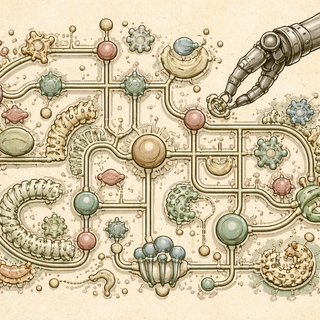
Disclaimer: This blog post is a simplified summary of published research for educational purposes. The accompanying illustration is artistic and does not depict actual model architectures, data, or experimental results. Always refer to the original paper for technical details.